
Seggiano on the slopes of Monte Amiata: olive oil, art and history
Accommodation in Seggiano
Seggiano on the slopes of Monte Amiata – a landscape shaped by the Vivo stream valley
Seggiano is a small hill town situated on the slopes of Monte Amiata. The town lies in a landscape shaped by centuries-old olive trees in the valley of the Vivo stream.
Seggiano is first documented in 903. At that time, the hamlet of Senganu or Sergiano was owned by the Abbey of San Salvatore on Monte Amiata. These two early forms of the name exist alongside the present-day name Seggiano.
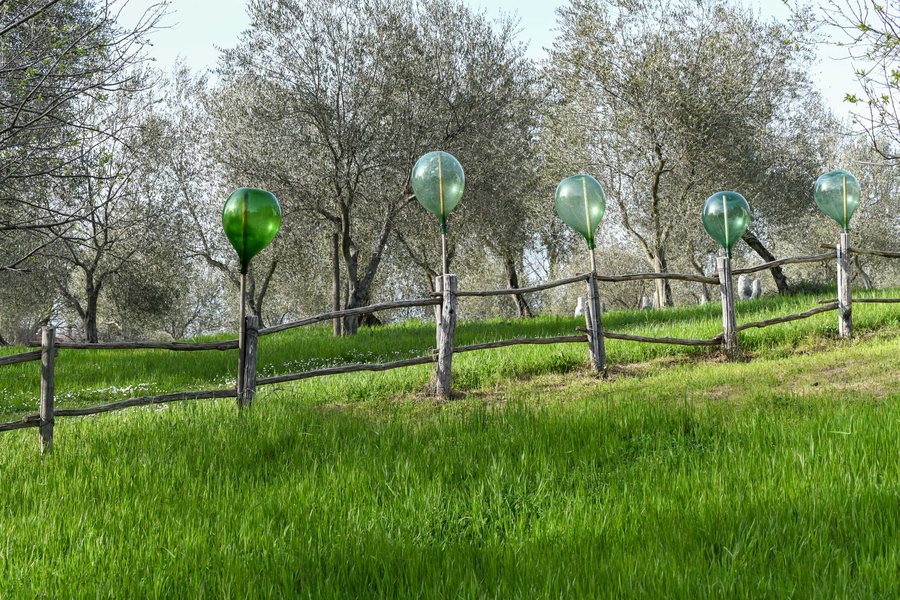 File:Giardino Spoerri Seggiano Pasquetta 2018 Impressions with Glass BHO 118-LR.jpg
Photo: Bernhard Holub via Wikimedia Commons, CC BY-SA 4.0
File:Giardino Spoerri Seggiano Pasquetta 2018 Impressions with Glass BHO 118-LR.jpg
Photo: Bernhard Holub via Wikimedia Commons, CC BY-SA 4.0
History since 903, sacred art and historic buildings
The Museo dell’Olio was established in 2012, is spread throughout Seggiano’s historic centre, and was conceived by the Municipality of Seggiano and the Fondazione Le Radici di Seggiano. The historic centre is therefore home to a museum spread across several locations.
The Chiesa di San Bartolomeo preserves a polyptych. A polyptych is a multi-panel altarpiece. Several painted panels form part of a single altar artwork. It depicts the enthroned Virgin Mary and Jesus, as well as Saints Bartholomew, Michael and John the Evangelist. The work is therefore part of Seggiano’s sacred art.
The Santuario della Madonna della Carità was built after a famine at the end of the 16th century and was probably completed around 1603. It has three naves. In addition to the main altar, there are six further altars. In church architecture, a nave is a longitudinally oriented interior space of the sanctuary.
The area of the Castello del Potentino appears intact. It includes agricultural buildings and an L-shaped Renaissance palace with two corner towers. The two corner towers belong to the Renaissance palace; the agricultural buildings form another part of the area.
Olive oil from the native Olivastra seggianese, the Festa dell’Olio and the Olivo nel Cisternone
The native Olivastra seggianese is used to produce the Seggiano DOP extra virgin olive oil. The place name Seggiano forms part of this product designation. The Festa dell’Olio takes place in Seggiano at the end of November.
The Olivo nel Cisternone is a scientific installation featuring the first specimen of the Olivastra seggianese and the world’s largest plant supplied using aeroponic technology. Aeroponic technology refers to supplying plants without conventional soil. The name Olivo nel Cisternone refers to the installation; the Olivastra seggianese is the first specimen contained within it.
Contemporary art at the Giardino di Daniel Spoerri across approximately 16 hectares
The Giardino di Daniel Spoerri is a contemporary art park in Seggiano. For those interested in culture, contemporary installations complement Seggiano’s sacred polyptych with another form of artistic expression. Across approximately 16 hectares, 115 installations by 55 artists are distributed throughout the park. The park encompasses contemporary works by numerous creators across an extensive area.
For further destinations, discover Pescina, Castel Del Piano, Arcidosso and Santa Fiora.
For the higher-level travel overview: Grosseto.

