
Moena: Alpe Lusia, Hiking Trails and Culture
Accommodation in Moena
Slope Characteristics in the Alpe Lusia Ski Area
The Alpe Lusia ski area mainly offers red and black runs towards Moena, including the “Piavac”. The southern side towards Castelir–Bellamonte offers gentler and sunnier descents. If you would like to classify the different levels of slope difficulty: in alpine skiing, red runs are generally considered intermediate, while black runs are considered difficult. For a ski holiday around Moena, this results in a clear distinction between the more demanding northern side and the gentler descents on the southern side.
Hiking Trails between Alpe Lusia and Passo San Pellegrino
The Moena–Laghi di Lusia circular trail leads through the wilder natural surroundings of Alpe Lusia and to its lakes. The Moena–Laghi di Lusia route reaches Le Cune at 2,200 metres by cable car from Ronchi via the first and second sections and offers views of the Catinaccio, Latemar, the Monzoni Group, the Pale di San Martino and the Lagorai range. The Moena–Alpe Lusia–Cima Bocche hiking trail follows the traces of the First World War and passes trenches and tunnels of the Austro-Hungarian line. The Passo San Pellegrino area has particularly historically significant hiking trails suitable for different levels of hiking experience.
Mountain Landscapes around Moena
The Church of San Vigilio stands at an elevated location and offers views of Val San Pellegrino and the Monzoni Group. Monte Ciamp, Viezzena and the Le Pezze summit are located in the immediate vicinity of Moena. The Torre Vallaccia summit is located in the area surrounding Moena. The ascent from Moena to Passo San Pellegrino is also a clearly defined sporting route: it is 13 kilometres long in total, 11 of which are uphill.
Churches, Town Centre and Regional Culture
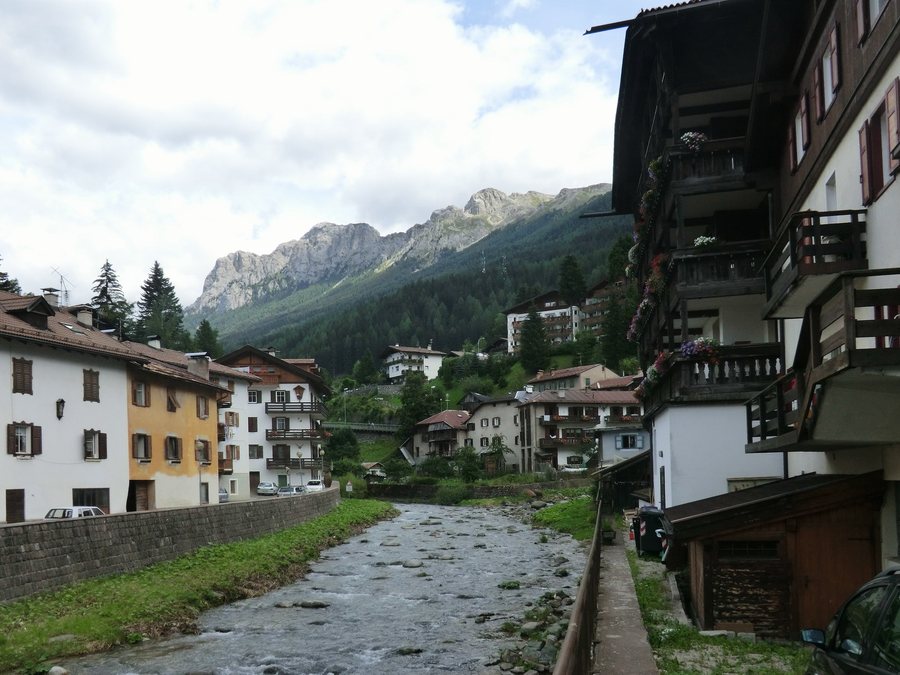
The Church of San Volfango is probably Moena’s oldest religious building. Inside, there are several recently restored frescoes from the second half of the 15th century, as well as a wooden ceiling by the Moena sculptor Giovanni Guadagnini. Moena’s well-maintained centre includes fountains, shops, cafés and historic buildings. Car traffic is partially restricted in the centre of Moena.
The Latemar Art Museum is located in the area surrounding Moena. Castel Salego is a castle in the wider regional surroundings of Moena. Castelveccio is a ruin in the wider regional surroundings of Moena. The Museo della Apicoltura Plattner is located in the wider regional surroundings of Moena. Alongside the ski slopes and hiking trails, specific churches, buildings, museums and squares therefore also provide points of reference for exploring the area.
Other places: Caldonazzo, Centa San Nicolò, Tassullo, Villa Rendena, Nanno, Stenico, Vigo Di Fassa, Flavon.
To the higher-level travel overview: Trentino–South Tyrol.

