
Discover Piobbico: Castles, Trails and River Valleys
Accommodation in Piobbico
Piobbico Between Rivers and History
At the center of Piobbico’s settlement area, the Biscubio and Candigliano rivers converge.
Castello Brancaleoni is an important aristocratic residence in the Marche. It stands as a symbol of the power of the Brancaleoni family, which ruled the area for centuries, as well as of art, history and Piobbico’s collective identity. The Museo Civico Brancaleoni was established in Castello Brancaleoni in 1983. The building itself dates back to the 13th century.
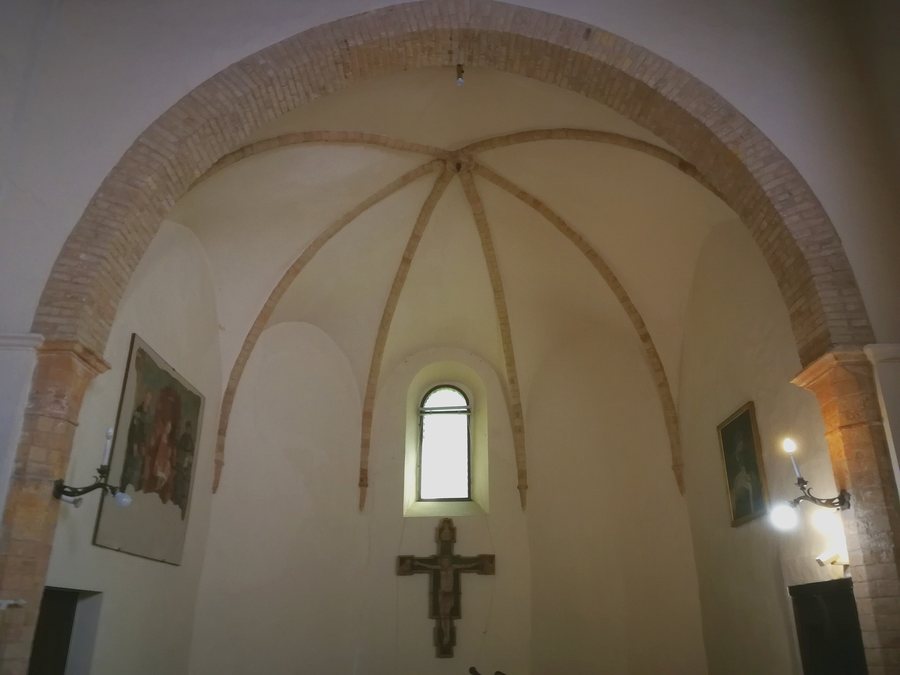 File:Piobbico, Santa Maria in Val d'Abisso, abside.jpg
Photo: Bluteo via Wikimedia Commons, CC BY-SA 4.0
File:Piobbico, Santa Maria in Val d'Abisso, abside.jpg
Photo: Bluteo via Wikimedia Commons, CC BY-SA 4.0
Castello Brancaleoni and Historic Buildings
At the foot of Castello Brancaleoni in Piobbico stands the Chiesa di San Pietro. Its history dates back at least to the 14th century. In the vicinity of Piobbico, the Eremo di Morimondo was founded in the 11th century by Cistercians who followed the rule of Saint Pier Damiani.
In the vicinity of Piobbico, Castello dei Pecorari features partially preserved medieval architectural elements, visible sections of walls and towers. From there, views extend over the Candigliano Valley and the town of Piobbico. On a summit of the Monte Nerone massif, high above the town, stood the structures of the Brancaleoni family’s original residence, known as Castello di Mondellacasa.
Trails, Viewpoints and Gorges
The Itinerario dei Brancaleoni begins at Palazzo Brancaleoni in Piobbico and leads downhill towards Borghetto and the bridge over the Candigliano. The route also passes several viewpoints overlooking Borghetto, Castello Brancaleoni and the Candigliano.
In the vicinity of Piobbico, a path reached via an approximately half-hour ascent leads to the ruins of the Eremo di Morimondo. A Gothic arch remains visibly preserved among the ruins. The route therefore offers a short historical ascent to a clearly identified architectural monument.
In the vicinity of Piobbico, the Santuario di Santa Maria in Val d’Abisso lies southeast of the town on a hill. From there, views extend over a wild area of Monte Nerone and the Balza Forata rock formation. The deep, narrow gorges of the Candigliano are also located in the vicinity of Piobbico. Fast-flowing water has shaped channels and rock walls there. Along the waterways, there are also small streams, waterfalls and tranquil pools reflecting the surrounding forests.
Crafts, Procession and Local Cuisine
Piobbico has a traditional craft history of wool-carpet production. A religious accent is provided by the traditional Processione delle Rocche, held in Piobbico on September 8. Girls in rural costume carry decorated spindles as offerings to the Virgin at the Santuario di Santa Maria in Val d’Abisso.
Regional cuisine also has a fixed date in local life: the Sagra del Polentone alla Carbonara takes place annually in Piobbico. The festival celebrates a typical dish of rural tradition made from polenta, meat and local spices.
Further destinations: Apecchio, Massa.
For the overarching travel overview: Pesaro - Urbino.

