
Bologna: UNESCO Porticoes, Old Town and Musical Heritage
Accommodation in Bologna
The UNESCO Porticoes of Bologna comprise a selection of 12 porticoes within the city’s overall 62-kilometre network of porticoed walkways, the largest portico system in the world. The tradition of constructing and maintaining these porticoes dates from the 12th to the 21st century. Their covered spaces remain privately owned and are used by the public.
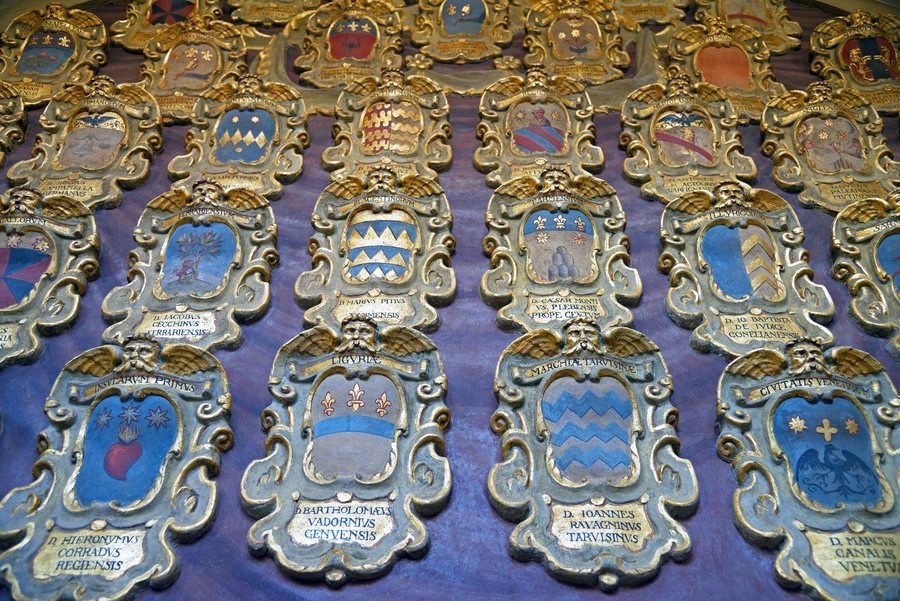 File:Coats of arms of alumnus on the walls of the Archiginnasio of Bologna. Italy.jpg
Photo: Ввласенко via Wikimedia Commons, CC BY-SA 3.0
File:Coats of arms of alumnus on the walls of the Archiginnasio of Bologna. Italy.jpg
Photo: Ввласенко via Wikimedia Commons, CC BY-SA 3.0
Culture
The Pavaglione, Banchi and Piazza Maggiore component encompasses one of the most significant and best-preserved medieval public spaces in Europe. The Pavaglione is also the longest uninterrupted portico in Bologna. The Basilica di San Petronio is home to the organ built around 1470 by Lorenzo da Prato, which is considered the oldest organ still in use in the world. The Basilica di San Petronio is open to citizens, tourists and visitors of all kinds.
The Palazzo dell’Archiginnasio is also one of the places closely associated with Bologna’s educational and architectural history. It was built in 1562 and 1563 at the request of Bologna’s papal legate, Cardinal Carlo Borromeo, and the vice-legate Pier Donato Cesi, based on a design by the Bolognese architect Antonio Morandi, known as Terribilia. The aim was to provide a unified site for university teaching, which had previously been spread across various locations. The Teatro Anatomico in the Archiginnasio was designed in 1637 for anatomy classes by the Bolognese architect Antonio Paolucci, known as il Levanti, a pupil of the Carracci. It is made of fir wood and decorated with two rows of statues: twelve famous physicians below and twenty of the best-known anatomists of the Bolognese Studio above.
The city’s musical heritage also includes the Sala della Musica. It is Italy’s first permanent exhibition on the history of popular music in a city. Bologna also holds the UNESCO title “Creative City of Music”.
Nature
The Santuario di San Luca is connected by a portico to a four-kilometre-long road starting at Porta Saragozza. The portico has more than 600 arches and is considered the longest in the world. The Finestrella di Via Piella offers another perspective on the city’s waterways: it looks out over the Canale delle Moline and one of the city’s few remaining open stretches of water. Bologna offers several trekking routes throughout the year, allowing visitors to discover art, architecture and nature within the city.
Cuisine
The Quadrilatero is an area in the heart of Bologna’s historic old town shaped by an artisanal, trading and commercial tradition dating back to the Middle Ages. Fresh egg pasta is one of Bologna’s best-known products; its longstanding tradition is based on recipes passed down through generations. A traditional cooking course is offered in Bologna city centre.
History and Getting There
Bologna has a medieval old town that is among the largest and best-preserved in Europe. For travel connections, the city is Italy’s most important railway hub and is particularly well connected by high-speed rail.
You can also visit Lizzano In Belvedere, Vidiciatico.
To the overview of destinations: Emilia-Romagna.
More destinations
More places within the same destination:

