
Torgnon: Winter Park, Cross-Country Skiing and Alpine Culture
Accommodation in Torgnon
Winter Activities and Trails
The Torgnon ski area has 25 kilometres of downhill slopes, all of which are equipped with artificial snowmaking. Torgnon’s cross-country skiing options include panoramic loops of 3, 5, 7.5, 10 and 20 kilometres, with varying levels of difficulty. The connection between the La Maisonnette and Verrayes cross-country ski trails forms a 40-kilometre loop that can be used with a single ticket. The winter park in Chantorné has two conveyor belts, a practice slope and runs for snow tubing, Snakegliss and Zibob. Torgnon also has two winter Nordic walking routes.
Torgnon is home to 16 kilometres of the Tour des Alpages as well as more than 50 kilometres of other family-friendly trails in a natural setting. The Tour des Alpages cycling route is a 21-kilometre loop that takes three hours, with 389 metres of ascent and 388 metres of descent. Torgnon’s Easy Downhill is a 4.5-kilometre route accessible by the Collet chairlift, descending from 2,250 metres to 1,850 metres.
History Around Mongnod
In the central district of Mongnod stands the parish church of St Martin, a three-nave Neo-Gothic building dating from 1868. The Musée Petit Monde is housed in three historic buildings: the Raccard, dating from 1462 to 1503, the Grandze from 1700 and the Grenier from 1476. The Musée Petit Monde presents the history, culture, work and everyday life of Torgnon through objects from an agro-pastoral community. From Mongnod, you can reach the Musée Petit Monde via a mostly level panoramic walk. The route to the Musée Petit Monde passes a panoramic terrace and the Cappella di Ponty. The walk can be continued from the Musée Petit Monde to the mill and waterfall on the Petit Monde stream. An ancient, recently restored mill is part of the Petit Monde museum complex.
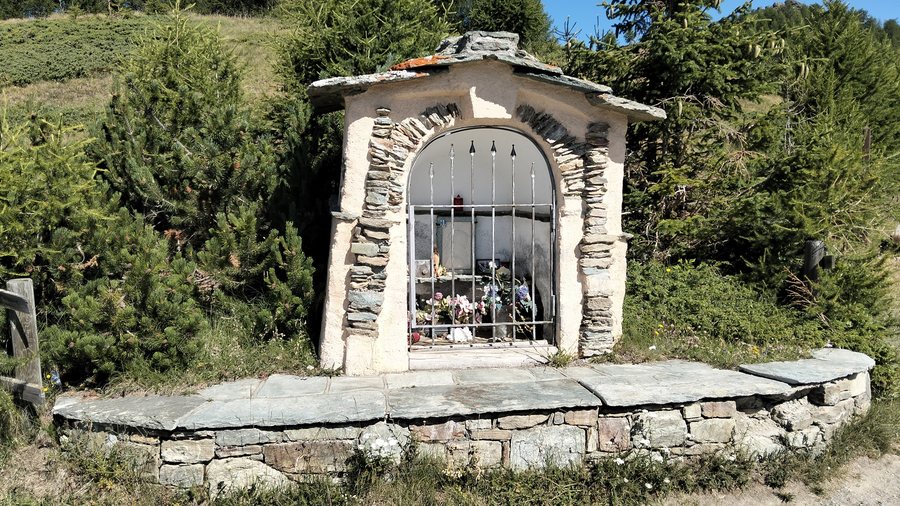
Prehistoric settlements were identified at Chaté and Chatrian, showing that Torgnon was inhabited even before the Roman Empire. The Cappella di Ponty was built into the rock between 1720 and 1730 and lies along the route connecting Mongnod and Triatel. The Cappella di Ponty is an important place of worship for the local people.
Chapels, Viewpoints and Nature
The summit near the Madonna degli Alpini can be reached either via a path partly cut into the rock or via the Cappella di San Grato followed by a steep grassy slope. The Cappella di Saint-Evence stands on a plateau that serves as a viewpoint over nearby and more distant peaks. The Oratorio di Gilliarey is a small white building for prayer and meditation on a rocky outcrop above Antey. The route to the Oratorio di Gilliarey from Etirol is approximately 5 kilometres long, climbs around 585 metres and takes about one and a half hours. The viewpoint at the Oratorio di Gilliarey offers views of the Matterhorn and part of the Monte Rosa group, including the Breithorn peaks near the Swiss border. The complete loop around Lo Ditor takes about 45 minutes. In the higher elevations around Torgnon, you can spot marmots, ibex and chamois. Sentiero 16 is designated “SIC Lodetor – Site of Community Importance”.
Regional Cuisine and Festival Traditions
Torgnolette is a potato dish with Fontina cheese that was created for the Torgnon d’Outon festival and is now served by several restaurants in the village. The Torgnon d’Outon festival, held for the feast day of the patron saint Saint Martin, includes a Sunday market with typical products and local handicrafts. Fontina d’alpeggio and mountain potatoes are sold at the market.
Further destinations: Coveyrand, Gressoney-Saint-Jean, Saint Jacques, Pré-Saint-Didier, Issime, Saint Pierre, Breuil-Cervinia, Brusson
Back to the main travel overview: Aosta Valley.

