
Fertorakos: Quarry, Local History and Beach
Accommodation in Fertorakos
Fertorakos brings together historical traces in public spaces, a quarry used as an exhibition and event venue, collections and crafts, as well as a beach on Lake Fertő. For planning, you can sort these topics by interest: local history, distinctive spaces and different collections each offer their own focus.
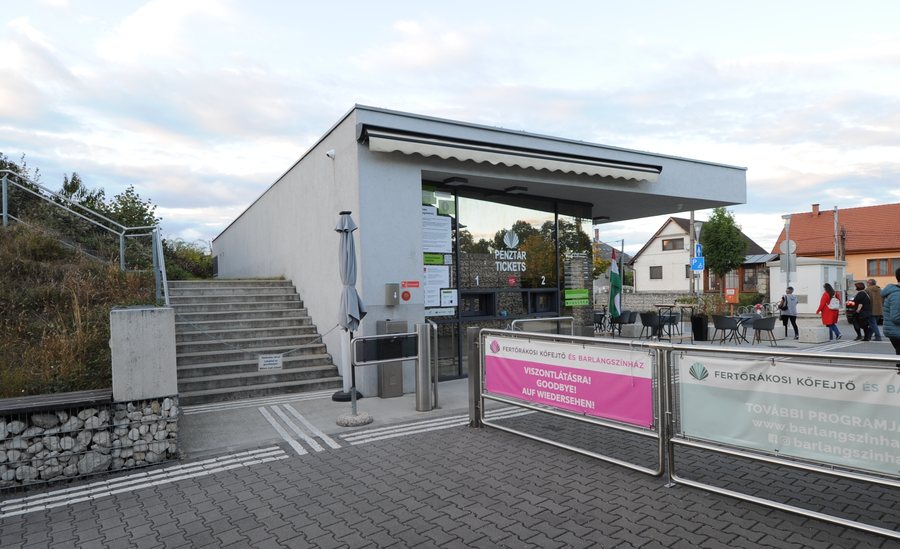 File:Fertőrákos, Entrance to the quarry and theatre- hungary.jpg
Photo: Lysippos via Wikimedia Commons, CC BY-SA 4.0
Local history in public spaces
At the center is Hungary’s only pillory still preserved in a public square. It dates from the 17th century. On Fő utca, four-meter-high walls from the 16th century, with loopholes, can still be seen today. Together, these traces show two different features of the townscape: a single object in a square and remnants of walls along a street.
The bishop’s palace served the bishops of Győr partly as a refuge and partly as a summer residence. It currently needs renovation and is not open to visitors. As this status may change, it is advisable to check its current visitor status before planning your visit.
Quarry, viewpoints and theatre
The cave-like halls of the quarry took shape over nearly two thousand years. The quarry is an exhibition and event venue with a distinctive atmosphere. Here, the halls and the site’s use as a cultural venue shape the visit—unlike the historical traces in the square and along the street.
A path through the quarry leads to themed viewpoints. There, you can learn about protected plant and animal species. The themed stops give the route its own subject matter. The Barlangszínház is also part of the quarry: its theatre hall has special acoustics.
Collections and ceramic crafts
The Ásványmúzeum houses a collection of about 2,000 calcite crystals and 400 fossils. The owner guides visitors through the collection, explains its origins and answers questions. If a guided tour is important to your visit, check the current arrangements in advance, as they may change.
The local history exhibition offers a different perspective. A ceramics workshop is located in the back courtyard of a typical Rákos house. There, you can view hand-shaped one-of-a-kind pieces; they are available in the adjoining shop. Alongside the mineral and fossil collection, local crafts and their finished works are therefore another option for what to see.
Beach and route to the Mithras Sanctuary
Fertorakos has the only beach on the Hungarian shore of Lake Fertő. Another point of interest is the Mithras Sanctuary: from Fertorakos, you can reach it on foot, by bicycle or by a narrow-gauge railway along a narrow path through Fertő-Hanság National Park. When planning your visit, take the sanctuary’s seasonal opening details into account.
Landscape in the wider destination
In the wider destination of Győr-Moson-Sopron, the Fertő/Neusiedler See cultural landscape includes Eurasia’s westernmost steppe lake, as well as wetlands, saline soils, reed beds and lakeshore areas. The Hungarian part of Lake Neusiedl has been protected since 1977. The Fertő-táj cultural landscape was granted UNESCO World Heritage status on December 13, 2001. This broader context complements visits to the town with landscape and conservation themes.
Discover more destinations: Sopron, Kópháza, Fertőboz.
Go to the overview of the wider destination: Sopron–fertődi.

