
Saale-Orla: Reservoirs, nature and culture
Accommodation in Saale-Orla
Saale-Orla combines a reservoir landscape with nature and cultural attractions. The River Saale, with the Saale Cascade—a roughly 80-kilometre stretch dammed five times—forms Europe’s largest contiguous reservoir area, the Thuringian Sea. The Bleiloch Reservoir is Germany’s largest reservoir. This lets you plan your trip around the destinations you want to visit.
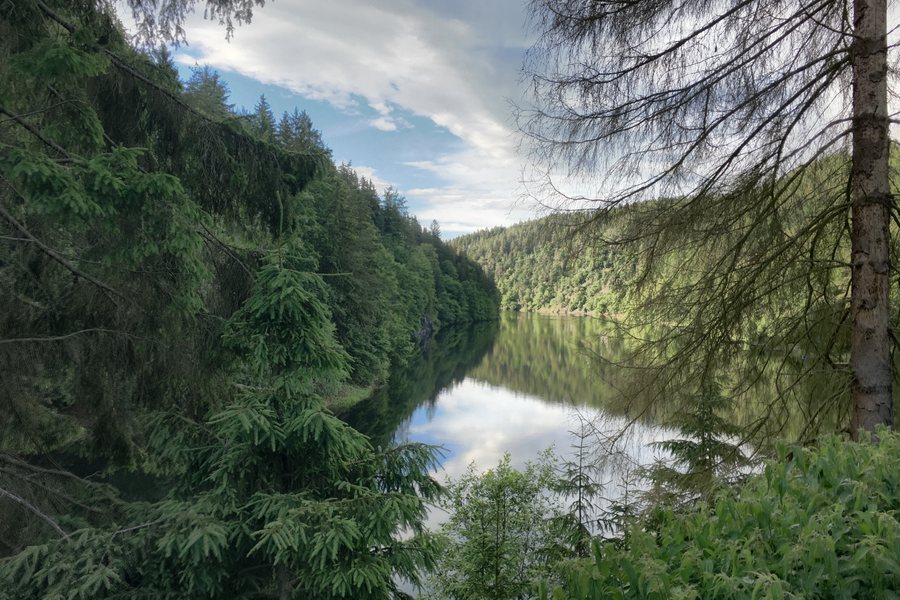
Reservoirs and nature
At the Hohenwarte Reservoir, the Mühlenfähre ferry operates seasonally between the Linkenmühle and Altenroth landing stages. If you plan to take the ferry, check the timetable and crossing conditions before your trip. The Thuringian Slate Mountains/Upper Saale Nature Park is characterised by the blue ribbon of the Saale and the Thuringian Sea, the vast forests along the Rennsteig, the Plothen pond area and seemingly endless orchid meadows.
A special natural area is the 1,094-hectare Dreba-Plothen pond area nature reserve, also known as the Land of a Thousand Ponds. More than 250 bird species, 14 amphibian and newt species, 23 dragonfly species and six bat species have been observed there. The figures for these different groups of species give a concrete sense of the diversity that makes this landscape such a notable destination.
Hiking and cycling
In Wurzbach, more than 120 kilometres of signposted hiking trails invite you to explore the scenic low mountain landscape. Near Neustadt an der Orla, the 32.65-metre-high Bismarck Tower is a prominent landmark; the medieval Hohe Straße high trail passes directly by it. The 168-kilometre Rennsteig begins or ends in Blankenstein.
The cycling routes also connect different places and directions: the Orla Cycle Route passes through Neustadt an der Orla, while the Oberland Cycle Route runs from Schleiz to the Thuringian Sea. If you plan a trip on one of these routes, bear in mind that trail conditions and signage may change. When choosing accommodation, it may therefore help to first decide which location or route section is important for your excursions.
Museums, history and special places
In Wurzbach, the Heinrichshütte foundry brings the history of technology to life with an interactive experience: it houses Europe’s largest and most powerful steam engine. The hands-on museum welcomes families with children, as well as children from nursery schools and schools. Other historical highlights include the Wysburg archaeological site near Weisbach, the site of an old robber-knight castle, and the hydroelectric power museum in Ziegenrück, said to be the only museum of its kind in Germany. Information about access to Wysburg may vary; check it before your visit.
Museum Schloß Burgk houses historic living quarters and exhibition rooms with valuable interiors, as well as collections and exhibitions. Its bookplate collection comprises more than 200,000 prints and is the museum’s largest specialist collection. Concerts and festivals are also held there. If you would like to plan your trip around an event, check the specific dates.
Further insights can be found at Burg Ranis Museum, with exhibits covering topics from the geology of the Orla Valley and the Ice Age to the history of the castle, and at Museum642: visitors of all ages can explore the history of Pößneck on an individual multimedia tour through every level of the museum. The Schleizer Dreieck is considered Germany’s oldest natural race track and adds a motorsport heritage site to the selection.
Discover more destinations: Altengesees, Gahma, Bad Lobenstein, Neundorf, Wurzbach, Saaldorf, Remptendorf, Schmalkalden-Meiningen.
Go to the main travel overview: Thuringia.

