
Stützerbach: Goethe, Glass and the AtemWeg
Accommodation in Stützerbach
When looking for accommodation in Stützerbach, Goethe’s history, the history of technical glass and the AtemWeg offer concrete ways to explore the town’s themes. Stützerbach is also located in a zone of the UNESCO Thuringian Forest Biosphere Reserve.
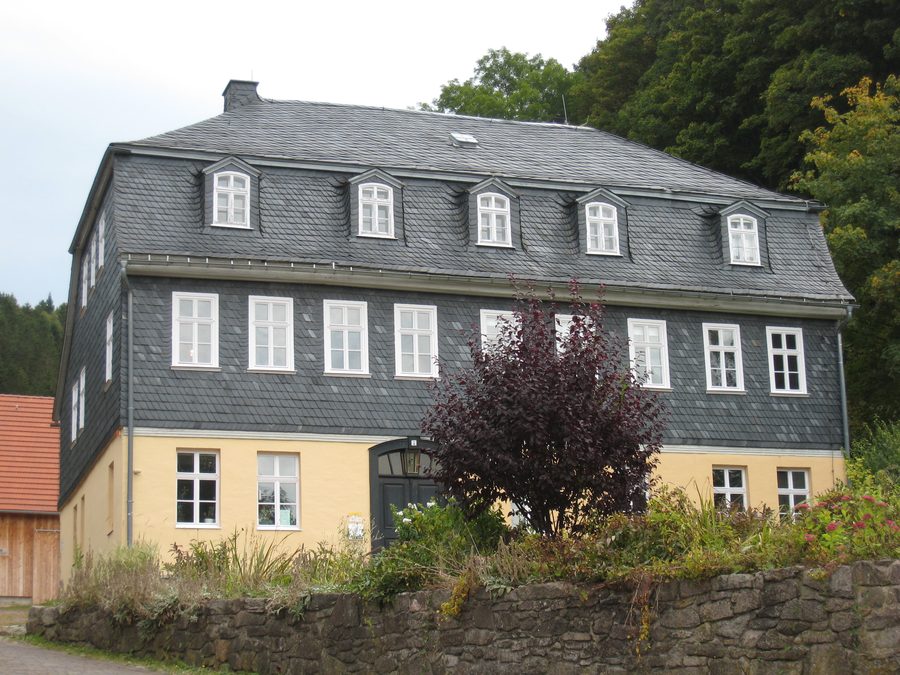 Das Goethemuseum erinnert an die historischen Aufenthalte Goethes in Stützerbach.
Photo: Giorno2 via Wikimedia Commons, CC BY-SA 4.0
Das Goethemuseum erinnert an die historischen Aufenthalte Goethes in Stützerbach.
Photo: Giorno2 via Wikimedia Commons, CC BY-SA 4.0
Goethe and the History of Glass
Johann Wolfgang von Goethe visited Stützerbach thirteen times from 1776 onward and stayed at the Gundelachsches Haus, now the Goethehaus Stützerbach Museum. This ties Goethe’s connection to the town to a specific building. The museum’s ground floor houses an exhibition on the history of technical glass in Stützerbach.
Glassmaking and glass processing have had a significant influence on Stützerbach. Together, the Goethe connections and the exhibition offer two distinct reference points for the town’s history: a personal historical connection and the development of glass technology. Visitors particularly interested in cultural history will find several clearly defined themes here, rather than just a single historical connection.
The first X-ray tube was also developed and tested for the first time in Stützerbach. This is another distinct historical connection to the town.
The AtemWeg and its connection to the town
Along the AtemWeg, eleven stations present exercises to strengthen lung and heart function, as well as breathing techniques, breathing relaxation and breathing meditation. The stations therefore offer a different focus from the museum’s historical themes: here, the emphasis is on breathing and relaxation. The number of stations and their content help visitors understand the nature of the trail.
Stützerbach’s location in a zone of the UNESCO Thuringian Forest Biosphere Reserve is another specific connection to the surrounding area.
Winter trails and more places to explore in Ilmenau
The wider destination of Ilmenau has numerous ski and winter hiking trails: they run from Ilmenau to the Rennsteig and from Auerhahn to Kickelhahn. Snow conditions and trail availability may vary, so check local conditions before planning a trip.
The Goethe Hiking Trail also connects places across a wider area: this 20-kilometre trail links the places where Goethe worked, from Ilmenau to Stützerbach. Its length is a useful point of reference when planning, but does not in itself indicate how much time you should allow.
Another landmark in the wider destination of Ilmenau is Kickelhahn, Ilmenau’s local mountain. It is 861 metres high, and its 21-metre observation tower is one of the town’s landmarks.
In the wider destination of Ilmenau, the Münzkeller offers a glimpse into the 16th century and is located directly next to the Alte Münze. The Ilmenauer Bergmannskapelle also houses an exhibition on Ilmenau’s copper shale mining.
Discover more destinations: Frankenhain, Altenfeld, Bücheloh, Elgersburg, Gehlberg, Geschwenda, Schmiedefeld Am Rennsteig and Neustadt Am Rennsteig.
View the wider travel overview: Ilm-Kreis.

