
Discover Sachsenbrunn
Accommodation in Sachsenbrunn
If you are looking for accommodation in Sachsenbrunn, you can plan your stay around two distinct themes: local history and notable sights, or trails in the surrounding area. The landmark is the dancing linden tree, which is over 360 years old; the Werra springs and Werrateich are also among Sachsenbrunn’s sights. There are about 60 kilometres of hiking trails around the village. This will help you decide whether to focus your stay mainly on cultural history, individual destinations or hikes.
Dancing linden tree and church: local history in Sachsenbrunn
The dancing linden tree, which is over 360 years old, is Sachsenbrunn’s landmark. The Tanzlinde Sachsenbrunn e.V. association organises the traditional Lindenfest. The landmark and the festival thus represent two different aspects of local culture: a visible symbol of the village and a long-established event.
The church in Sachsenbrunn is said to be over 400 years old. Inside is an intricately carved wooden sculpture depicting Mary and John beneath the cross of Jesus Christ. The Crucifixion group is attributed to the workshop of Würzburg sculptor Tilman Riemenschneider; this attribution is part of the tradition, but has not been verified.
Sights and trails in the surrounding area
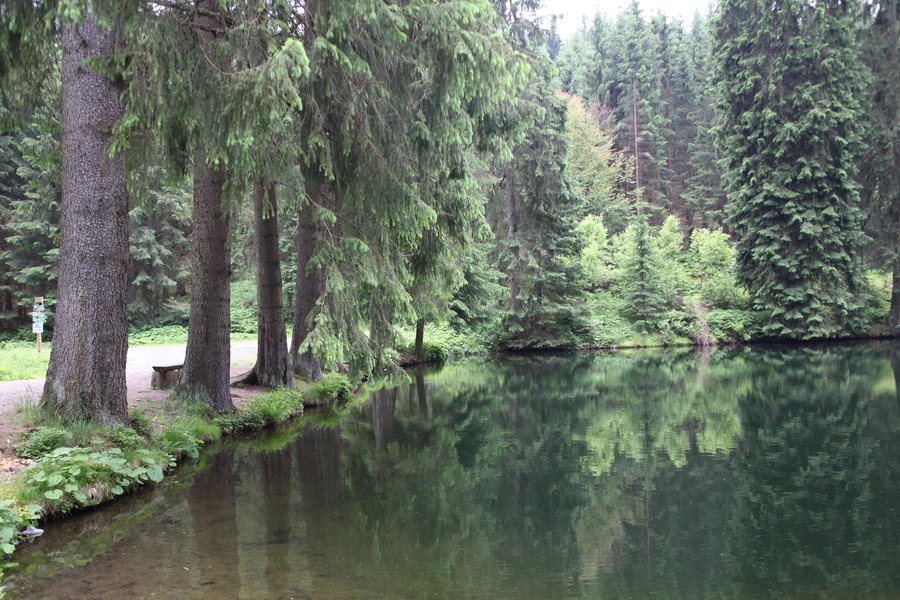
Other sights in Sachsenbrunn include the Fleischbaum, Werrateich and the Werra springs. There are about 60 kilometres of hiking trails around Sachsenbrunn. The Sachsenbrunn Rennsteig feeder trail runs via Sachsenbrunn, Sophienau and Werrateich to the Rennsteig Eisfelder Ausspanne. The route also includes a swimming spot at a pond and a rest area right by the water.
When planning, keep two different scales in mind: the roughly 60 kilometres refer to hiking trails around the village; the Rennsteig feeder trail is a named route with its own sequence of stops leading to the Rennsteig Eisfelder Ausspanne. This makes it possible to distinguish the local trail network from the specifically described route, rather than treating the two details as the same trail.
More cultural themes in the wider destination of Eisfeld
The wider destination of Eisfeld offers additional, distinct cultural themes. At its core, Eisfeld Castle is a medieval fortification and today houses the town museum. The Eisfeld Museum features an extensive porcelain collection, historic workshops, toys, town history and regional folklore. A stone marble mill from Truckenthal, dating from 1867, has been back on permanent display there since 2024.
The Otto Ludwig literary memorial is housed in the Ludwig family’s summer home, built in 1814. Its collection focuses on the life and work of the poet and musician Otto Ludwig, who was born in Eisfeld in 1813. The sites in Eisfeld also differ according to your interests: the museum focuses on collections and exhibitions, while the literary memorial brings together the life and work of a single individual.
The historic buildings in Eisfeld also represent different periods: the school building, constructed in 1575 and later extended, is considered the second-oldest school building in Thuringia. Above the round entrance portal of Eisfeld Town Hall is a coat-of-arms relief carved from sandstone in 1557.
The traditional programme of the Eisfeld Kuhschwanzfest includes the early-morning wake-up call, a historic parade of the guards with a fire brigade drill, the commander’s ride and the festival procession. These elements have remained largely unchanged.
Discover more destinations: Friedrichshöhe, Eisfeld, Erlau, Schleusingerneundorf, Lichtenau, Auengrund, Fehrenbach, Biberschlag
Back to the wider travel overview: Hildburghausen-Suhl.

