
Gotha between Castle Culture and Countryside
Accommodation in Gotha
There are several ways to plan a trip to Gotha, with a focus on castle and theatre history, museums, geological features or trails leading to a castle. The district’s landscape also stretches far: to the south, Gotha district extends to the Rennsteig trail, and to the west, to the 916.5-metre-high Großer Inselsberg.
Castle History, Theatre and Museums
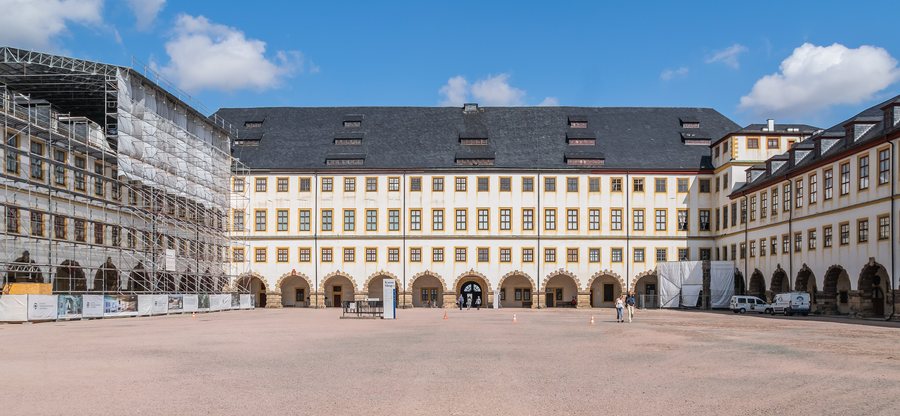
Friedenstein Castle is a landmark visible from afar and appears on the coat of arms of Gotha district. The Ekhof Theatre at Friedenstein Castle was founded in 1775 by Duke Ernst II as the first German court theatre. A distinctive feature is its stage machinery, which still exists and is fully operational. Those interested in theatre history will find not only a historic founding date here, but also an example of stage technology that has been preserved and remains functional to this day.
The painting *Gothaer Liebespaar* is on display at the Ducal Museum. This offers a specific point of reference for visitors who want to seek out a particular work of art during their museum visit. Another cultural stop is the Bach Stammhaus in Wechmar, where models of the original places where the Bach family worked in Wechmar are on display. The connection to Bach is also celebrated with a special invitation: on Johann Sebastian Bach’s birthday, visitors are invited to a Bach-style coffee table at the Bach Stammhaus.
Cave, Hiking Trails and Countryside
The Marienglashöhle cave in Friedrichroda runs through a 110-metre-long tunnel. Geological windows reveal rock layers that are millions of years old. In the crystal grotto, gypsum crystals up to 90 centimetres long sparkle. The cave thus offers a geological highlight distinct from the themes of castle history and art. The tunnel’s length and the visible rock layers give you specific points of reference for understanding this destination.
Many hiking trails, including the Benediktinerpfad and Zöglingsweg, lead to Tenneberg Castle. The Puppet Museum in the castle continues to attract visitors from all over the world. At Tenneberg, trails to the castle and a museum with its own distinctive theme go hand in hand: when planning your trip, you can decide whether to focus more on hiking or puppet art. The spacious park around Ehrenstein Castle also invites you to take a stroll, offering another distinct connection to the landscape and castle heritage.
Today, recreation is the main focus at the Old Gotha Dam near Tambach-Dietharz. The Three Gleichen castles are a historical landmark: they were built between the 8th and 11th centuries. These places offer different ways to explore the region, from a reservoir now centred on recreation to castles whose history dates back to the Early and High Middle Ages.
Places to Help Plan Your Trip
The Thuringian Forest Railway runs from Gotha via Waltershausen and Friedrichroda to Tabarz. This named route can help you plan which places to visit during your stay. The Rennsteig trail to the south and the 916.5-metre-high Großer Inselsberg to the west also indicate the extent of Gotha district in two directions. These details refer to the district: the Großer Inselsberg lies at its western edge, and the Rennsteig at its southern edge.
When looking for accommodation in Gotha, make your choice based on the interests that matter to your trip, such as Friedenstein Castle and the Ekhof Theatre, the Ducal Museum, the Marienglashöhle cave or trails to Tenneberg Castle. This way, you can start planning with a clear theme rather than trying to combine every destination into a single itinerary.
If you’d like to include more local pages in your trip planning, you can find Emsetal, Leinatal, Laucha, Hörselgau, Crawinkel, Aspach, Friedrichroda, Luisenthal, Tambach-Dietharz, Tabarz and Finsterbergen here.
For the wider travel overview: Thuringia.

