
Mengerskirchen: Castle History and Cycling Routes
Accommodation in Mengerskirchen
When looking for accommodation in Mengerskirchen, the historic town layout and cycling routes offer two specific themes to help you find your bearings. The castle, tower museum, and surviving parts of the fortifications define the town’s historical focus, while the named routes add a distinct emphasis. This can help you decide whether to focus more on architectural and collection history or on cycling during your stay.
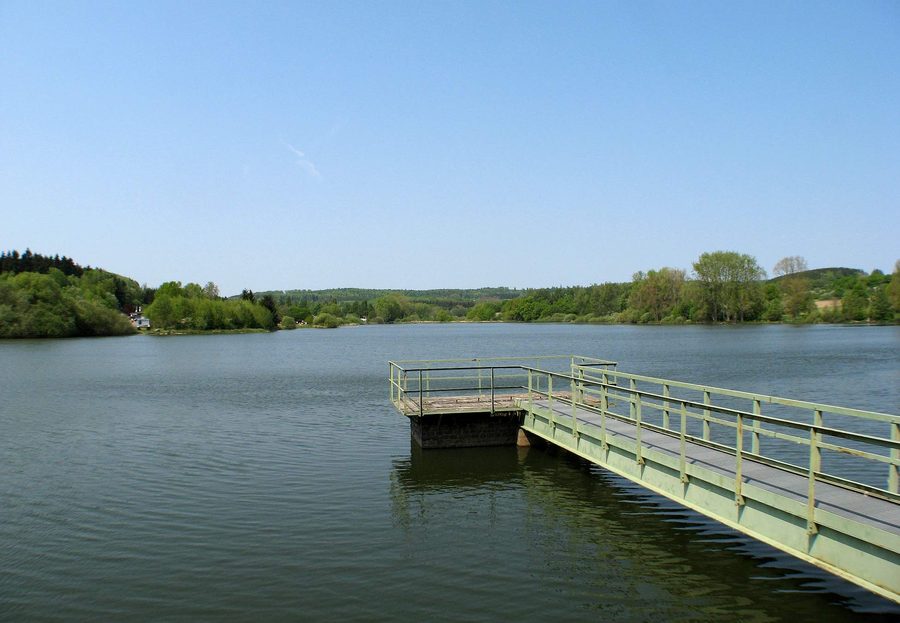 Der Seeweiher gehört zum Gemeindegebiet von Mengerskirchen.
Photo: Oliver Abels( SBT ) via Wikimedia Commons, CC BY 2.5
Castle and Tower Museum in the Historic Town Center
Built between 1321 and 1341, Mengerskirchen Castle is the centerpiece of the walled town complex. A section of its own wall has survived, along with the gateway and a half-tower. This means that, in addition to the castle itself, parts of the former fortifications are also identifiable features of the complex.
The Tower Museum is located in the oldest part of the castle, a medieval residential and defensive tower commissioned by Count Johann of Nassau-Dillenburg in 1320. The museum opened in 1990. The tower features medieval vine-pattern paintings in the lime-secco technique, dating from 1523. The castle, tower, and paintings thus provide different points of reference for the town’s history: the early 14th century, the castle’s construction period, and the tower’s decoration in the 16th century.
Exhibits and Church History
Among the oldest exhibits in the Tower Museum are Celtic storage vessels dating to around 500 BC. Fragments of 17th-century architectural painting can also be viewed in the entrance hall. The collection therefore brings together objects from widely separated periods; the dates refer to the vessels and painting fragments, respectively, not to the age of the museum building.
St. Mary Magdalene Parish Church is another dated point of reference in the town’s history: it stands on the site of a church first mentioned in 1313. Together with the castle and Tower Museum, it offers a picture that encompasses several historic sites and different forms of historical record.
Cycling Routes Around Mengerskirchen
The 32-kilometer “Rund um den Knoten” circular cycling route runs around Mengerskirchen and passes through the Westerwald’s low mountain landscape. The long-distance R8 cycle route runs directly along the Seeweiher lake in Mengerskirchen. The descriptions emphasize different features: “Rund um den Knoten” is identified as a circular route, with its length and the Westerwald specified, while the R8 is described as running along the Seeweiher. For a specific ride, you can use the 32-kilometer distance as a planning guide and check the current route details.
More Cultural Highlights in the Wider Limburg-Weilburg Destination
Within the wider Limburg-Weilburg destination, Runkel and Weilburg offer their own distinct historical highlights. The medieval castle in Runkel was first mentioned in 1159 and still shapes the townscape today; the historic Lahn Bridge in Runkel dates from 1448 and is one of the oldest bridges on the Lahn to have survived in its original condition.
In Weilburg, the navigable ship tunnel was built between 1844 and 1847. It is Germany’s oldest and longest navigable ship tunnel; together with the cupola lock at its lower entrance, it forms a technical monument. These examples complement Mengerskirchen’s local themes with further cultural history in the wider Limburg-Weilburg destination. They can help you put your stay in context without treating the places or their distinctive features as equivalent.
Discover more destinations: Elbtal, Bad Camberg.
Back to the main travel overview: Limburg-Weilburg.

