
Hersfeld-Rotenburg: Festivals, Half-Timbered Houses and Nature
Accommodation in Hersfeld-Rotenburg
Hersfeld-Rotenburg offers several specific starting points for planning a trip: recurring festivals in Bad Hersfeld and Nentershausen, half-timbered houses in Rotenburg an der Fulda, a history of castles and trails in Nentershausen, and named natural areas. Each place has a different focus. If you are looking for accommodation, it helps to decide first whether a festival, a historic townscape, a trail or a protected area should shape your stay.
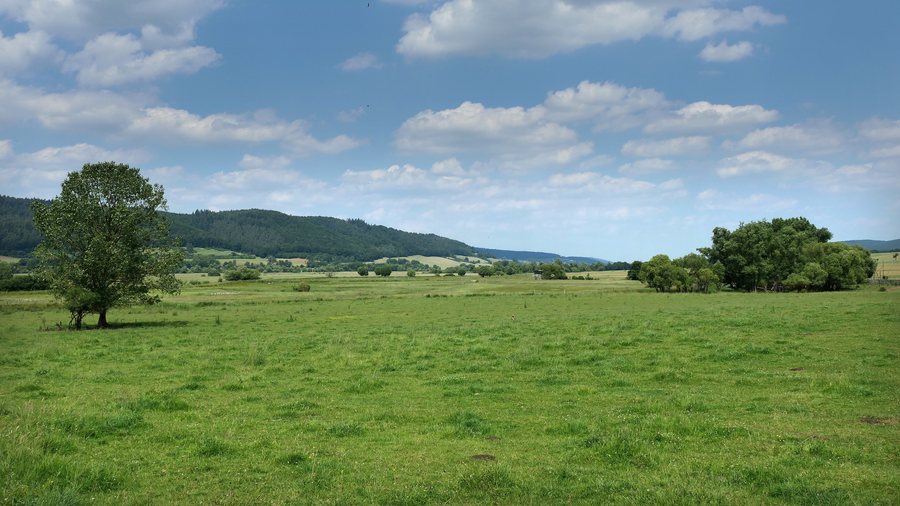 Bruchwiesen bei Mengshausen im Landkreis Hersfeld-Rotenburg (3)
Photo: Heinz K. S. via Wikimedia Commons, CC BY 4.0
Festivals and Townscapes
The collegiate church ruins in Bad Hersfeld are considered the largest Romanesque church ruins in the world. They are also the venue for the Bad Hersfeld Festival, held there annually since 1951. The Lullus Festival has a different connection to time: it has been celebrated every year without interruption since 852, during the week of October 16, in honour of the town’s founder, Lullus. For the festival, its annual return to the collegiate church ruins is the key point of reference; the week in October is also specified for the Lullus Festival. If you would like to plan your stay around either event, take the respective dates into account.
Rotenburg an der Fulda offers a different cultural focus. Its historic town centre includes more than 350 half-timbered houses. On the banks of the Fulda, together with Rotenburg Castle, they form a distinctive row of half-timbered buildings. This gives the townscape a different character from Bad Hersfeld, with its festivals and church ruins: in Rotenburg, the focus is on the interplay between many houses and the castle by the river.
Castles and Trails
Tannenberg Castle in Nentershausen was built around 1300 by Ludwig I of Baumbach and was a fief castle of Hersfeld Abbey. The castle festival, featuring more than 600 performers, takes place there every year on the first weekend in October. Check the exact dates for the relevant year when planning. The Werra-Burgen-Steig trail also begins in Nentershausen. The castle and the trail’s starting point thus offer different reasons to choose this location.
In Cornberg, Franzosenstraße is part of the Wartburgpfad and the long-distance hiking trail X9. On the watershed between the Werra and Fulda rivers, it offers views of the cultural landscape. Unlike Nentershausen, where a hiking trail begins, Cornberg’s focus is a road that forms part of two trails and also offers a named landscape viewpoint.
Natural Areas with Distinctive Characteristics
The Rhäden nature reserve is part of the Green Belt Germany biotope network. The Große Doline near Rockensüß is also a nature reserve: it covers 60,000 square metres and is home to rare orchids and ferns. The two places offer different starting points for nature-based excursions. At Rhäden, its connection to the Green Belt is a defining feature; at the Große Doline, the area and the specified plant characteristics are concrete points of reference.
Choose Where to Stay Based on Your Reason for Travelling
When looking for accommodation, you can first decide what your trip will focus on: the Bad Hersfeld Festival or Lullus Festival, the ensemble of half-timbered houses in Rotenburg an der Fulda, the castle and trailhead in Nentershausen, the trails in Cornberg, or the nature reserves. You can then check which accommodation location suits the places you plan to visit. The events and landscape themes mentioned offer different starting points, rather than prescribing a single type of trip. If you are staying around the castle festival, the exact date for the relevant year should also be part of your planning.
Discover more destinations: Kirchheim, Neuenstein, Odenwald, Wetterau, Lahn-Dill-Kreis, Rheingau-Taunus-Kreis, Fulda, Waldeck-Frankenberg.
For the broader travel overview: Hesse.

