
Discover Antdorf: Churches, trails and local traditions
Accommodation in Antdorf
Get to know Antdorf through its churches, local traditions and trails through the surrounding countryside. When looking for accommodation in Antdorf, it helps to consider your interests: would you like to focus on architectural history, explore the trails in the surrounding area or experience recurring local traditions?
Churches and art in Antdorf
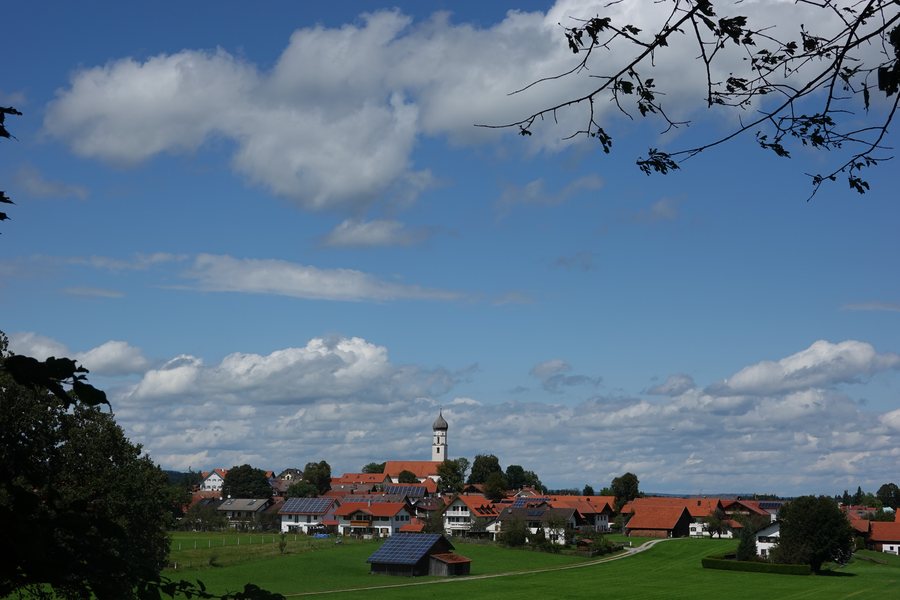
The parish church of “St. Peter and Paul” stands on a hill above the village. The Wessobrunn master builder Caspar Feichtmayr erected it between 1688 and 1694; it was restored in 2002 and 2003. Its construction dates and builder provide a specific historical reference point, while its elevated position also makes the church a prominent feature of the village landscape. Those interested in ecclesiastical architectural history will find a clearly dated starting point here.
Another landmark is Kirnberg Chapel, the largest chapel in Antdorf. It stands on a hill south of the village. Its ceiling painting was created by Munich painter Franz Seraph Kirzinger in 1794. The chapel offers a different way to explore local history than the parish church: the focus here is on a single dated work of art and its location on Kirnberg.
In the district of Frauenrain, the Church of the Assumption of Mary combines a long history with a distinctive architectural form. It was already in existence around 1440 and has always been a place of Marian devotion. Its massive walls are in the Romanesque style; the square tower, built from tuff blocks and rubble stone, has a pitched roof.
Trails through meadows, forests and moorland
The Höllfilz Trail starts in the centre of Antdorf. It passes through moorland and meadows, past fields, small bodies of water and hamlets, and offers sweeping views of the Alps. On the return journey, it passes the Church of the Assumption of Mary in Frauenrain on its way back to Antdorf. Visibility and trail conditions may depend on the weather. One possible way to reach the Höllfilz Trail is to take the train to Weilheim and then the bus to Antdorf; check current timetables before travelling.
The Antdorf Betbichl Loop takes in different landmarks: it passes a Lourdes grotto, goes to the church in Frauenrain and continues to the chapel on Kirnberg. This loop is also described as offering sweeping views of the Alpine massif; visibility depends on the weather. By contrast, the Höllfilz Trail is characterised by its moorland and meadows, as well as the return route via Frauenrain.
In general, cycling and hiking trails in Antdorf cross meadows and pass through forests. The Osterseen lakes are 3 kilometres from Antdorf and can be reached by bicycle or on foot. If you plan to visit this destination, bear in mind that trail conditions can vary. This makes the local routes and the nearby natural landscape distinct options for outdoor activities.
Recurring traditions
The events calendar is another useful guide: a maypole is erected in Antdorf every three years, and the Mailaufen run takes place the following Sunday. This tradition is held at a different interval from the Corpus Christi procession, which winds through Antdorf on the Sunday after Corpus Christi, following the festive church service. Houses along the procession route are decorated with cloths, flags, flowers, candles and images of saints. The two occasions therefore take place at different points in the annual calendar; their specific dates are important when planning a trip.
Further afield: Weilheim-Schongau
The wider destination of Weilheim-Schongau offers a broader regional perspective. The district is part of the Pfaffenwinkel travel region; the Lech forms its western boundary, the Ammer flows through its central area, and the Loisach runs along its eastern boundary. One of the region’s distinctive cultural destinations is the Wieskirche near Steingaden. Dominikus Zimmermann built it between 1745 and 1754; it has been a UNESCO World Heritage Site since 1983. Church services, summer concerts and quiet contemplation are among the reasons to visit, although dates may vary. Another historical highlight is the Penzberg Mining Museum: it preserves the memory of the pitch-coal mining carried out there from 1796 to 1966 and offers multilingual guided tours for international visitors, families and school groups.
Discover more destinations: Sindelsdorf, Obersöchering.
Return to the overview of destinations: Habach.

