
Habach
Accommodation in Habach
Explore Habach through tangible landmarks of its local history and the ponds within the municipality. At the heart of the former collegiate-village center are Hauptstraße and St. Ulrich Parish Church, complemented by historic buildings. The area also has recurring festivals and natural wetlands. This lets you understand its culture and landscape through named places and clearly dated details.
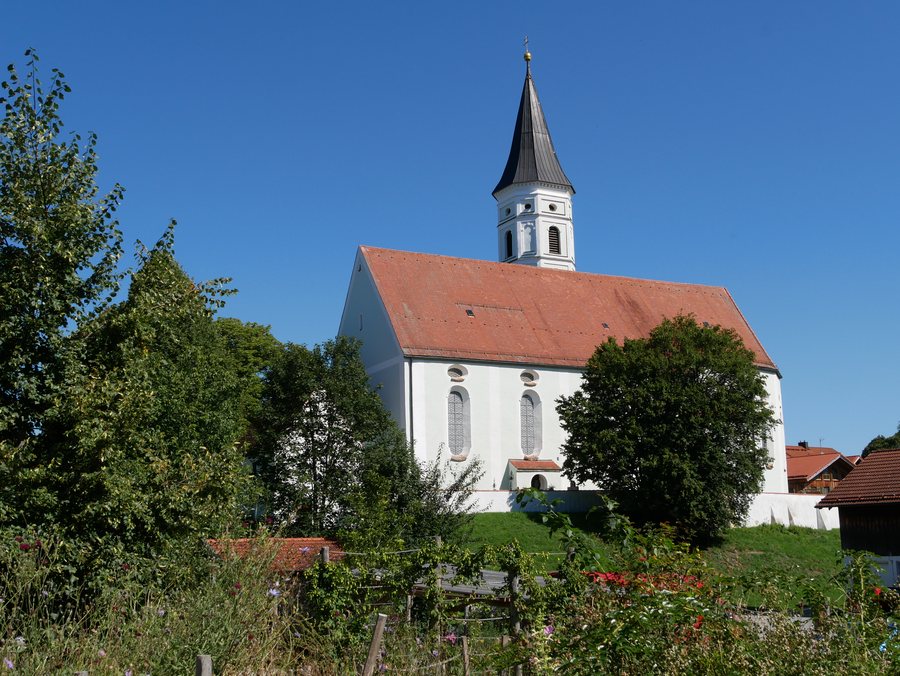
Historic Town Center and Parish Church
The protected Habach Town Center ensemble encompasses the central area of the former collegiate-village center, located along Hauptstraße. Six larger houses along Habach’s Hauptstraße can be identified as former canon residences. The village’s former role as a collegiate village is thus part of the history of its center and buildings.
Today’s Baroque St. Ulrich Parish Church was built between 1662 and 1668 and consecrated on October 14, 1668, by Kaspar Zeiler, Auxiliary Bishop of Augsburg. The high altar is by Weilheim artist Ambros Degler. The altarpiece was created in 1681 by Murnau painter Simon Bernhard: it depicts St. Ulrich and the Battle of Lechfeld. Ulrich’s Fountain, considered one of the oldest Ulrich’s fountains in the Diocese of Augsburg, lies southwest of the church.
Further Architectural History in the Municipality
Different historic uses and architectural styles can also be seen in other buildings. The listed former Altwirt at Hauptstraße 5 was an inn with lodging dating from 1626. The building was renovated in the early 18th century and again in the second half of the 19th century. The listed sacristan’s house at Hofbichlweg 2, formerly called the Moserhaus, is a Werdenfels-style farmhouse of the Mittertenn type. Its residential section is on the left and the stable on the right.
In Dürnhausen, within the municipality, stands the Catholic filial church of St. Martin. Its Romanesque nave dates from 1063; the choir and tower date to the 15th century, and the church was given a Baroque makeover around 1670. The historic walking route through Habach follows other named landmarks: along Hauptstraße, beside the Heubach, and over Kirchhofbichl.
Annual Festivals
Two Habach processions take place every five years: the Carnival procession winds through the streets on Shrove Tuesday, and the traditional harvest thanksgiving festival is also celebrated with a procession every five years. The Easter bonfire, by contrast, takes place annually on the evening of Easter Sunday at Hinterfeld. If you’d like to plan your trip around one of these events, check the specific event date in advance.
Ponds and Wetlands
In Habach’s open countryside, Wiesleitenweiher is one of the ponds with particularly natural surroundings and abundant wildlife. Habach municipality also has natural wetlands with moors, litter meadows, ponds, and shores. These landscape features offer a different perspective on the municipality from the historic buildings in the town center.
Koppenbergweiher is within walking distance of the town center. Swimming is possible in Habach in summer. Water quality and local conditions can change; check them before swimming.
Getting There and Dining
Habach is accessible via the A95 and B472, as well as by public transport. Check current public transport connections before traveling. For a meal, Eichbichl-Stüberl serves traditional Bavarian cuisine and hearty snacks, and has a beer garden. Opening status and hours may change, so check before visiting.
Discover more destinations: Sindelsdorf, Antdorf, Obersöchering, Huglfing, Steingaden, Altenstadt, Seeshaupt, Schongau.
Back to the regional travel overview: Weilheim-Schongau.

