
Discover Tann
Accommodation in Tann
Tann is in southeastern Bavaria, in the southern part of the Rottal-Inn district. The town is near the confluence of the Inn and Salzach rivers and close to the Austrian border near Braunau and Burghausen. Two perspectives help put the destination in context: the hilly, forested landscape around Tann and the history reflected in local buildings and traditions.
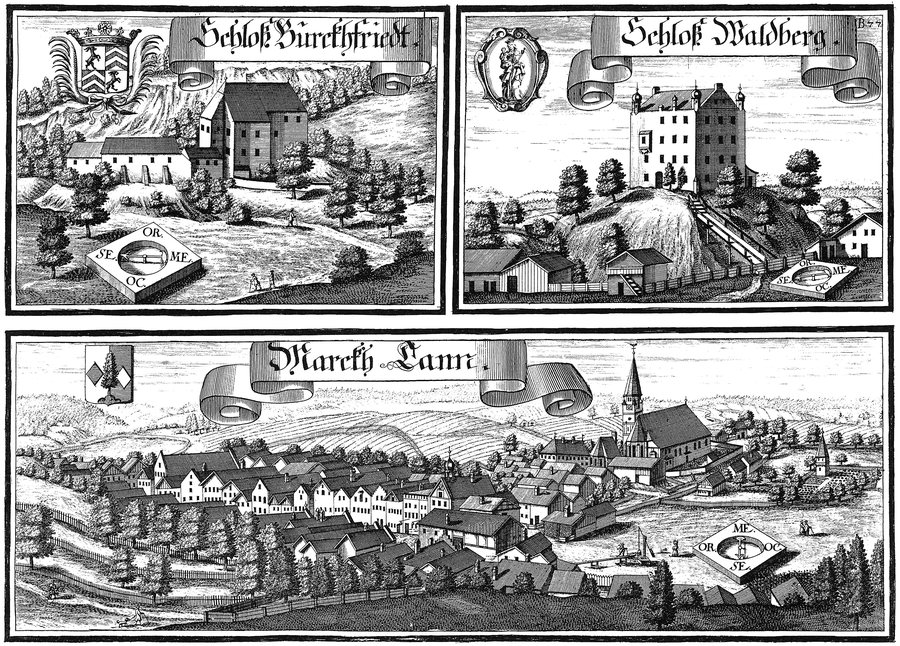 File:Wening B077 Burckfriedt, Schloss; Tann, Markt; Waldberg, Schloss.jpg
Photo: Michael Wening via Wikimedia Commons, Public domain
Landscape and Local History
The landscape around Tann is hilly and forested, offering ever-changing panoramic views. This shapes the town’s scenic setting. Among its notable buildings is the Church of St. Peter and Paul, built in the neoclassical style. The pilgrimage to the “Herrgott von Tann” (Lord God of Tann) is also part of the town’s history: it reached its peak at the end of the 17th century. The object of veneration was a cross believed to have miraculous powers.
Another part of local history is “Tanner Tuch” (Tann cloth). It became widely known through the industriousness of Tann’s citizens. The church, pilgrimage, and cloth tradition offer different insights into the town’s history: its architectural heritage, religious significance, and the craftsmanship associated with Tann.
Markets and Nearby Activities
The Martinimarkt was established by Duke Georg in 1481 and is the oldest of the markets associated with Tann. This historical distinction makes it a notable part of the town’s market history. Tann also has an outdoor swimming pool. Nearby, in Zeilarn, there is a miniature golf course; the distance from the destination is listed as 3 km. Local history and nearby leisure activities therefore offer different starting points for planning your visit.
Rottal-Inn as the Wider Region
Beyond its local features, the wider destination of Rottal-Inn offers additional topics to consider when planning your trip. The Rottal Terme has more than 30 thermal-water pools with temperatures ranging from 26 to 40 °C, as well as 13 saunas and steam baths. It also features a 105-meter-long thermal stream and health, prevention, and wellness services. Individual facilities may change as a result of renovations. The Theater an der Rott in Rottal-Inn also presents premieres every year in drama, musicals, concerts, dance, operetta, and opera; individual productions vary. It is the only theater in Germany owned by a district.
Those interested in architectural history can explore the “Gothic Tours” in Rottal-Inn, which visit selected Gothic monuments. Brochures, maps, the tour portal, and the Gothic portal provide guidance. The Gothic portal includes on-site audio guides to Gothic buildings, as well as an online museum with information, learning resources, and educational content. The Rottal-Inn leisure region has an extensive network of several hundred kilometers of cycling and hiking routes. The Inn Cycle Path runs through the Lower Inn European Reserve and offers insights into its flora and fauna. The tour portal supports route planning with information on elevation profiles, trail conditions, and GPX downloads.
The Rottaler Hoftour is also part of what Rottal-Inn has to offer. This experiential program explores themes such as rural life, everyday work, wildlife, farming culture, traditional crafts, handicraft techniques, and regional culinary specialties. These regional activities belong to the wider destination of Rottal-Inn, not to Tann itself.
Plan Your Stay Around Your Interests
When planning, check the specific locations and details of the regional activities. This helps keep Tann’s local character distinct from the other options in Rottal-Inn.
Discover more destinations: Wurmannsquick, Hebertsfelden.
See the wider travel overview: Rottal-Inn.

