
Discover Altdorf b. Nürnberg
Accommodation in Altdorf bei Nürnberg
When choosing accommodation in Altdorf b. Nürnberg, it helps to consider in advance which local features are important to your stay. These include cultural details such as the Wallenstein Fountain and the preserved wooden gate at the Obere Tor, the Doktorsgärtlein, and a network of circular walking trails around 100 km long.
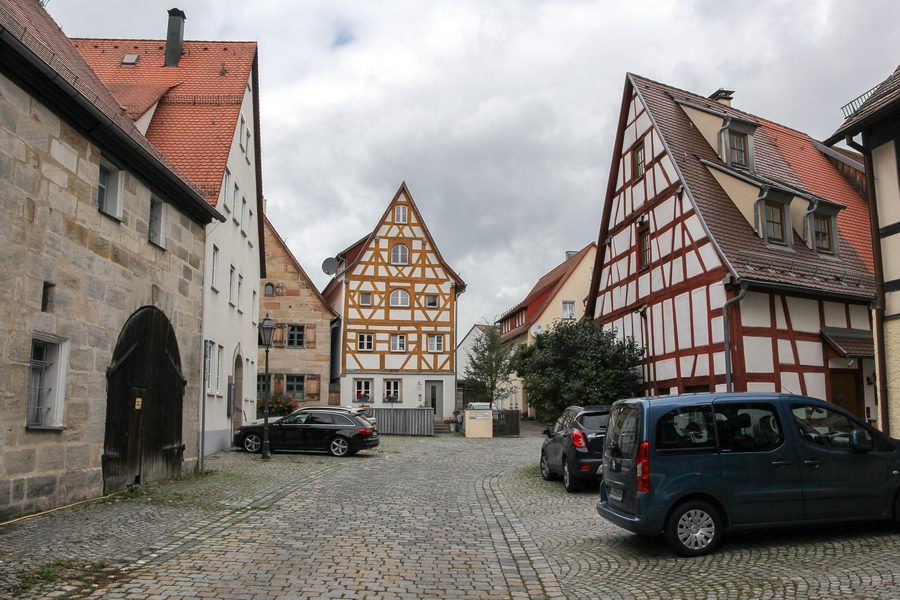 Historisches Ensemble in der Altstadt von Altdorf bei Nürnberg.
Photo: Derzno via Wikimedia Commons, CC BY-SA 4.0
Culture in the Townscape
The Wallenstein Fountain was installed in 1985 in front of the old Pflegamtsschloss. It was created by Altdorf sculptor Ludwig Manz. Its location, artist and year provide a specific way to understand this individual local landmark: you can place the fountain in context both through its creation and through its position in front of the old Pflegamtsschloss.
The wooden gate at the Obere Tor, also known as the Nürnberger Tor, is still preserved. For the fountain, the artist and year of installation are the main points; at the gate, it is the preserved wooden gate itself.
The Doktorsgärtlein in the Museum Courtyard
In the courtyard of the Altdorf University Museum, the Doktorsgärtlein has been recreated on a small scale as the former botanical garden of the Altdorfina. It invites visitors to relax and study more than 200 plant species. The garden thus combines its historical connection with two explicitly mentioned interests: a quiet break and learning about plants.
The Altdorf University Museum is temporarily closed for renovation. Before visiting the Doktorsgärtlein, check whether the museum courtyard is accessible.
Circular Walking Trails in Altdorf
The Altdorf network of circular walking trails is around 100 km long. This figure refers to the network as a whole, not to a single circular trail. When planning a specific hike, it is therefore the length of the individual loop that matters; the total length mainly helps put the size of the local trail network into perspective. Check current trail conditions before setting out.
The Nürnberger Land as a Wider Destination
Across the wider destination of Nürnberger Land, more than 3,000 kilometres of well-marked hiking trails and well-developed cycling routes, with varying levels of difficulty, run through the region.
One specific example in Nürnberger Land is the “Hohenstein (634 m) – SevenSummits” route in Kirchensittenbach. It is 10.1 km long, with 406 metres of ascent and 397 metres of descent. Another regional route, “Hochberg (619 m) – SevenSummits,” passes through the forests around Pommelsbrunn. Its highlight is the “Acropolis of the Celts” on Hochberg. The two descriptions focus on different aspects: one gives the route length and elevation figures, while the other highlights the forest landscape and a named landmark.
The Franconian Dune Trail also runs through Nürnberger Land, passing sandstone ravines, sand dunes and shady forests. Nürnberger Land is part of the Franconian Switzerland–Franconian Jura Nature Park.
For further regional inspiration, Nürnberger Land also offers attractions beyond its trails. In Hersbruck, the Fackelmann Therme is accessible to people with disabilities; lifts lead to the foyer and the thermal spa world, and from there to the sports and adventure pool and the sauna park. The spa offers relaxation in state-recognised healing water and a sauna area with seven saunas. The German Shepherds’ Museum in Hersbruck displays clothing, equipment and handicrafts made by shepherds from around the world.
Discover more destinations: Reichenschwand, Lauf an der Pegnitz, Engelthal, Pommelsbrunn, Happurg, Kirchensittenbach, Hartenstein, Schnaittach.
Go to the wider travel overview: Nürnberger Land.

