
Schäftlarn: Monastic Culture and Paths along the Isar
Accommodation in Schäftlarn
Schäftlarn combines monastic culture, historic churches and paths along the Isar. If you are looking for a hotel in Schäftlarn, these highlights can guide your plans: the monastery complex and the Prelate’s Garden showcase architectural history, while two walks of different lengths offer time outdoors. This lets you plan your stay around architectural history, a short circular walk or a longer route along the river.
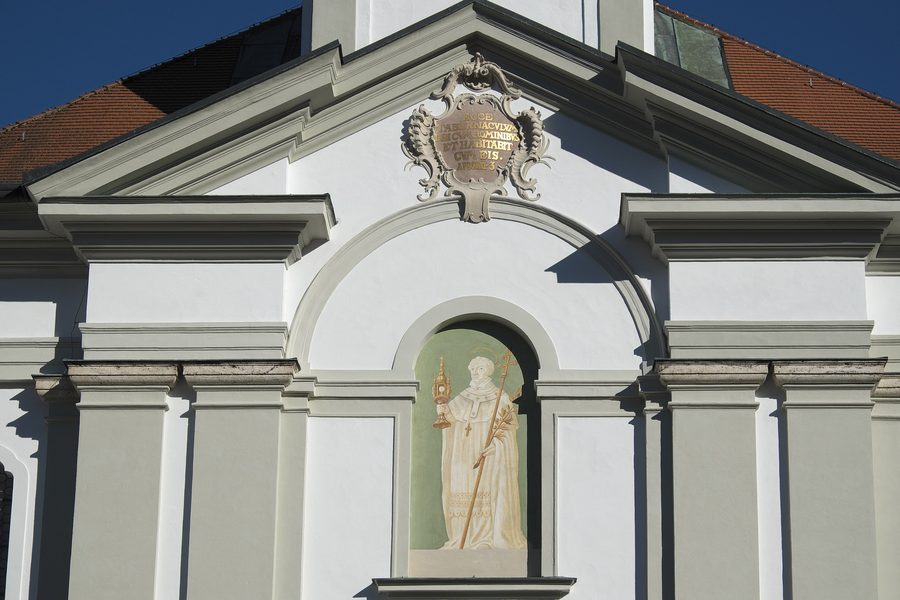 Die Klosterkirche St. Dionysius und Juliana prägt das kulturelle Bild Schäftlarns.
Photo: GFreihalter via Wikimedia Commons, CC BY-SA 3.0
Monastery Church, Garden and Churches
The monastery church in Schäftlarn is considered a remarkable Rococo gem and is probably one of the finest late Baroque religious buildings in southern Germany. Together with the church, the 300-year-old main monastery building forms an important architectural ensemble and is one of Upper Bavaria’s outstanding cultural monuments. The main monastery building is not open to visitors.
At the center of the Prelate’s Garden is a fountain fed by a spring on the nearby hillside. Baroque-era buildings and a curved boundary wall from the same period surround the garden. It attracts rose lovers and people who enjoy beautiful surroundings.
St. George’s Church in Hohenschäftlarn is one of the oldest branch churches of the former Schäftlarn monastery parish. The present building was constructed from 1729 to 1732 under the direction of Munich master mason Johann Georg Ettenhofer. These dates refer to the present building; its classification as a branch church refers to the former monastery parish.
The Neuchl Estate and Its History
The Neuchl Estate, also known as Stallwastl, was first mentioned in 1492, almost completely burned down in 1828, and was subsequently rebuilt. Schäftlarn’s last authentically preserved small farmstead dates from 1829. The year 1492 marks the estate’s first mention, while 1829 is the date of the surviving house.
On Foot, by Bike and Getting There
The 9.6-kilometer “Nature” trail runs along the Isar between the Dürnsteiner Bridge near Schäftlarn and the Ickinger Weir. The walk takes approximately three hours.
A short circular walk starts opposite the monastery cemetery. It follows a paved path up the hillside, past the “Maria Rast” chapel, and then along the hillside. The path offers a view of the monastery church. Check local conditions before setting out.
This gives you a clear idea of the time involved in planning your day: the circular walk is short, while the nature trail takes around three hours.
Schäftlarn Monastery is a stop on the Isar Cycle Path, with a church, a monastery tavern and a beer garden.
By car, you can reach the monastery via the A 95 Munich–Garmisch-Partenkirchen and the Schäftlarn exit. Take the S 7 to Ebenhausen-Schäftlarn station; from there, a footpath leads to the monastery. When traveling by train, this section is part of the journey. Check current travel information before setting out.
Discover more destinations: Aying, Höhenkirchen-Siegertsbrunn, Kirchheim near Munich, Unterschleißheim, Munich, Aschheim, Garching near Munich, Grasbrunn.
Back to the main travel overview: Munich Region.

