
Bad Kissingen: Rhön Foothills, Culture and Wine Tradition
Accommodation in Bad Kissingen
The district of Bad Kissingen lies on the southern edge of the Rhön. Its regional character ranges from the foothills and wide-open spaces of the Rhön to valuable healing waters and a long wine-making tradition. When choosing where to stay, it is worth considering the places you plan to visit: the cultural attractions in the city of Bad Kissingen have a different focus from trails near Münnerstadt or Hammelburg.
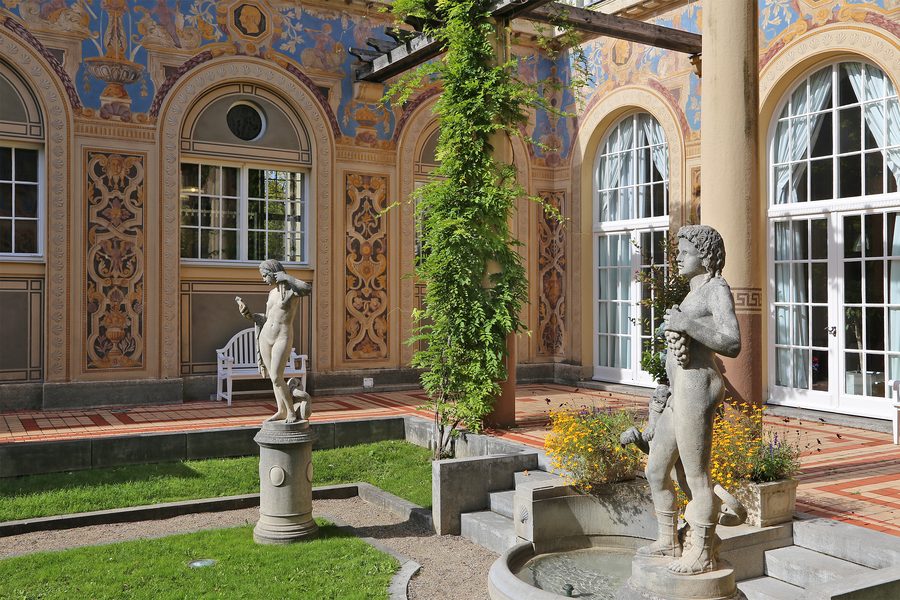 Der Arkadenbau ist ein prägender Bestandteil des historischen Kurensembles von Bad Kissingen.
Photo: W. Bulach via Wikimedia Commons, CC BY-SA 4.0
Getting oriented in the district
Two north–south routes are important for road travel: the A 7 between Fulda and Würzburg and the A 71 between Erfurt and Schweinfurt cross the district from north to south. For public transport, the district has been part of the Nahverkehr Mainfranken transport network (NVM) since January 1, 2025. When choosing accommodation, check the specific connections to the places you want to visit; membership in the transport network alone does not identify any particular connection.
The landscape also has different character in different areas. The Schondratal is considered one of Franconia’s most beautiful unspoiled forest valleys. Wine and cycling are the main attractions in Hammelburg, while the Extratour “Michelsberg” hiking route starts near Münnerstadt. These places and activities offer different points of reference for planning, without assuming that they share the same starting point.
Culture and spa tradition in Bad Kissingen
In the city of Bad Kissingen, the spa gardens ensemble is an exceptional contribution to the UNESCO World Heritage Site The Great Spa Towns of Europe. The fan fountain was added to the city’s park in 1959 and quickly became one of the city’s best-known landmarks. The Max Littmann Concert Hall in the Regentenbau is also considered one of Europe’s finest concert halls.
The Bismarck Museum includes the historic Bismarck apartment, with its original interior from his stays in Bad Kissingen between 1876 and 1893, as well as museum exhibition rooms about Bismarck’s politics. The Obere Saline Museum covers other subjects: exhibits include a historic Bismarck apartment, handmade toys from the Rhön and around the world, and the history of salt and salt production. This offers a choice of topics spanning political history, regional crafts and toys, and the history of salt.
Other notable places include the graduation house, which is still used for saline inhalation. The “Dampferle” boat continues to operate on its original route; service is seasonal. If you are planning a trip, check the seasonal sailing dates in advance. One hiking route in Bad Kissingen follows the favorite route of Empress Elisabeth of Austria: it passes through the spa gardens and Luitpold Park, over the Altenberg hill, and on to the Sisi Monument.
Hiking trails and wine country
Near Münnerstadt in the district is the Extratour “Michelsberg,” a certified premium trail. From Münnerstadt town center, you can hike along varied paths to the Michelsberg, after which the trail is named. You can get there by train, bus or car. This identifies the starting point, destination and possible means of transport; you can check the specific connection to suit your accommodation and plans for the day.
The Franconian Saale Wine Genuss hiking trail also offers two different routes. The wine route runs from Bad Kissingen via Ramsthal and Sulzthal to Trimburg. The Saale route also leads to Trimburg, passing through Wirmsthal, Euerdorf and Aura along the Franconian Saale. The places along the two routes differ; compare them to see which route better suits your excursion plans.
The area around Hammelburg is suitable for cycling and mountain biking, including routes along the Franconian Saale and the Thulba. The Hammelburg Wine Trail is 5.8 kilometers long and has 17 stations. It also marks the starting point of the 84-kilometer Abtsweg between Hammelburg and Fulda. The different lengths provide a point of comparison: the Wine Trail is the shorter of the two routes mentioned, while the Abtsweg connects Hammelburg and Fulda over a considerably longer distance.
The Wine Trail also conveys the long-standing historical connection between Hammelburg, Franconia’s oldest wine town, and Fulda, dating back to the year 777. In this way, the route combines the history of wine-growing with guidance along a specific trail. Whether you are considering a shorter themed trail, a hike on one of the two Saale routes, or a longer connection, choose your starting point and accommodation based on the places that are most important to your stay in the district.
Discover more destinations: Motten, Bad Brückenau, Burkardroth, Ebersberg District, Munich Region, Rosenheim, Freising and Berchtesgadener Land.
Go to the main travel overview: Bavaria.

