
Østermarie: Church, History and E-Bike Route
Accommodation in Østermarie
Østermarie can be explored through two distinct themes: the church’s architectural and artistic history, and the Hilly Billy e-bike route, which leads into the town through gently rolling terrain.
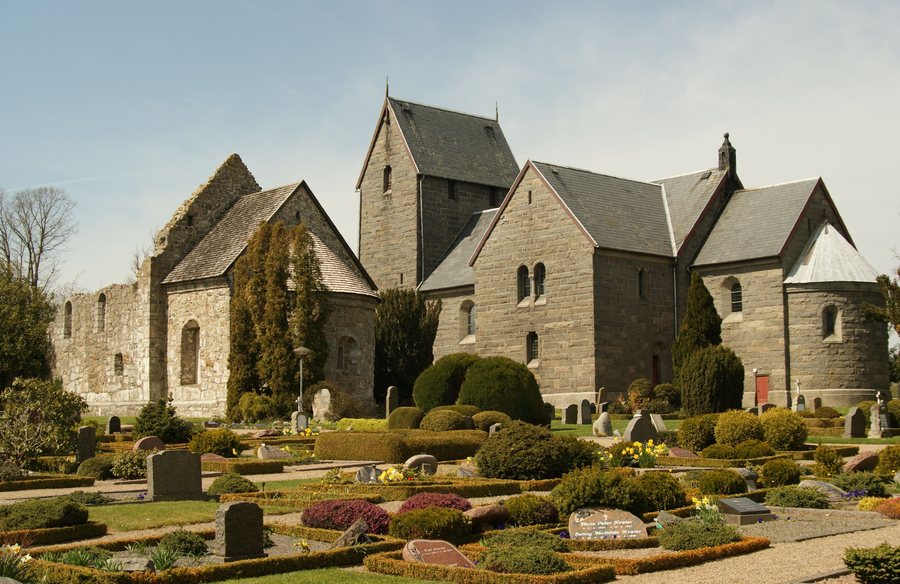 Østermarie church (1891) and ruins of the old church (approx 1200)
Photo: Jens Cederskjold via Wikimedia Commons, CC BY 3.0
Østermarie Church: Building History and Furnishings
Østermarie Church was inaugurated on 18 October 1891. It was designed by architect Andreas Clemmensen, and “Paradis granite” was used as the building material. The inauguration date, design and stone provide three different clues to the building’s history. The altar shows the colour scheme by Bornholm artist Poul Høm, created when the church was restored.
The baptismal furnishings can also be identified by different features. The granite baptismal font dates from around 1250 and was made on Gotland. The baptismal dish dates from around 1575, comes from Nuremberg and depicts the Annunciation to Mary. For the font, the material and place of manufacture are key; for the dish, the date, origin and image all contribute. The furnishings thus offer several ways to explore the church’s history, without suggesting that each object tells the same story.
E-Bike Route and Surroundings
The Hilly Billy e-bike route passes through gently rolling terrain to Østermarie and its double church; one of the two churches is a ruin. From there, the route continues towards Paradisbakkerne and through the fishing village of Årsdale on the east coast. There, you can stop for a beer or smoked herring. Check the current route before setting off, and check current availability before planning a stop.
Another point of interest lies outside the town: Fru Petersens Café is about 1 km from Østermarie in a former church school dating from 1908. The school building was designed by Mathias Bidstrup. The route to Østermarie and the café’s location are therefore separate geographical reference points; don’t plan them as though they were the same place.
Bornholm: Landscapes, Exhibitions and History
On Bornholm, landscapes and exhibitions complement the themes of Østermarie and its route. Ekkodalen in Almindingen is Bornholm’s largest rift valley. From the cliffs above Opal Lake, you can look out over the surrounding area, the Baltic Sea and the castle ruins of Hammershus. The visitor centre at Hammershus offers a panoramic view of Hammershus. The two descriptions of the views emphasise different things: at Opal Lake, the sea and surrounding area are part of the vista, while Hammershus is the focus from the visitor centre.
The NaturBornholm experience centre features dinosaurs, live crocodiles, an aquarium and a bison exhibition. Since exhibitions can change, it’s a good idea to check what’s currently on offer before planning a visit. Bornholms Middelaldercenter is a 15-hectare open-air museum that presents Bornholm in the 14th century in an accessible, interactive way. The offerings therefore differ in their subject matter: NaturBornholm brings together the animals mentioned above and the aquarium, while Middelaldercenter focuses on Bornholm’s medieval history.
The island’s churches also have different visitor arrangements. When no service is taking place, visitors can enter Østerlars Round Church for a fee and climb up to the roof beams. Check in advance whether these conditions apply to your planned visit.
Bornholm’s Smoking Tradition
Bornholm’s first smokehouse opened in Gudhjem in 1866, and herring has been smoked there ever since. Hasle Smokehouse is the last smokehouse on Bornholm where smoking is done in the traditional way, using open chimneys and alder wood. These two facts show different aspects of the smoking tradition: Gudhjem represents its historical beginning and the continued smoking of herring, while Hasle is associated with a specific smoking method.
Discover more destinations: Listed, Østerlars, Arsballe, Tejn, Klemensker, Rø, Kås, Gudhjem.
For the broader travel overview: Bornholm.

