
Østerlars – Round Church, Risen and Medieval Centre
Accommodation in Østerlars
If you are looking for accommodation in Østerlars, historic sites in the village and nearby can help you plan your stay. These include prehistoric traces south of the village, the Round Church and Bornholm’s Medieval Centre. Each offers a different focus – from archaeological evidence and church art to vivid accounts of medieval history.
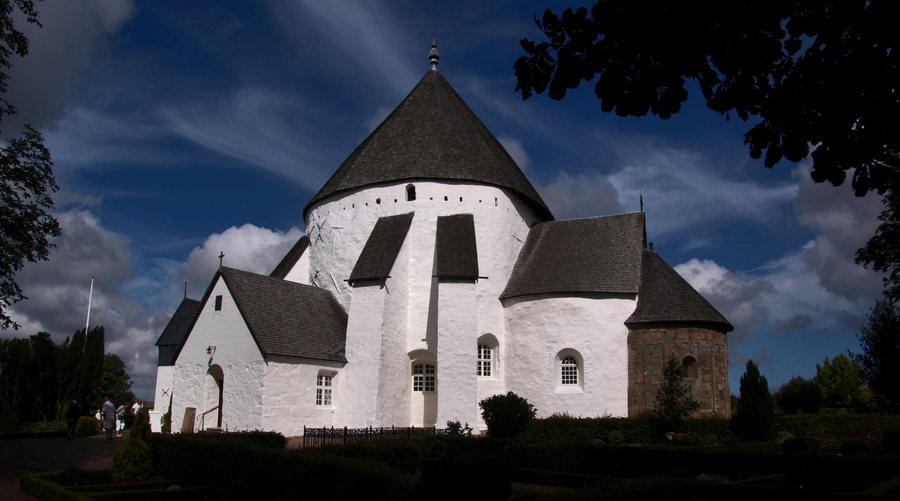 File:Østerlars Kirke 2016-08-15 a.jpg
Photo: Guillaume Baviere from Uppsala, Sweden via Wikimedia Commons, CC BY-SA 2.0
Archaeological traces at Risen
The woodland area of Risen lies south of Østerlars. It contains several hundred prehistoric field systems enclosed by stone walls. Most date from the Early Iron Age, roughly from 400 BC to 200 AD. The land was also used during the Late Iron Age, and some of it continued to be used until the 19th century. This long history of use shows that these remains are not limited to a single period.
Bøgebjerg in Risen is also home to a burial ground with burial mounds, stone cists and standing stones. It dates from the Iron Age and the Viking Age. Taken together, the field systems and burial ground reveal different traces of human activity and burial practices. If you are interested in archaeology, they offer a distinct theme alongside the village’s buildings and frescoes.
The Round Church and medieval frescoes
Østerlars Round Church is Denmark’s largest round church and the best known of Bornholm’s four round churches. It is also considered the oldest of the four. Its exact year of construction is unknown; it was probably built around 1150. In addition to its religious function, it once served as protection against enemies arriving from the sea. Its different aspects – architectural form, religious use and historic defensive function – offer several ways to explore its cultural history.
The church’s interior frescoes date from around 1350. Their scenes tell the story of Jesus’s life, from the Annunciation to Mary to the Last Judgement. The frescoes were whitewashed during the Reformation and came to light again in 1889. A conservator from the National Museum restored them in 1958. The paintings therefore reveal both their narrative sequence and their eventful history of preservation.
Around 120,000 visitors come to the Round Church each year. Under the visitor rules, people may enter outside service times for a fee and climb up to the roof beams. Check in advance whether a visit is currently possible.
Bornholm’s Medieval Centre
Bornholm’s Medieval Centre is located in Østerlars and first opened its doors in 1996. This 15-hectare open-air museum brings 14th-century Bornholm to life in an engaging, interactive way. It complements the surviving archaeological and ecclesiastical remains with a portrayal of medieval life on the island.
The centre offers a free guided tour every day. Visitors can also try activities such as archery and coin minting each day, or watch a medieval breech-loading cannon being fired. The current weekly programme lists the activities on offer. If you want to plan your stay around particular activities, check the programme before your visit.
Bornholm as a travel-planning reference
For planning a trip from further afield, Bornholm is the relevant point of reference: the island can be reached by ferry, plane, bus or train. The ferry crossing from Ystad in Sweden to Bornholm takes one hour and 20 minutes. Check the current timetables when planning your journey.
These sites make it easier to compare cultural interests: Risen is known for its prehistoric field systems and burial monuments, the Round Church for its architectural history and frescoes, and the Medieval Centre for its vivid presentation of the 14th century. This can help you decide which of these highlights to include in your travel plans.
Discover more destinations: Listed, Østermarie, Gudhjem, Kås, Klemensker, Arsballe, Tejn, Rø.
Back to the main travel overview: Bornholm.

