
Piste, ski route or off-piste terrain?
Pistes, ski routes and terrain off marked runs describe different areas. A piste is groomed for regular skiing; a marked ski route may be ungroomed. In open terrain, there are no markings identifying an open piste or ski route. The piste map and signs at the entrance help you identify the area.
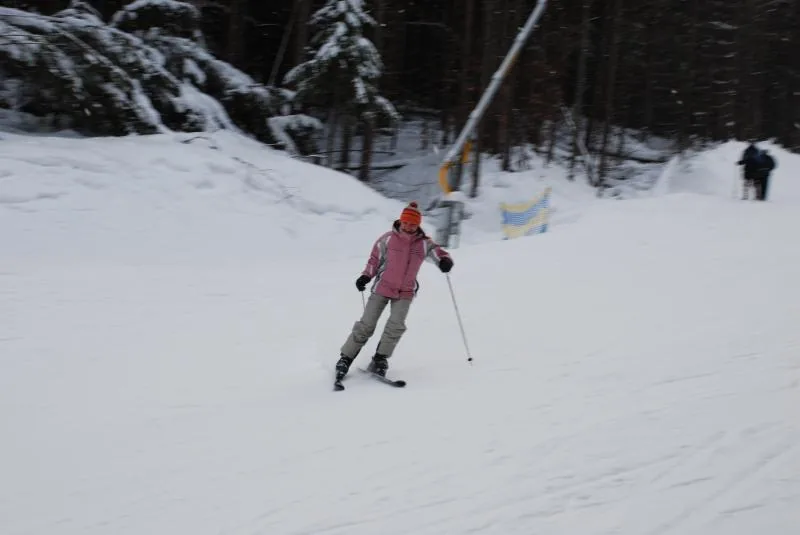 Skifahrer in pinker Jacke und orangefarbener Mütze fährt einen verschneiten Hang hinab.
Photo: Olga Buko
Key facts
- Groomed pistes are marked and prepared for regular skiing.
- A ski route may be marked without being groomed like a piste.
- Piste colours indicate difficulty, but their meaning is not the same everywhere.
- The local piste map legend explains colours, symbols and numbers.
- Snow, ice, visibility and crowds can make a descent more challenging.
- Beyond marked runs, navigation and safety conditions are different.
- Current closures and signs at the entrance take precedence over an older map.
Groomed pistes
Groomed pistes are prepared for regular skiing and marked on the mountain. Blue, red and black often indicate increasing levels of difficulty; however, colours and criteria are not identical in every country or area. So check the legend on the specific piste map and look out for signs at the entrance. A colour indicates a general rating, not the conditions at every point or at every time of day.
Ski routes and connections
A ski route is shown as a separate route on the piste map, but it is not necessarily groomed like a piste. Conditions underfoot, snow and visibility can vary more. Connections between descents may be narrow, steep or busier. Before setting off, check where they lead, which junctions come next and whether the route is currently open. The local map legend and on-site signs are authoritative.
Terrain beyond marked runs
Terrain outside open pistes and marked ski routes is not a groomed or automatically secured descent. Navigation, snow cover and hazards can be difficult to assess. Anyone skiing there needs suitable experience and must heed current local safety and avalanche information. Closures and warning signs must be obeyed. Preparation includes assessing the avalanche risk off-piste.
Assessing difficulty appropriately
The rating alone does not determine whether a descent is suitable for you. Hard snow, fresh snow, moguls, wind, shade, poor visibility and crowds can make skiing more challenging. Compare the piste colour and terrain with your ability and that of the least experienced member of your group; choose an easier open alternative if you can no longer control your speed, turns or visibility well. Interpret piste colours and markings using the local legend. The piste rules and safety advice apply to conduct and consideration for others on open runs. The FIS Code for skiers and snowboarders summarises basic rules of conduct.
FAQ
Is a ski route a groomed piste?
Not necessarily. Check the local legend and signs at the entrance; a marked ski route may be ungroomed.
Can a blue piste be difficult?
Yes. Snow, weather, visibility and crowds affect the descent in addition to its general rating. Choose a route you can manage under the current conditions.
