
How to choose the right ski clothing
Ski clothing should keep you warm and dry while skiing, on the lift and during breaks, without restricting your freedom of movement. What matters is not having as many garments as possible, but choosing a combination that suits the temperature, wind, precipitation, activity level and your personal sensitivity to cold. Before your trip, try on your clothing while moving and wearing the layers you actually plan to use.
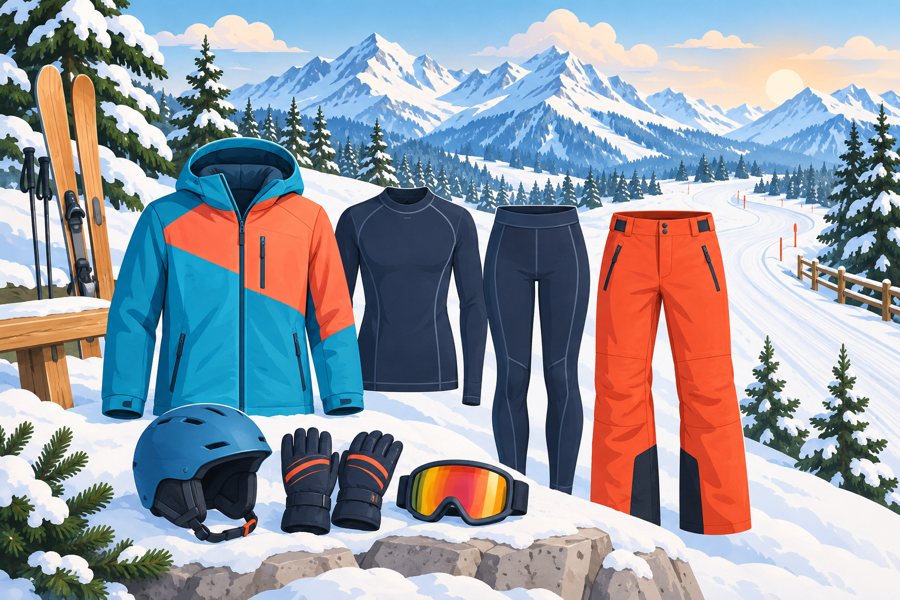 Illustrative, nicht-dokumentarische Darstellung von Skikleidung mit Jacke, Basisschicht, Hose, Handschuhen, Helm und Skibrille; kein bestimmter Ort.
Photo: OpenAI / Max-TD (AI illustration)
Illustrative, nicht-dokumentarische Darstellung von Skikleidung mit Jacke, Basisschicht, Hose, Handschuhen, Helm und Skibrille; kein bestimmter Ort.
Photo: OpenAI / Max-TD (AI illustration)
Key facts
- A base layer wicks moisture away from your skin.
- You can add or remove a warm mid layer depending on the temperature.
- The outer layer should protect you from wind and moisture while still allowing you to move.
- Your jacket and pants should fit comfortably over your layers without pulling or flapping.
- Cotton dries slowly and is often unsuitable in cold, wet conditions.
- Gloves, socks, helmet and ski goggles should all be included when checking the fit of your complete outfit.
Putting together a practical layering system
Start with a close-fitting base layer made from quick-drying performance fabric or suitable wool. It should fit snugly without digging in. Its main purpose is to wick sweat away from your skin. A second layer adds warmth. Fleece, wool or a lightweight insulated jacket may be suitable, depending on the cold and your activity level. When skiing actively, you often need less insulation than during long lift rides and frequent breaks.
The outer layer protects you from wind, snow and rain. Look for zippers that close securely, well-fitting sleeve cuffs and a hem that does not ride up when you lean forward. The National Park Service winter clothing guide offers a simple overview of the three layers and their functions. However, the specific combination still needs to suit your daily routine and local conditions.
Check the fit and freedom of movement
Try on your jacket and pants while doing more than just standing upright. Bend your knees, raise your arms, twist your torso and assume a position as if you were using your poles. The shoulders should not pull, your knees should bend freely and your back should remain covered even when you lean forward. Clothing that is too tight leaves no room for an extra warm layer; clothing that is too loose can catch the wind or snag on the lift or your equipment.
Bring your base layer and a possible mid layer when trying on your clothing. Check that the sleeves and cuffs fit together with your gloves, and that your pants cover your ski boots without obstructing the fasteners. Your hood, helmet and ski goggles should not push one another forward or restrict your field of vision. Pockets should be easy to reach without having to open your jacket wide.
Weather protection, ventilation and materials
Waterproof, water-repellent and windproof describe different properties. A well-protective outer layer makes sense for frequent snowfall and wet conditions. In dry, cold weather, a lighter combination may be more comfortable. Ventilation zippers help release heat when you are skiing actively. However, they do not replace a suitable base layer, since moisture should ideally not remain on your skin in the first place.
Check the seams, zippers, snow skirt and hood. A snow skirt is especially useful in deep snow and if you fall, provided it works with your pants. For children, it is also important that they can operate the fasteners themselves and that too many layers do not restrict their movement. Reflective details can be helpful in poor visibility and in busy areas.
Buying, renting and packing for a ski day
If you are skiing for only a few days, you can rent some of your ski clothing. Check in advance which sizes, layers and accessories are included. If you are buying, try everything on with your helmet, gloves and ski boots. Your clothing should work when sitting, walking, lifting and bending—not just look good in front of a mirror.
Pack a dry base layer, spare socks and, for children, ideally an extra set for longer breaks. Wet clothing should not stay in a closed backpack all day. Lay out wet items to dry as soon as possible. An extra layer is only helpful if it adds warmth without compromising your freedom of movement or moisture wicking.
Care and checks after a day on the slopes
Follow the manufacturer's care instructions and dry your jacket, pants, gloves and boots completely at room temperature. Excessive direct heat can damage coatings, seams, hook-and-loop fasteners or insulation. Before using them again, check the zippers, seams, cuffs and snow skirt. Small repairs are easier to make outside your holiday. Store your clothing dry and loose so it does not remain packed away damp.
FAQ
What layers do I need for skiing?
A functional base layer, a warm mid layer depending on how cold it is, and a protective outer layer are a flexible starting point. Adjust the combination to the weather, your activity and your breaks.
Is cotton suitable for ski clothing?
Cotton absorbs moisture and dries slowly. For cold or wet days on the slopes, quick-drying performance fabrics or suitable wool layers are usually more practical.
How should ski clothing fit?
It should accommodate the layers you plan to wear and not pull when you bend your knees, raise your arms or use your poles. Excessive looseness should not compromise your freedom of movement or protection from the wind.
How important is a waterproof outer layer?
That depends on the weather, type of snow and how long you will be outside. A well-protective outer layer offers clear benefits in wet snow, rain or if you fall frequently.
What should I dress my children in?
Choose several adjustable layers, dry spare items and a well-fitting jacket that allows plenty of freedom of movement. Also check their helmet, gloves, socks and ski boots together.
Can you rent ski clothing?
Yes, depending on the provider, you may be able to rent a jacket, pants or accessories. Check the sizes, condition, included items and whether exchanges are possible in advance.
