
Remüs: Hotels and accommodations
Accommodation in Remüs
At the entrance to Val Sinestra lies the Tschanüff castle ruins, which are among the most impressive ruins in Graubünden. The castle was destroyed several times during wars, rebuilt afterwards, and abandoned in 1780.
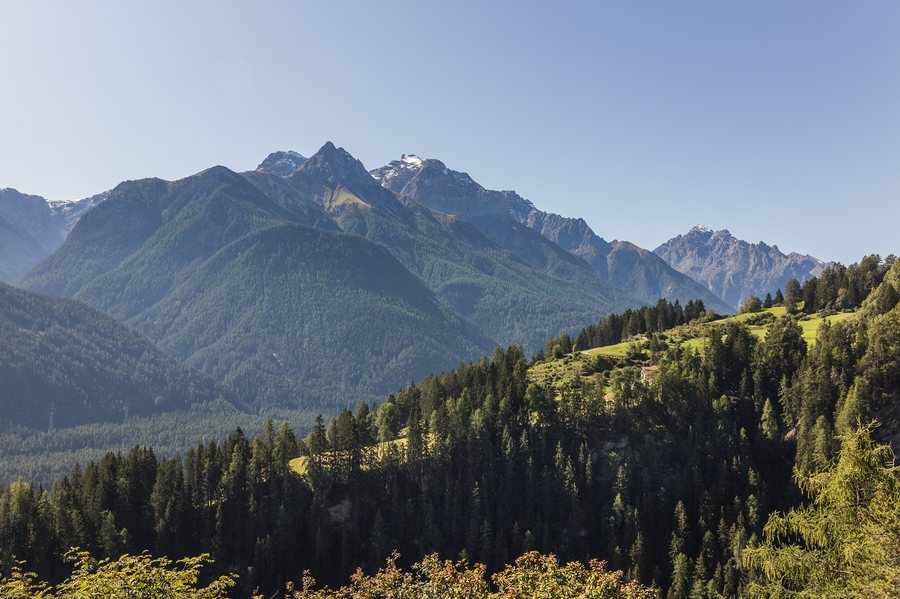 File:Bergtocht van Val Sinestra naar Ramosch 15-09-2019. (actm.) 07.jpg
Photo: Agnes Monkelbaan via Wikimedia Commons, CC BY-SA 4.0
File:Bergtocht van Val Sinestra naar Ramosch 15-09-2019. (actm.) 07.jpg
Photo: Agnes Monkelbaan via Wikimedia Commons, CC BY-SA 4.0
You would like to find a hotel in Remüs.
Culture and history
The Sonch Flurin Church is under cantonal heritage protection and is accessible to the public at all times. Its choir contains a tabernacle built into the left side dating from the pre-Reformation period.
Bronze Age and Iron Age settlements stood on the rocky outcrop of Mottata near Ramosch between 1600 and 400 BC.
Landscape
The historic field terraces continue to shape the landscape of Ramosch today. The area around Ramosch also has drought-influenced, almost steppe-like vegetation that is considered unique in Switzerland.
Routes and connections
The Vnà–Ramosch via veglia route initially leads across open meadows below Vnà and then into the Bos-cha Grischa forest above Ramosch.
The Vnà–Ramosch winter hiking trail leads across the open southern slope through a snow-covered terraced landscape.
The Ramosch–Sent route begins with a steep climb from the village of Ramosch to Motta da Ramosch. It then leads via Vnà, Alp Muranza, Sent and Sur En back to Ramosch.
The Sent–Val Sinestra–Vnà–Ramosch stage connects Ramosch with Vnà and Val Sinestra.
Ramosch is located directly on the Engadine Road H27. PostBus connects Ramosch hourly with Vnà as well as with Scuol and Martina.
For the final four kilometres downhill to Ramosch, it is recommended to bring a sled so that you can travel the route by sled rather than on foot.
To the overarching travel overview: Inn.
More destinations
More places under the same destination:

_07.jpg)