
Pedra – Romanesque Sacred Architecture and Historic Paths
Accommodation in Pedra
Landscape
Pedra lies at an elevation of 1,120 m at the foot of the Serrat dels Gats in the Vall de Pedra. Pedra lies at the foot of the Moixeró limestone massif, which, together with the Serra del Cadí, forms the Cadí-Moixeró Natural Park. The mid- and high-mountain landscape forms part of the geographical setting of Territori Cerdanya 360.
Culture
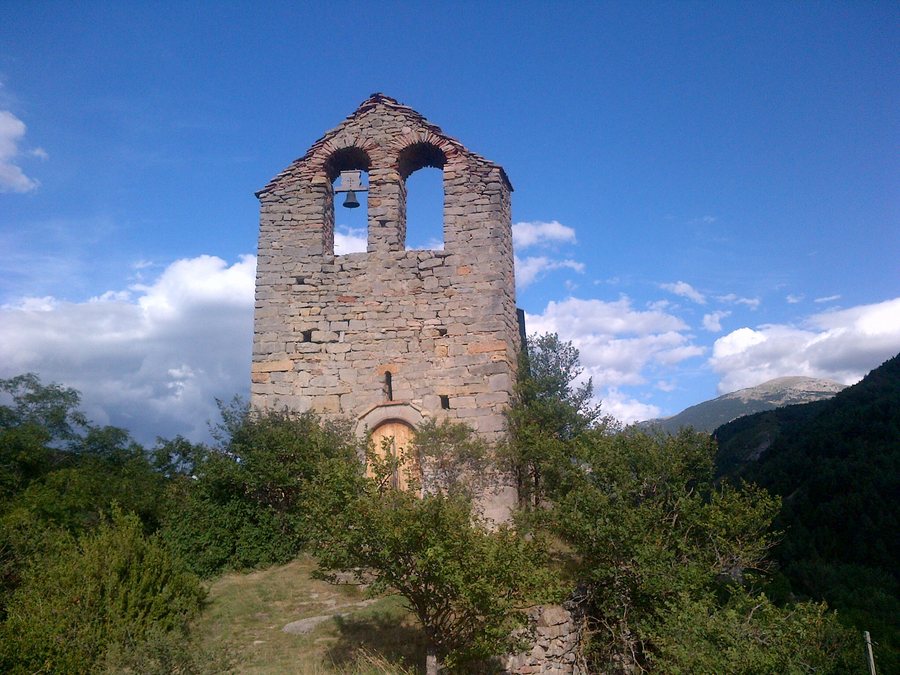
Sant Julià de Pedra stands on a rocky promontory overlooking the Batllia plain. Its trapezoidal floor plan comprises a nave and a semicircular apse; in front of these is a presbyterial space in the form of a transept. The oldest part of Sant Julià de Pedra may have been built at the end of the 10th or the beginning of the 11th century. Within the Cadí-Moixeró Natural Park, Sant Julià de Pedra is one of the examples of Romanesque sacred architecture. Its floor plan, spatial sequence and possible early date of construction are therefore among the church’s defining features.
Routes
The Ruta de l’Obaga includes Sant Julià de Pedra as one of four churches. Pedra is also one of the named stops on municipal Route 21, “Vall de Pi – Bor – Pedra – Baltarga”. Territori Cerdanya 360 is a 178 km circular hiking route through traditional paths, villages, valleys and notable places in a mid- and high-mountain landscape.
The three formats have different focuses: the Ruta de l’Obaga links churches, Route 21 names Pedra as a stop within a municipal sequence, and Territori Cerdanya 360 describes a long circular route. For classification purposes, scope, geographical setting and thematic focus are therefore particularly relevant. A church route, a sequence of stops and an extensive circular hike can be considered separately without equating their routes.
History
The Camí dels Capellans was formerly used by clergy who walked from Bellver to Pedra and Bor. The section between Riu and Bellver is known as the Camí dels Capellans; this path was formerly used by clergy who travelled from Talló to attend Mass in Coborriu, Beders, Bor, Pedra and Riu.
The Ruta de l’Obaga is not recommended for people with reduced mobility because access to the church of Pedra is difficult.
A side path leads from Colomina to Pedra and the Romanesque church of Sant Julià in about ten minutes.
When choosing accommodation for Pedra, you can consider travel dates, room category and cancellation conditions separately. The place combines the Romanesque church, the historic paths mentioned above and several differently structured route formats within a clearly defined thematic framework. In Pedra, you can keep comparing accommodation as a separate step alongside considering the place itself. The church, the former Camí dels Capellans and the three named routes represent different cultural, historical and geographical perspectives. This allows the information to be read separately without conflating their different scales.
For the overarching travel overview: Bellver De Cerdanya.

.jpg)