
Olopte: Natural Areas, Hiking and Historic Architecture
Accommodation in Olopte
If you would like to combine historic architecture, protected landscapes and geological features when planning your trip, Olopte offers a range of themes to explore. Sant Pere d’Olopte, the Tossals d’Isòvol i Olopte, the Esterregalls d’Olopte and the Coves d’Olopte each offer their own impressions, combining history, nature and paths.
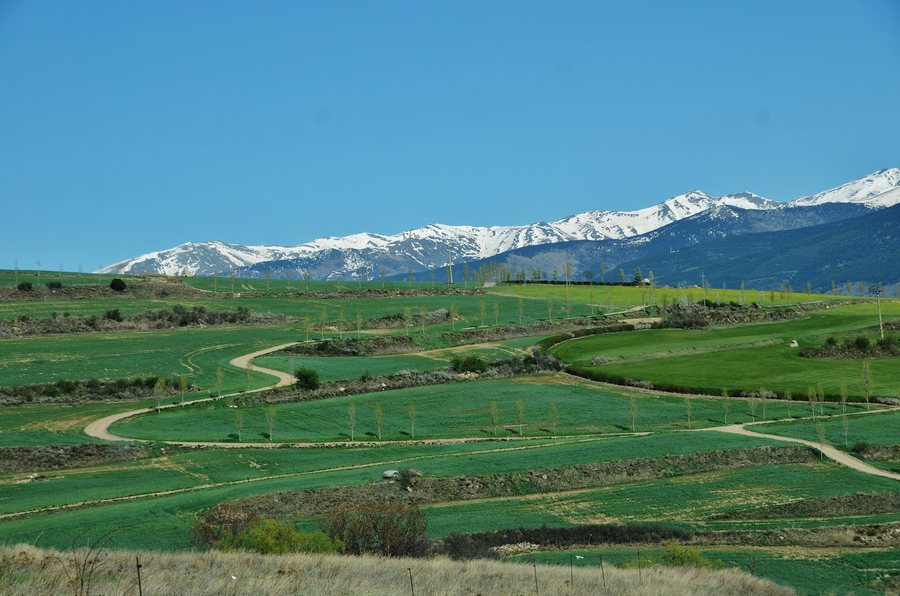 File:Tossals d'Isòvol i Olopte - 7.jpg
Photo: MARIA ROSA FERRE ✿ via Wikimedia Commons, CC BY-SA 2.0
File:Tossals d'Isòvol i Olopte - 7.jpg
Photo: MARIA ROSA FERRE ✿ via Wikimedia Commons, CC BY-SA 2.0
Sant Pere d’Olopte: The church was built between the 12th and 13th centuries.
Portal design: The portal of Sant Pere d’Olopte is decorated with heads and anthropomorphic figures in a seemingly primitive style.
Apse area: The east-facing apse area rests on a base more than three metres high.
Protected natural area: The Tossals d’Isòvol i Olopte are a protected natural area.
Hiking and views: In the natural area, you can go hiking and enjoy good views from a viewpoint in a former quarry for Isòvol’s characteristic pink marble.
Paradolmen: The extension to the Paradolmen del Tossal d’Isòvol can be covered on foot from Olopte.
Circular hike: A circular hike around the Tossal d’Isòvol begins and ends in Olopte. For planning your day, the return route is clear: a circular path leads back to Olopte, while the extension is an additional section starting from the village.
Flora and geological formations
The Tossals d’Isòvol i Olopte are home to plant species that are very rare in Catalonia. They are also inhabited by endemic cave-dwelling invertebrates. The natural area is therefore intended not only for people who want to admire the landscape while hiking, but also for visitors interested in special habitats and their biological characteristics.
The Esterregalls d’Olopte form a small badlands outcrop consisting of conglomerates and dark-coloured clayey sediments. Geologically, they are particularly significant for sedimentology and geomorphology. The different rock and sediment formations give the landscape its own character and complement the natural-history perspective with a clear geological focus. During a stay in Olopte, observing the Esterregalls on site can be combined with geological questions about the sediments and landforms of the small outcrop.
Caves and accessibility
The Coves d’Olopte are not easy to access. If you take this aspect into account in your planning, you should therefore not equate the caves with an ordinary walk. Accessibility is a separate decision criterion alongside the historical and natural-history topics associated with the caves.
The Coves d’Olopte are considered prehistoric dwellings on the eastern slope of Montcurto. Montcurto is also known as Tossal d’Olopte. Cova B d’Olopte has a distinctive form: it has two entrances that join after a few metres to form a low gallery.
Historical traces near Olopte
The Força d’Olopte was probably located on the hill next to the church; almost no remains have survived. Those interested in historical traces will therefore not encounter a fully preserved complex here, but rather a presumed location with only a few remaining traces. This combination of a well-documented church and a fortification history that must be interpreted with caution shapes the historical view of Olopte.
For the overarching travel overview: Isòvol.

