
Szklarska Poręba: Waterfall, Gorge and Culture
Accommodation in Szklarska Poręba
Szklarska Poręba offers several clearly distinct themes: Wodospad Kamieńczyka with its gorge and cave, institutions devoted to local history and geology, and attractions focused on nature and art. Consider whether landscape, culture or geological history will shape your stay most. Each of the institutions mentioned offers a different focus.
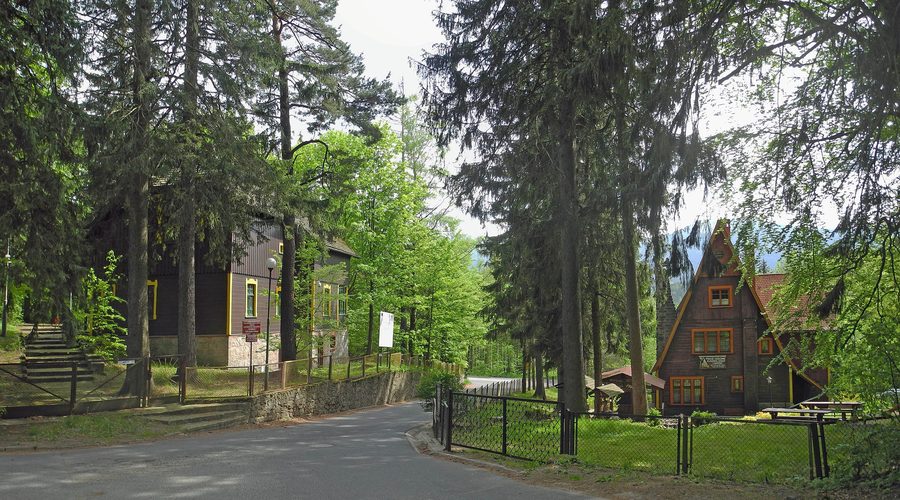 Historische Villen an der Muzealna-Straße in Szklarska Poręba.
Photo: SchiDD via Wikimedia Commons, CC BY-SA 4.0
Waterfall, Gorge and Cave
Wodospad Kamieńczyka is the highest waterfall in the Polish Giant Mountains. Its lip lies at 843 m above sea level; the water plunges into the Wąwóz Kamieńczyka gorge in a three-tier cascade 27 m high. The two elevation figures describe different measurements: 843 m is the elevation of the lip, while 27 m is the height of the cascade. This distinguishes the waterfall’s elevation from the height of its drop.
Wąwóz Kamieńczyka is about 100 m long. Its vertical rock walls are over 25 m high, and in some places the gorge is no more than 4 m wide. The length, wall height and narrowness of individual sections describe different aspects of the terrain. Together, they give a concrete impression of the compact rocky landscape without confusing the measurements.
Behind the middle cascade lies “Złota Jama,” a cave partly excavated artificially by the Walloons, with pegmatite and amethyst deposits. The cave links a specific mineral theme with the tiered waterfall landscape: its position behind the middle cascade and the named rock deposits are different aspects of this place. This adds a geological detail to the measurements of the waterfall and gorge.
Local History, Geology and Nature
The Muzeum Karkonoskie – Dom Carla i Gerharta Hauptmannów presents local history and the Szklarska Poręba artists’ colony. Two cultural and historical perspectives are brought together here: local history and the artists’ colony. This focus differs from the waterfall landscape as well as from the geological themes of the other museums.
The Muzeum Mineralogiczne and the Muzeum Ziemi JUNA present geology, including minerals and fossils from around the world. Both therefore focus on geology. Compared with the Muzeum Karkonoskie, the difference is in the subject matter: geology, minerals and fossils take center stage here, while the other museum focuses on local history and the artists’ colony.
The Centrum Edukacyjne KPN presents the natural environment of Karkonoski Park Narodowy and Góry Izerskie. This adds a natural-history perspective alongside geology, encompassing both named areas. The Sudeckie Centrum Kultury i Sztuki presents art, adding another cultural dimension. When planning a stay around your interests, you can choose among different focuses: landscape, local history, geology, nature and art.
Glassware at Leśna Huta
Leśna Huta has a shop selling glassware made on site. If you are looking for a particular glass product, ask about the current selection in advance, as the range may change.
Discover more destinations: Bukowiec, Karpacz, Zachełmie, Sosnówka K Jeleniej Góry, Przesieka, Kopaniec, Staniszów, Marczyce.
Return to the broader travel overview: Jeleniogórski.

