
Armeno: Churches, Walking Trails and Local History
Accommodation in Armeno
Armeno between Romanesque Architecture and Local History
The parish church of Santa Maria Assunta dates from the 12th century and was built over the remains of an ancient Roman temple. The interior is Romanesque in style up to the altar, divided into three naves, and features medieval capitals carved with depictions of animals. The term “Romanesque” refers to a medieval architectural style; three naves are a division of the church interior. The parish church houses Fermo Stella da Caravaggio’s painting “Deposizione della Croce” from 1548. The church is located at the entrance to Armeno on Viale Cadorna and borders a parking lot.
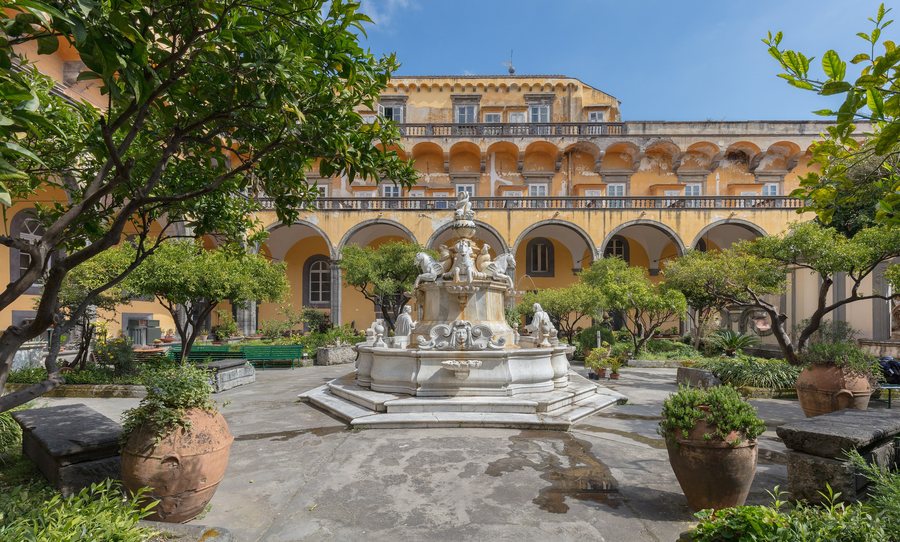 File:Claustro de San Gregorio Armeno, Nápoles, Italia, 2023-03-25, DD 97.jpg
Photo: Diego Delso via Wikimedia Commons, CC BY-SA 4.0
File:Claustro de San Gregorio Armeno, Nápoles, Italia, 2023-03-25, DD 97.jpg
Photo: Diego Delso via Wikimedia Commons, CC BY-SA 4.0
Walking Trails with Clearly Defined Highlights
Gli anelli di Armeno comprises a network of seven circular walking trails. On a circular trail, the distance given describes the entire route; elevation gain indicates the ascent, while the duration provides a time estimate. The Anello Prati circular trail is 4.3 kilometres long, has 70 metres of elevation gain and has a stated duration of 1 hour and 30 minutes. The Anello Prati circular trail leads from the town centre through the meadows along the Agogna stream and past the “Bontà” and the fitness trail. The Anello Falò circular trail offers a short detour to Monte Falò with a 360-degree panoramic view.
Sovazza, Coiromonte and Chéggino
The hamlet of Sovazza in Armeno is located on a ridge above the valley of the Agogna River. A ridge is an elongated elevation in the terrain. The Chiesa di Santa Cecilia in Sovazza was founded in 1602. The church square in Coiromonte offers a broad panoramic view; a panoramic view means an expansive vista. An easy path leads through the charming village of Chéggino, offers panoramic views of Lake Orta and descends to Bàssola by the church.
The Santuario di Luciago
The Santuario di Luciago, dedicated to the Nativity of the Virgin Mary, became a local destination for religious devotion; numerous votive offerings hang on the walls of its naves. Votive offerings are religious gifts placed at a shrine. The old chapel of the Santuario di Luciago contained a fresco from 1520. It depicts Christ crucified with Our Lady of Sorrows and Saint John the Evangelist. A solemn procession took place on 8 September. It was subsequently decided to build a small church near Mazzarone and to rebuild the existing old chapel halfway between Armeno and Mottarone.
Memories of the Alberghieri
The Museo degli Alberghieri displays work tools, photographs, written documents, menus, rare cookbooks and old newspapers. The Museo degli Alberghieri also explores the past four centuries, during which thousands of people left this area of Cusiana to work in kitchens, hotels and restaurants around the world. Work tools and written documents show different aspects of the same subject area; menus, cookbooks and newspapers complement the collection with tangible traces of everyday and professional life.
Further places for your travel planning: Pettenasco, Lesa, Orta San Giulio, Massino Visconti, Pella, Miasino.
To the higher-level travel overview: Novara.

