
San Bernardino Verbano: Nature, Trails and Cultural Heritage
Accommodation in San Bernardino Verbano
Natural Areas and Trails
A large part of the San Bernardino Verbano area lies within Val Grande National Park. The Corte Buè da Ompio route passes through extensive beech forests and stands of birch that are recolonizing abandoned pastures.
The “L'uomo-albero” nature trail leads from Ompio to the summit of Monte Faiè. The nature trail has nine information panels and 20 numbered observation markers. The route offers exceptional views of Lago di Mergozzo and large parts of Lago Maggiore. For personal planning, this nature trail can be divided into several individual sections based on its fixed stations all the way to the summit.
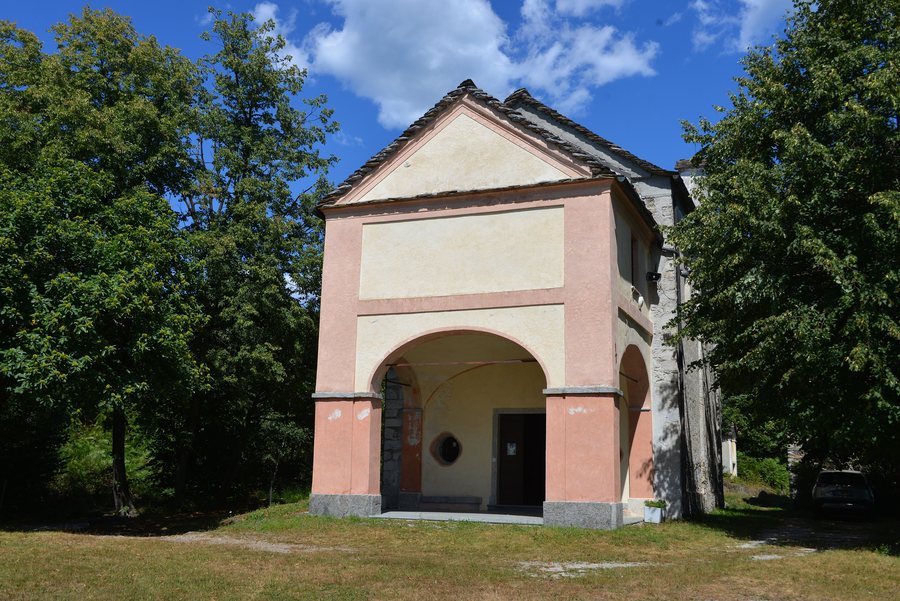 File:Madonna del Patrocinio San Bernardino Verbano.jpg
Photo: Civvì via Wikimedia Commons, CC BY-SA 4.0
File:Madonna del Patrocinio San Bernardino Verbano.jpg
Photo: Civvì via Wikimedia Commons, CC BY-SA 4.0
The Via Ferrata Selvaggio Verde is an 11 km route with an elevation gain of 417 m. The route connects In la Piana along the gorge of the Rio Val Grande with Ponte Velina. The two named points define the route geographically and help distinguish the start and end of the connection. On the Via Ferrata Selvaggio Verde, you can therefore consciously consider the route length and ascent separately.
Churches and Rural Buildings
The 18th-century Chiesa Parrocchiale della Purificazione di Maria in Bieno was built over an earlier Romanesque church. An inscription plaque from Roman times is set into the façade of the Chiesa Parrocchiale della Purificazione di Maria. The Romanesque bell tower of the Chiesa Parrocchiale della Purificazione di Maria is considered unique in the surrounding area from a typological perspective.
Dry-stone walls support the mule tracks in the mountain hamlets of San Bernardino Verbano. Rural buildings characterize the alpine pastures and historic village centers of San Bernardino Verbano. The Santuario della Madonna del Patrocinio, also known as Santa Maria del Calcare, stands along the old mule track that led from Bieno and Santino to the alpine pastures of Ompio. The Santuario della Madonna del Patrocinio was built at the beginning of the 18th century.
The Chiesa Parrocchiale di San Gaudenzio in Rovegro dates from the 16th or 17th century and was renovated and extended in the 19th century. The Chiesa Parrocchiale di Sant'Antonio Abate is the only three-aisled church in the area. The Oratorio di Sant'Antonio da Padova in Bieno is a rural oratory from the late 17th or early 18th century. In Rovegro, a house known as the “casa del castellano,” dating from 1553, has been preserved.
A bridge known as the “ponte romano” crosses the San Bernardino stream along the mule track between Rovegro and Cossogno. Thus, in addition to churches and oratories, paths, bridges, dry-stone walls and rural buildings are also among the named features around San Bernardino Verbano.
Getting There
The Intra–San Bernardino Verbano line stops at the S.P. n.61 – Via Fondotoce stop. Verbania–Fondotoce railway station is 6 km from San Bernardino Verbano.
More destinations: Oggebbio, Domodossola, Cavaglio-Spoccia, Formazza, Baceno, Masera, Brovello-Carpugnino, Bracchio
To the higher-level travel overview: Verbano-Cusio-Ossola.

