
Marsico Nuovo: Natural Environment, Cultural Heritage and Trails
Accommodation in Marsico Nuovo
Those looking for a ski hotel or other accommodation for a skiing holiday in Marsico Nuovo can understand the town through its elevation, the Fontana delle Brecce–Piana del Lago natural area and an unusually rich cultural heritage. Marsico Nuovo lies on the western side of the upper Agri Valley at an altitude of 865 metres. For your planning, routes through woodland landscapes combine here with churches, historic building complexes, sacred art and a historical food-and-wine tour.
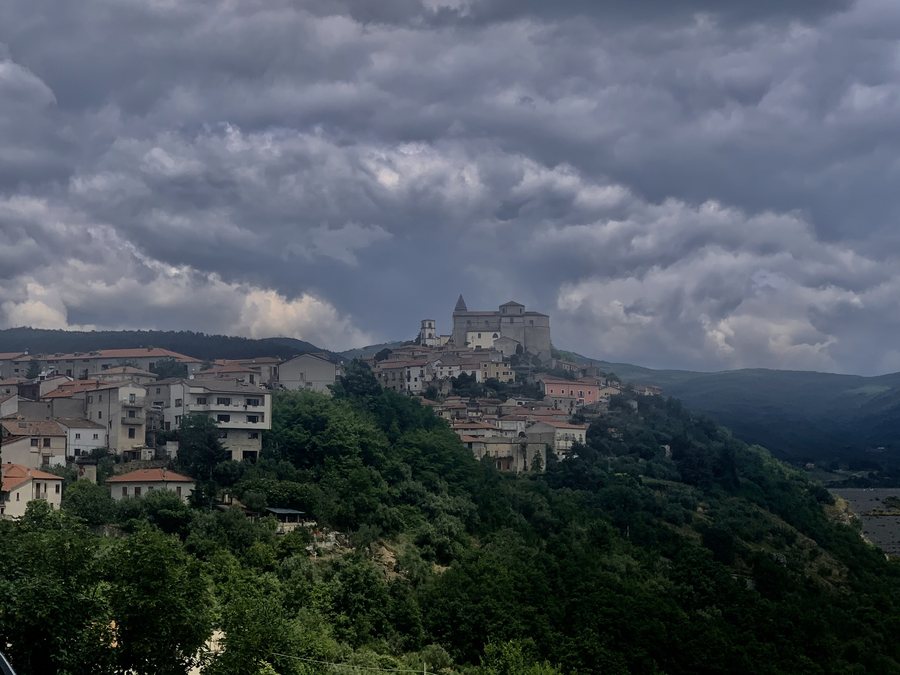 File:Panorama di Marsico Nuovo scattato dal Monastero.jpg
Photo: Lida arena via Wikimedia Commons, CC BY-SA 4.0
File:Panorama di Marsico Nuovo scattato dal Monastero.jpg
Photo: Lida arena via Wikimedia Commons, CC BY-SA 4.0
Fontana delle Brecce–Piana del Lago Natural Area
The Fontana delle Brecce–Piana del Lago natural complex lies within the Appennino Lucano Val d’Agri Lagonegrese National Park. The area features beech and downy oak forests, springs and seasonally flowing streams. This means that the focus is not merely on elevation, but on a landscape with different natural structures that can be clearly distinguished when planning your day.
Fontana delle Brecce–Piana del Lago is suitable for hiking, cycle tourism and trekking. From the Rifugio Fontana delle Brecce, a path approximately two kilometres long leads through the woodland to a wooden bridge reserved exclusively for pedestrians, which is connected to the village of Piana del Lago.
Piana del Lago has a body of water fed by local springs, as well as drainage channels resembling streams. There is also an approximately 1,000-metre-long level circuit suitable for sporting activities throughout the year. The different types of routes are of interest to visitors who want to choose between a woodland connection and a level circuit, or who want to incorporate nature and sporting activities into their stay.
Churches and Sacred Art
The Chiesa di San Gianuario features Corinthian-style columns on its stone portal. The bas-relief depicts medieval bishops and abbots; the work has been declared a national monument. The same church also houses a medieval fresco from the Chiesa di San Francesco, considered one of the oldest paintings in the area.
The Chiesa della Madonna del Carmine is attached to the Monastero di San Tommaso di Canterbury and dates from the 13th to the 14th century. The church houses a 14th-century wooden sculpture of the Madonna and Child, attributed to Giovanni di Nola.
The Chiesa di San Giorgio e San Gianuario replaced the former cathedral of San Michele Arcangelo. In 1131, Bishop Enrico and Count Goffredo Guarna had a new cathedral built at the current site in Romanesque forms.
Palazzo Manzoni and the Museo di arte sacra
The Palazzo Manzoni building complex was originally founded in 1179 by Guglielmo III Guarna as an Augustinian monastery and was later converted by Ruggero Sanseverino into a Benedictine nuns’ monastery. The monumental complex covers approximately 7,000 square metres and includes courtyards, pathways and structural remains surrounded by imposing stone walls. Anyone interested in historic monastic complexes and the transformation of religious buildings will find an extensive architectural setting here.
The Museo di arte sacra preserves and exhibits religious artworks and sacred objects of historical and artistic value. Together with the churches and Palazzo Manzoni, it forms a cultural programme distinct from the nature activities around Fontana delle Brecce–Piana del Lago.
Springs, Milestones and Cave System
Near the Fonte di San Giovanni, two milestones from the time of Diocletian and several funerary stelae dating from the 3rd century AD were found. In the Middle Ages, the same spring supplied water to the nearby Rocchetta of the Sanseverino counts.
The Grotta di Castel di Lepre is considered the longest cave system in Basilicata and extends for almost two kilometres into the mountain.
Historical Tour in the Old District
The Passeggiate nella Storia takes place every year in the second half of August in the old Civita district as a historical food-and-wine tour. The 2025 edition was the 25th edition and commemorated the visit of Saint Thomas Aquinas to Teodora.
The Passeggiata nella Storia Marsico Medievale featured medieval scenes and old inns serving traditional dishes.
For comparison with other towns, you can also see Pignola and Viggiano.
For the higher-level travel overview: Potenza.

