
Scanzano between the Castello, churches and hiking trails
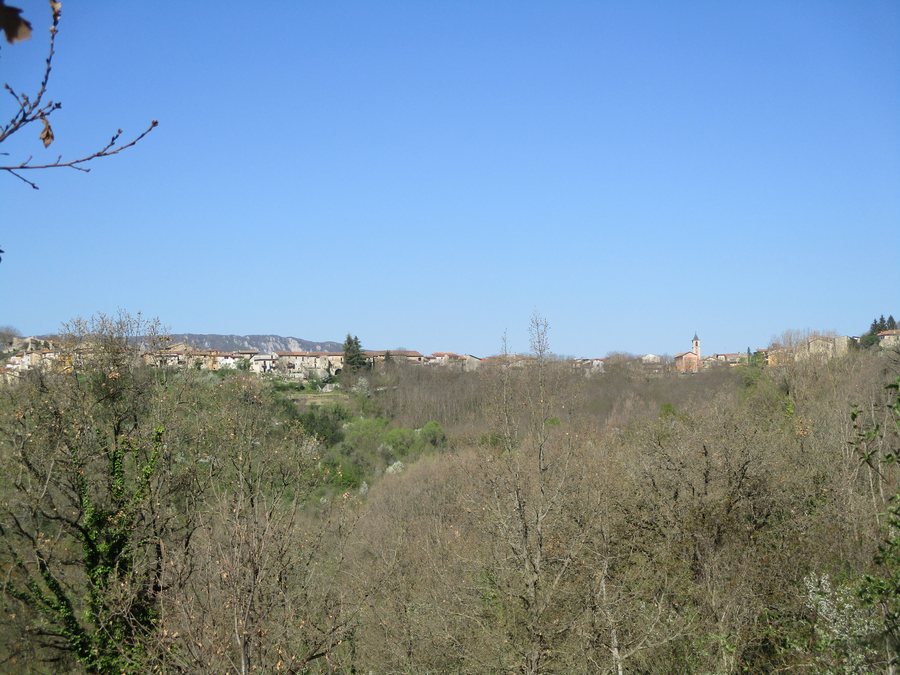 File:Scanzano di Sante Marie - Marsica.jpg
Photo: Marica Massaro via Wikimedia Commons, CC BY-SA 4.0
File:Scanzano di Sante Marie - Marsica.jpg
Photo: Marica Massaro via Wikimedia Commons, CC BY-SA 4.0
Anyone looking for accommodation in Scanzano can organize their stay around several clearly distinguishable themes: sacred sites, the building known as the “Castello,” a far-reaching viewpoint, archaeological traces and the hiking trails of the Grande Cammino della Brigantessa. The individual destinations and route connections are not all located in the same place. For planning purposes, it is therefore worth distinguishing between the town center, the slopes of Monte Faito and the pilgrimage destination located somewhat outside the town.
Churches and religious traditions
The Chiesa di Santa Maria, located somewhat outside Scanzano, is a pilgrimage destination during the pilgrimage tradition known as “le passate.” The period runs from August 14 at 5:00 p.m. until August 15 at 6:00 p.m. This precise timing makes the church particularly interesting for visitors who wish to combine their stay with a religious custom and a fixed date.
The parish church of Scanzano houses a wooden statue of Saint Athanasius. The work was created by Salvatore Conti from Sulmona. The church thus contains a specific artistic object that fits into an exploration of the town’s religious and artisanal traditions. For your tour, this offers a different focus from the pilgrimage to the Chiesa di Santa Maria.
The Castello of Scanzano
The “Castello” of Scanzano stands at an altitude of 925 meters at the southern tip of the long ridge on which the village of Scanzano is situated. Its location is therefore closely linked to the shape of the settlement site. Anyone interested in the town’s structure can use this building to see how clearly the location on an elongated mountain ridge is reflected in Scanzano’s layout.
The “Castello” is also Scanzano’s most important viewpoint. From there, the 360-degree view extends across large parts of the municipal area of Sante Marie and over a substantial part of the neighboring municipality of Tagliacozzo. To the southwest, the wooded Simbruini mountains limit the view; on the opposite side, the ridge of Monte Faito forms the natural boundary. These different landscapes give the viewpoint its distinctive spatial orientation.
The building’s historical period can also be defined more precisely. Based on their technical characteristics, the oldest masonry phases of the Castello di Scanzano are generally dated to the 13th and 14th centuries. They therefore mostly belong to the period after the Normans and after the Catalogus Baronum. For visitors interested in cultural history, this creates a chronological link between the visible building fabric and the area’s older systems of rule.
Church architecture and archaeological traces
The Chiesa S.S. Cipriano e Giustina was built after the 1915 earthquake. Architectural elements from other old churches were used, among other things, in its design. Those churches had collapsed or were no longer in use. The building thus combines a church constructed after the earthquake with older architectural components whose original buildings had not survived or had fallen out of use.
The interior of the Chiesa S.S. Cipriano e Giustina is particularly defined by three Renaissance stone portals. They correspond to the church’s three naves and give the building a clearly recognizable architectural structure. This connection between the portals and the naves is a distinct point of interest alongside the building’s history.
The archaeological area known as Area Archeologica extends along the southern slope of Monte Faito between Scanzano and Santo Stefano. Its location complements the buildings in the town with an area on the slope characterized by a different setting. If you would like to organize your stay thematically, the Area Archeologica can therefore be regarded as a separate destination between Scanzano and Santo Stefano.
The Palazzo Ducale, a palace, is located in the vicinity of Scanzano. It adds another type of building to the range of noteworthy structures. Together with the churches and the Castello, it creates a selection of different historical sites, without suggesting that these destinations form a single building complex.
Hiking routes around Scanzano
Scanzano is the endpoint of the third stage of the Grande Cammino della Brigantessa. The stage ends in the town center after a steep descent. For hikers, this route is particularly straightforward to classify: the village is not merely a section of the route, but the conclusion of this third stage after the descent described.
From the town center, the Grande Cammino della Brigantessa initially follows the Cammino dei Briganti for approximately 1 kilometer. It then continues downhill on a comfortable path toward San Donato. The route therefore consists of two distinct sections: first, the shared course with the Cammino dei Briganti, followed by the downhill path to San Donato. The approximate length of the first section remains about 1 kilometer.
Scanzano and Sante Marie in historical connection
In the Catalogo dei Baroni commissioned in 1187 by Guglielmo II il Buono, Scanzano and Sante Marie are linked together with the fief of the De Pontibus family; the family had granted both places as a fief to Giovanni Duca. The Catalogo dei Baroni commissioned by Guglielmo II il Buono forms part of this historical context. This connection places Scanzano within a history in which the town is considered together with Sante Marie rather than in isolation.
For your further selection of destinations, you can also compare Fontecchio, Pacentro, Pescocostanzo, Cappadocia, Rocca Di Cambio, Barrea, Castel Di Sangro and Opi.
To the main travel overview: L-Aquila.
Check prices, availability and amenities for your travel dates directly on Booking.com.
View accommodation and offersAdvertisement · Affiliate link to Booking.com
