
Pacentro: Mountain Sports, Culture and Living Tradition
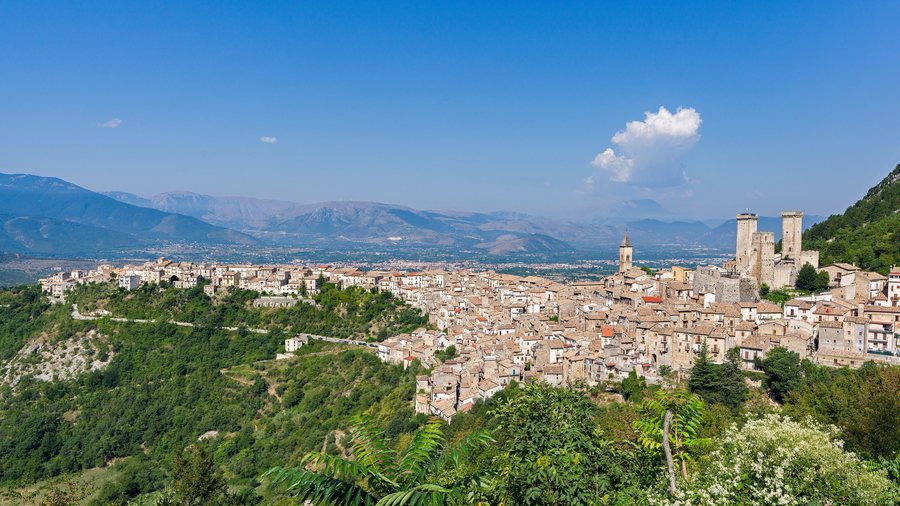 File:Pacentro - Veduta dalla strada per Campo di Giove.jpg
Photo: Gianluca Pirro via Wikimedia Commons, CC BY-SA 4.0
File:Pacentro - Veduta dalla strada per Campo di Giove.jpg
Photo: Gianluca Pirro via Wikimedia Commons, CC BY-SA 4.0
For your planning, Pacentro combines mountain sports opportunities with a historic setting. The slopes at Passo San Leonardo are suitable for cross-country skiing and ski mountaineering; at the same time, trails lead through beech forests and to the summit meadows of the Morrone. In the town itself, castles, churches, museums, traditional events and local specialities shape the landscape.
Mountain sports and trails around Passo San Leonardo
Passo San Leonardo is a mountain pass at an altitude of 1,282 metres. It separates the Valle dell'Orta in the Pescara area from the Sulmona side of the Majella. The slopes around the pass are suitable for cross-country skiing and ski mountaineering.
Hikes to Monte Morrone and Monte Amaro can begin at Passo San Leonardo. The Q5 hiking trail starts in Pacentro on the S.S. 487 at an altitude of 850 metres and ends at Mandra Castrata at 1,725 metres, at the junction with trail Q6. It passes through various types of landscape, from beech forests to the summit meadows of the Morrone.
Castles, churches and traces of local history
Castello Caldoresco is one of the best-preserved fortifications in Abruzzo. Its first historical references appear in the Chronicon Casauriense from the 11th century. I canaje, an old public washhouse, is located near the castle. The town's historic features also include la preta tonna, also known as pietra dello scandalo, a large hollowed-out stone. It was once used as a measure for a tomolo of grain; one tomolo corresponded to 56 litres.
Several churches add buildings from different periods to the townscape. The Chiesa della Madonna di Loreto dates from the late 16th century. Its history is closely linked to the Corsa degli Zingari. The Chiesa di San Marco was built in the late 17th century and preserves an old fresco of the Madonna dei Sette Dolori. The rural Chiesa della Madonna degli Angeli was probably built towards the end of the 16th century.
The Chiesa di San Marcello dates back even further: it was founded in 1047 and rebuilt and reopened after a fire in 1166. The entrance to Palazzo La Rocca has served as a museum area since 2015. The museum displays a Franciscan nativity scene by the artist Peppino Avolio.
The rock paintings of Balze del Morrone consist of ochre-coloured figures on a narrow rock ledge at an altitude of 680 metres.
Traditions and events throughout the year
The Corsa degli Zingari takes place in Pacentro every year on the first Sunday in September. Its roots lie in the customs and myths of the Peligni; later, it became associated with the Christian cult of the Madonna di Loreto. I CALDORESCHI nell'Anno del Signore 1450 is a six-day historical re-enactment in Pacentro that presents scenes of medieval customs during the third week of August.
The 2018 edition of Pacentro's living nativity scene also led through the town's narrow streets to the area next to Castello Caldoresco. This edition featured craft workshops and venues where typical products such as chestnuts, sweets, pizzas and gnocchi could be sampled.
Pacentro's Christmas market takes place until mid-December. Stalls belonging to local artists and craftspeople can also be found at historic house entrances, in alleyways and on squares.
Regional cuisine and pastoral connections
The gastronomic event Pecure allu cutture took place in Pacentro in 2024 and revived the town's historic connection with pastoral activities and mountain landscapes.
To compare other destinations, you can also view Rocca Di Cambio, Ovindoli, Pescasseroli, Cansano, Cappadocia, Castel Di Sangro, Scanzano and Pettorano Sul Gizio as well.
For the overview of the wider area: L-Aquila.
Check prices, availability and amenities for your travel dates directly on Booking.com.
View accommodation and offersAdvertisement · Affiliate link to Booking.com
