
Bács-Kiskun: Archaeology, Lace and Nature
Accommodation in Bács-Kiskun
Bács-Kiskun can be explored through a range of visitor interests: Bronze Age archaeology in Tiszaalpár, Halas lace, nature trails and landscapes around Lake Szelid, and visitor facilities in Kecskemét. When choosing where to stay, it helps to first decide which experiences matter most to you. The places offer different kinds of experiences: some provide insights into history and crafts, while others introduce you to bodies of water, nature or protected areas.
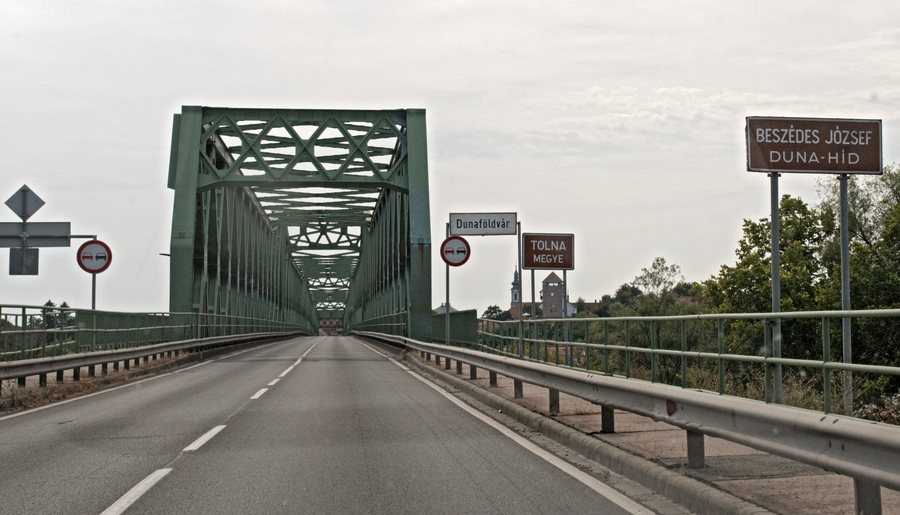 Beszédes József bridge across the Danube at Solt
Photo: Rik Schuiling / TropCrop-TCS via Source, CC BY-SA 4.0
Archaeology in Tiszaalpár
The Tiszaalpár, Földvár nature trail explores the history of the Bronze Age fortified settlement of Tiszaalpári Földvár and the way of life of people in the Bronze Age. Its focus therefore extends beyond the site itself to the question of how people lived in that period. Tiszaalpári Földvár is a specially protected archaeological site in Bács-Kiskun; this designation was made under Regulation 3/2003. (I. 25.) NKÖM. If you consider historic sites by their subject and protection status, you can look at these two aspects together.
Another archaeological display in Tiszaalpár is a reconstruction of an Árpád-era village, built to mark the millennium. It represents the settlement layout discovered during local excavations. This distinguishes it chronologically and thematically from the Bronze Age nature trail: here, the focus is on an Árpád-era settlement type. This makes it possible to distinguish between two different historical contexts without treating the fortified settlement and reconstructed village layout as the same thing.
Halas Lace: History and Craft
At the Kiskunhalasi Csipkeház and Csipkemúzeum, visitors can learn about the history of Halas lace, which began in 1902, admire lacework dating back centuries and see the lace embroidery process. The Csipkeház was established as a workplace for lace embroiderers to preserve the patterns, designs and traditions of the world-famous Halas lace. These different perspectives—the beginning of its history, older lacework and the embroidery process—bring together craft as historical development, visible work and technique. If you are interested in textile crafts, you can explore all these aspects at the Csipkeház and Csipkemúzeum.
Nature Trails and Landscapes
The Boróka nature trail in Bugac is 1,100 metres long and features information boards and activity stations such as a forest xylophone and a play telescope. Its length gives you a useful guide for planning your route, while the stations complement the information boards with engaging experiences. At Lake Szelid, by contrast, the lake itself is the main focus. It is a natural oxbow lake that developed from a branch of the Danube after the Ice Age. The lake’s blue-green algae nature trail has twelve information stations covering the lake’s development, the properties of its water, the organisms living in it and the wildlife in the surrounding area.
The blue-green algae nature trail is accessible on foot and by bicycle year-round, although local conditions may change. Check current local information before your visit. The two trails differ in both their approach and their subject: Bugac features activity stations such as a forest xylophone and a play telescope, while the twelve stations at Lake Szelid explore the lake, its water and its living organisms. This lets you choose according to your interest in nature-based activities or the development of a body of water.
Visitor Information and Museum
The Pásztormúzeum can be reached on foot from the Puszta Kapuja Information Centre via a dirt track; it is about 1.5 kilometres away. If you plan to walk to the museum, take both the approximate distance and the type of route into account.
The Természet Háza in Kecskemét is the visitor centre of Kiskunság National Park. There, you can get information about the national park’s nature trails, visiting conditions for protected areas, ecotourism programmes and forest schools. It provides guidance on a range of nature and protected-area topics. The Cifrapalota currently serves as an exhibition venue for the Kecskeméti Katona József Museum. In Kecskemét, you can therefore choose between different interests: information about the national park and protected areas at the visitor centre, or museum exhibitions at the Cifrapalota.
Discover more destinations: Kalocsa, Pest, Tolna, Baranya, Heves, Fejér, Komárom-Esztergom, Szabolcs-Szatmár-Bereg
Back to the main travel overview: Hungary.

