
Friedersdorf: Nature Park Trail and Weaving History
Accommodation in Friedersdorf
Friedersdorf combines a nature park trail, an opportunity to observe wildlife, and a local history dating back to the Middle Ages. The Thuringian Herb Garden Nature Park Trail runs through the village, past the wildlife enclosure and down to Waldgut Ölschröte. Friedersdorf’s weaving tradition and the historic Erfurt–Nuremberg trade route also offer insights into the village’s past. Großbreitenbach has its own historical connection in St. Trinity Church.
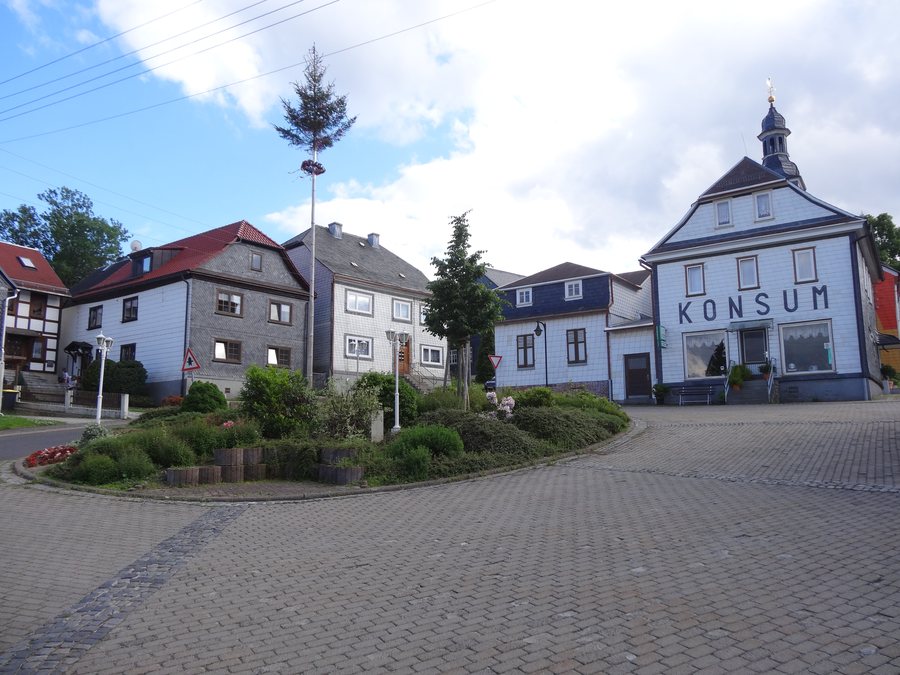
Along the Nature Park Trail
The Thuringian Herb Garden Nature Park Trail runs through Friedersdorf. Along the way, it passes the wildlife enclosure and leads down to Waldgut Ölschröte. This makes the sequence of the two local points of interest clear: first the route passes the enclosure, then it descends to the estate. Wildlife can be observed in the enclosure. There is also a covered seating area at the entrance to the village, where hikers can rest and have a picnic.
These are distinct points of reference to help you find your way: the trail describes a sequence of stops, while the seating area at the village entrance marks a separate place to rest. This makes it easy to distinguish the route description from the question of where you can take a break and have a picnic. The Nature Park Trail and the chance to observe wildlife give your stay a tangible connection to the surroundings of Friedersdorf.
Weaving Tradition and Local History
Friedersdorf was first mentioned in official records in 1370. The historic Erfurt–Nuremberg trade route also passed through the village. Because of its many weavers, Friedersdorf was given the nickname “Little Nuremberg.” The nickname refers to the weavers; the trade route is another, separate historical connection. Together, these details offer different perspectives on the village’s past: its first mention in official records, the trade route, and local craftsmanship.
Frauentag and Halloween are also celebrated in Friedersdorf. These occasions complement the historical themes with local celebrations. The history of Ölschröte also includes its former use as an inn and a children’s holiday camp: it served these purposes for many years. The name Ölschröte thus appears both in connection with the trail’s descent to the estate and in the context of its former use.
A Separate Historical Connection in Großbreitenbach
Großbreitenbach has its own historical connection in St. Trinity Church, distinct from the village of Friedersdorf. The church has 600 seats and is the largest half-timbered church in Thuringia. Construction began in 1679 as a replacement for the dilapidated St. John’s Church. Built in 1570, it collapsed in 1771, with only its church tower remaining. The plans for the new building were drawn up by Andreas Rudolphi, the Saxon-Gotha state master builder; the church was consecrated in 1690. It is entirely clad in slate. A striking hexagonal roof turret sits atop the steep roof of the broad nave. The wooden baptismal font dates from 1677 and was transferred from the old St. John’s Church. Its date predates the start of construction on the new church: it links the older church building with the later replacement.
Discover more destinations: Gehlberg, Gehren, Gräfenroda, Frauenwald, Altenfeld, Großbreitenbach, Geschwenda, Stützerbach.
See the overview of destinations in the wider area: Ilm District.

