
Discover Schmerbach
Accommodation in Schmerbach
Schmerbach offers several distinct points of interest to consider when planning a trip: the Fountain Festival on Whit Sunday, the Charcoal-Burners’ Festival in the first week of July, the old running fountains throughout the town, and Regional Route 2, “Am Großen Inselsberg,” which passes through the town. The festivals represent different local traditions; the fountains and the design of public spaces reveal another side of Schmerbach.
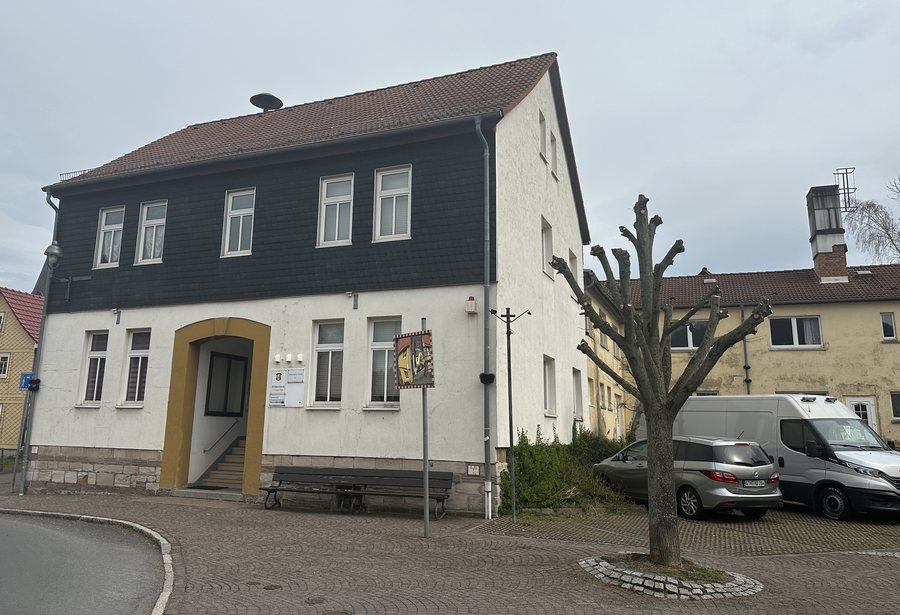 File:Kulturhaus Schmerbach 36599.JPG
Photo: Michael Wolf ( Webseite ) via Wikimedia Commons, CC BY-SA 3.0
File:Kulturhaus Schmerbach 36599.JPG
Photo: Michael Wolf ( Webseite ) via Wikimedia Commons, CC BY-SA 3.0
Festivals rooted in local history
The Fountain Festival takes place every year on Whit Sunday. It commemorates the replacement of the wooden troughs at the public fountains with stone ones in 1861. In this way, the festival day links a recurring tradition with a specific change to Schmerbach’s fountains. If you would like to plan your stay around the festival, check the date for the relevant year.
The Charcoal-Burners’ Festival takes place in the first week of July and celebrates the local tradition of making charcoal. Visitors can watch charcoal being made around the charcoal kiln. This gives the festival a craft focus as well as a set time of year. The Fountain Festival and the Charcoal-Burners’ Festival therefore have different emphases: one commemorates the stone fountains, while the other keeps charcoal burning alive as a local tradition.
Fountains, townscape and regional route
The old running fountains are a defining feature of Schmerbach’s townscape. They were incorporated into the redesign of the streets and public spaces. The fountains and public spaces can therefore be seen as interconnected elements of the town’s design: the fountains do not stand apart, but were part of the redesign. This provides a tangible point of reference for understanding Schmerbach beyond its festivals.
Regional Route 2, “Am Großen Inselsberg,” also passes through Schmerbach. Along with the festival traditions and running fountains, it offers another theme to consider when planning a trip. The route is a point of reference in its own right, separate from local events; mentioning it complements the information about local festivals without conflating them.
Culture in the wider destination of Waltershausen
The wider destination of Waltershausen offers further cultural and historical attractions. The GutsMuths Memorial Hall in Schnepfenthal is a centre for sport and culture. It provides information about history, nature, GutsMuths and the Rennsteiglauf, and has become established as a gallery hosting special exhibitions. Outside, information panels tell visitors about GutsMuths and his pupils, and trees from every continent can be seen.
Places of interest in Schnepfenthal include the historic cemetery in Hardt, an old manor house and the Salzmannschule grammar school. In Waltershausen itself, Tenneberg Castle provides another link to the past: its ballroom dates from 1719, is one of the castle’s three surviving Baroque rooms, and features a ceiling painting by Johann Heinrich Ritter, a court painter in Thuringia.
Waltershausen’s Stadtkirche “Zur Gotteshilfe” is also notable for its architecture: it is considered Thuringia’s first major Baroque central-plan church and a forerunner of Dresden’s Frauenkirche in its floor plan and construction. Its organ has three manuals, 53 sounding stops and 2,806 pipes. These attractions in Waltershausen complement Schmerbach’s local themes with distinct architectural, sporting and cultural history.
Discover more destinations: Winterstein.
See the wider travel overview: Emsetal.

