
Friedewald: Hotels and Accommodations
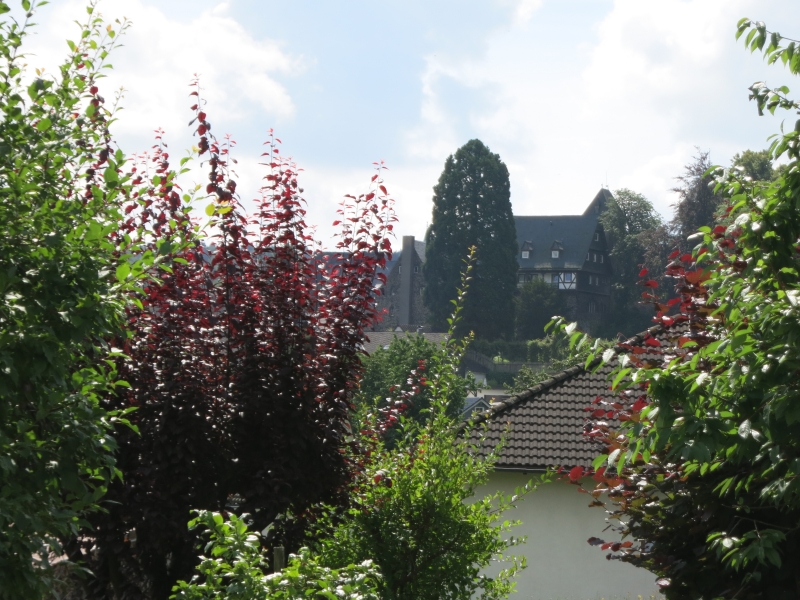
The circular trail in Friedewald passes the Crypt of the White Angel, a quarry biotope, the Old School, and Friedewald Castle. It is divided into a short and a long loop; the routes range from 1.3 to 10.3 kilometers, with walking times of up to three hours.
When planning your stay in Friedewald, you will want to find suitable accommodations.
Friedewald Castle is also connected to regional hiking and cycling trails. A 13.5-kilometer, moderately difficult section of the Druidensteig from Daaden to Elkenrother Weiher leads through Friedewald. Along the way, hikers see the castle with its onion-shaped tower and imposing wooden gate; the section continues through meadow landscapes toward the Neunkhausen-Weitefelder plateau.
The castle complex includes a five-hectare English-style park with several 120-year-old giant sequoias and an integrated rose garden. The park and garden feature mature trees and romantic plantings; both areas are used as settings for events.
Friedewald Castle is located in the Westerwald in northern Rhineland-Palatinate, near the borders with North Rhine-Westphalia and Hesse.
History and Architecture
The protected monument zone of the historic town center preserves the castle, remnants of the town fortifications, and the settlement that was originally surrounded by walls. Friedewald Castle dates back to a castle founded around 1320 by the Counts of Sayn. In 1324, Gottfried II of Sayn was granted the right to build a fortified castle in Friedewald; at the same time, the town was granted city rights.
The main building of Friedewald Castle is dated to 1580 and 1582 and was extended in 1609. It was extensively restored and remodeled between 1885 and 1895; its courtyard façade is designed in the Late Renaissance style. Basalt lava transported from the Eifel was used during work on the castle.
Low sections of the Friedewald town fortifications remain on the eastern and western sides, as well as part of a round rubble-stone tower in the northeast. East of the settlement lies the burial site of the castle lords, with a path, an entrance gate, a crypt with an angel, and two monuments dating from around 1900.
During the Thirty Years' War, Friedewald Castle served as the final refuge of the county. From 1671 to 1791, Friedewald was the principal seat of the County of Sayn-Altenkirchen. Friedewald Castle is considered a particularly striking example of German princely palaces in the Mannerist style.
Events and Uses
Friedewald Castle offers civil or free wedding ceremonies: in historic rooms, beneath the courtyard linden tree, or in the rose garden. The castle also provides settings for corporate events and private celebrations.
Friedewald Castle and its grounds are available for seminars and workshops, including yoga, relaxation, photography, and painting. The castle courtyard serves as a backdrop for product presentations and offers views of the Renaissance façade and the Daadetal valley.
Friedewald Castle has many parking spaces. During large events, additional parking is available in the surrounding area.
Visitor Information
Friedewald Castle and its park are not generally open to the public; group visits require prior arrangement. There is currently no public restaurant, café, or beer garden there.
The castle's outdoor areas are wheelchair accessible and have an accessible toilet. The castle itself can only be reached via stairs.
Other destinations: Schutzbach, Nisterberg.
For the higher-level travel overview: Daaden.
Check prices, availability, and amenities for your travel dates directly on Booking.com.
View Accommodations and OffersAdvertisement · Affiliate link to Booking.com