
Korbach: Old Town, Gold Trail and Green Trails
Accommodation in Korbach
Korbach combines the history of a medieval Hanseatic town with fossils, historic gold mining and singletrack trails on Eisenberg. When choosing where to stay, it helps to distinguish between these themes: explore the Old Town on walking tours and at various points of interest, focus on mining and mountain biking at Eisenberg, and discover the history of the Earth at the Korbacher Spalte and GeoFoyer. This makes it easier to plan your stay in Korbach around the activities you want to enjoy.
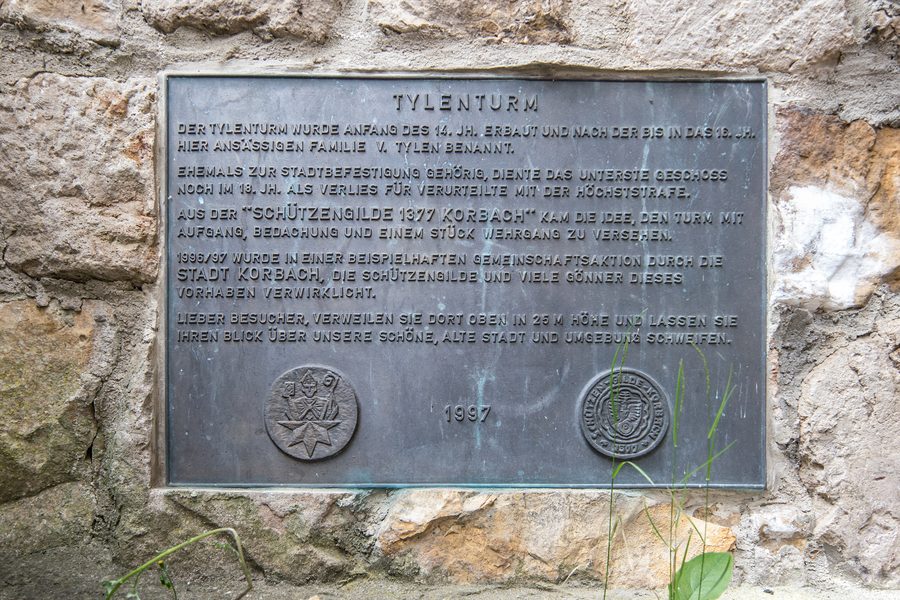 Der mittelalterliche Tylenturm ist ein markantes Korbacher Bauwerk und Teil der historischen Stadtmauer.
Photo: An-d via Wikimedia Commons, CC BY-SA 3.0
Two ways to explore the Old Town
The “Between the Walls” circular route is 2.1 km long and loops around the historic Old Town between its two medieval walls. At ten stops, you can discover fascinating and curious facts about the town’s history and learn about modern-day Korbach. The tour starts and ends at the Wolfgang-Bonhage-MUSEUM KORBACH, by the town model.
The Korbach Gold Trail offers a different way to find your way around: gold coins set into the ground lead to sights in the medieval Hanseatic town. Both routes explore the town, but in different ways: “Between the Walls” follows a circular route with designated stops, while the gold coins guide you to sights. The Wolfgang-Bonhage-MUSEUM KORBACH connects the town’s history with two other themes: the fossils of the Korbacher Spalte and evidence of historic gold mining at Eisenberg.
Fossils and landscapes from millions of years ago
The Korbacher Spalte is a fossil site of Upper Permian vertebrates. Alongside the Messel Pit UNESCO World Heritage Site, it is considered the most significant paleontological geotope in Hesse and the oldest fossil-bearing fissure discovered in Europe to date. It offers a glimpse far beyond the town’s thousand-year history, into a much more distant past.
The GeoFoyer Kalkturm Korbach focuses on the landscape and life forms of 250 million years ago. The rocks found near Korbach illustrate how this ancient landscape formed. Together with the museum, it offers a distinct perspective: the museum brings fossils, town history and mining together, while the GeoFoyer focuses on the early landscape and its rocks.
Gold mining at Eisenberg
The Korbach GeoTrail is a circular route of around 20 km connecting the Korbacher Spalte with Eisenberg near Goldhausen. Eisenberg is home to Germany’s largest gold deposit, a visitor mine and the “Gold Trail” educational path. Above ground, the trail features evidence of mining; more can be found underground in the visitor mine. At the Eisenberg Gold Visitor Mine, you can experience historic mining up close.
It helps to distinguish between the different attractions: the Korbach Gold Trail leads to sights in the Old Town, while the “Gold Trail” educational path at Eisenberg explores evidence of gold mining. The GeoTrail links the Korbacher Spalte and Eisenberg in a circular route; a visit to the mine adds a glimpse underground to the surface-level traces.
Green Trails at Eisenberg
The Korbach Green Trails include ten kilometers of singletrack trails at Eisenberg, near Korbach-Goldhausen. The routes have been complete since summer 2023 and form four loops with different levels of difficulty. The trails are also designed for fun rides for the whole family.
The main trailhead is on the outskirts of Korbach, right by Südring. It has parking, places to rest and a bicycle repair station. A connector trail runs directly from the car park to Eisenberg and the area’s four singletrack trails. When planning your activities, you can think of the Old Town routes, the GeoTrail and the four trail loops as distinct options rather than interchangeable outings.
Discover more destinations: Goldhausen, Lengefeld, Hillershausen, Frankenberg, Bromskirchen, Hatzfeld, Battenberg, Willingen.
For the higher-level travel overview: Waldeck-Frankenberg.

