
Habichtswald – between local history and natural lakes
Accommodation in Habichtswald
In Habichtswald, a cultural history trail, the story of a village smithy and a woodland landscape shaped by former basalt quarrying come together. These themes offer various points of reference as you plan your stay and look for a hotel. The Eco Path Cultural History Habichtswald connects Dörnberg and Ehlen. Since 1972, both villages have been part of the municipality of Habichtswald.
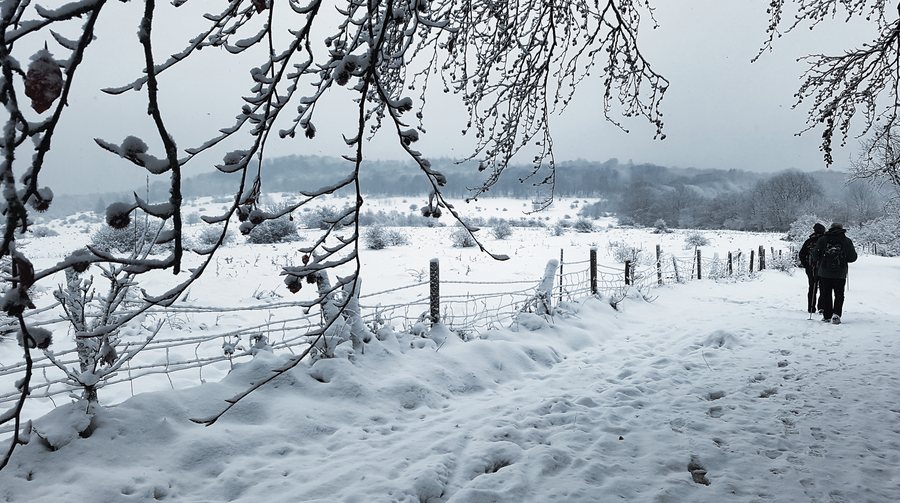 File:Winterwanderung im Naturpark Habichtswald.jpg
Photo: Fischer1961 via Wikimedia Commons, CC BY-SA 4.0
Local history between Dörnberg and Ehlen
The Eco Path connects the two villages. The route information was updated in September 2022; take this date into account when planning and check the route details before your tour. In Ehlen, the Schnegelsberg smithy represents a specific chapter of local history: it was built in 1893 and served as the village smithy until 1970. The trail links two villages, while the history of the smithy is rooted in a single building. This offers different ways to explore local connections, without equating historical use with present-day accessibility.
Woodland landscape and natural lakes
The woodland around Silbersee and Höllchen was shaped by the mining history of the 20th century. Former basalt quarries filled with groundwater and spring water, forming natural lakes. The landscape thus tells the story both of an earlier intervention and of a natural setting that emerged later. Those interested in local history will find a different perspective here than at the smithy: the focus is not on a single building, but on how the lakes formed in connection with former basalt quarrying.
More to explore in the wider Kassel travel destination
If you also include the wider Kassel travel destination in your plans, you’ll find additional landscape and cultural themes. The Habichtswald Nature Park is characterised by extensive beech forests and numerous volcanic basalt hills. Reinhardswald Nature Park is home to centuries-old pollarded oaks, extensive beech and spruce forests, river valleys, natural stream landscapes and calcareous grasslands with juniper and orchids. In Frau-Holle-Land Geo-Nature Park, deep forests alternate with meadows and fields, alongside colourful mountain meadows and trout streams. These descriptions refer to the wider Kassel travel destination and should be distinguished from Habichtswald’s local features.
Cultural offerings in the wider Kassel travel destination also cover a range of themes. The “Hör’ mal!” audio tours comprise 15 tours in Kassel district, following set routes to stops and viewpoints. The Eco Paths in the district have no opening hours and can be explored independently at any time of day, although conditions may vary from one trail to another. For finding more cultural sites, the discovery map published jointly by the City and District of Kassel lists 70 destinations with addresses, contact details, opening hours and websites.
Another way to explore a particular theme is the German Fairy Tale Route, which runs through Kassel district and includes, among other places, Sababurg, the Sleeping Beauty Castle, and Trendelburg Castle, with its 38-metre-high keep, moat and castle wall. Sababurg Zoo covers 130 hectares and is home to 80 animal species and more than 900 animals; it is open daily throughout the year. Since these figures may change, check the latest information and opening hours before your visit.
Finding a hotel and planning your trip
If you would also like to consider Kassel as a wider travel destination, its cultural and landscape themes offer a distinct framework for planning. This distinction helps you consider local visits separately from wider-ranging excursions.
Discover more destinations: Brasselsberg, Schauenburg, Zierenberg, Baunatal, Fuldabrück, Bad Emstal, Helsa, Kassel.
View the wider travel overview: Kassel region.

