
Oberammergau: History, Lüftlmalerei and Kolbensattel
Accommodation in Oberammergau
For a stay in Oberammergau, three themes can be considered separately: cultural history in the town, destinations on Kolbensattel and the Altherrenweg, with views across the Ammertal. These distinct points of interest make it easier to consider cultural sights, mountain activities and hiking separately when planning your day. When choosing accommodation in Oberammergau, you can consider which theme you would like to shape your stay.
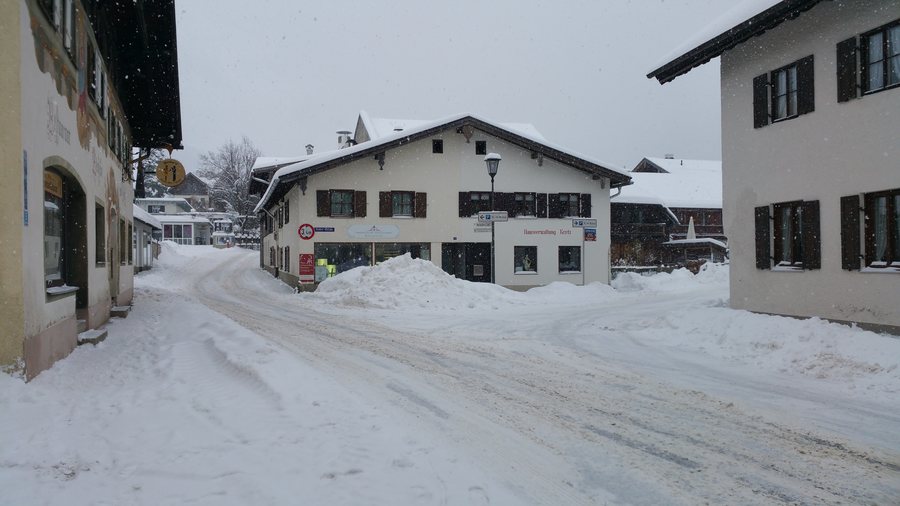
Cultural history and Lüftlmalerei
The monumental Crucifixion Group was solemnly inaugurated on 15 October 1875 on Osterbichl in Oberammergau. Its location, date and inauguration give it a clear historical context. Another depiction can be found on the garden side of the Pilatushaus: the Lüftlmalerei shows Jesus being sentenced by Pontius Pilate. The two motifs differ in form and location—one is a monumental Crucifixion Group on Osterbichl, the other a Lüftlmalerei on the Pilatushaus. Together, they offer two specific themes for local cultural history, both related to the depiction of the Passion.
Kolben chairlift and destinations on Kolbensattel
The Kolben chairlift is a double chairlift that runs from its valley station in Oberammergau to the mountain station on Kolbensattel. There you will find a bike park with six trails and the Alpine Coaster, a weatherproof toboggan run with magnetic brakes. The two attractions offer different activities: the bike park with its trails on the one hand, and tobogganing on the coaster on the other. When planning, you can consider which of the two activities you would like to include.
Hiking with views across the Ammertal
The Altherrenweg offers another kind of experience: it is a mountain hiking trail with views across the Ammertal and starts at WellenBerg in Oberammergau. Unlike the destinations on Kolbensattel, this is a hiking trail whose suitability depends on the weather. In wintry conditions, please follow local guidance on winter protection.
Additional destinations in the wider Garmisch-Partenkirchen travel region
The wider Garmisch-Partenkirchen travel region also offers its own natural and cultural attractions. In the Partnach Gorge, visitors can walk between massive rock walls and experience the water rushing below them. The gorge was declared a natural monument in 1912 and opened to visitors. In the wider Garmisch-Partenkirchen travel region, the Richard Strauss Institute is located in the historic Villa Christina in Partenkirchen’s spa gardens; it houses a permanent exhibition about Strauss’s life and work.
At 1,780 metres, Wank is Partenkirchen’s local mountain and is ideal for leisurely mountain hikes with far-reaching views. The Wank cable car runs directly from Garmisch-Partenkirchen to the summit; the cable car service is subject to operating conditions. For a different kind of hike in the wider Garmisch-Partenkirchen travel region, there is the Kramerplateauweg: a panoramic trail at the foot of the Kramer, with well-maintained hiking paths and gentle inclines.
The Werdenfels Museum in Garmisch-Partenkirchen was founded in 1895 from a private collection and is now one of the most important museums of its kind in Bavaria. In the Zugspitze room, visitors can see the original 150-kilogram summit cross from the Zugspitze. The Richard Strauss Festival takes place every June in Garmisch and features performances of his works; the programme may change.
Discover more destinations: Bad Kohlgrub, Seehausen Am Staffelsee, Krün, Wallgau, Ettal, Ohlstadt, Unterammergau, Saulgrub.
Back to the overview of the wider travel region: Garmisch-Partenkirchen District.

