
Prem: Moorlands, Hiking Trails and Local History
Accommodation in Prem
Prem lies in a pre-Alpine landscape surrounded by meadows, lakes, pastures and moorlands. The Premer Moor is a raised bog with a diverse range of plant and animal life that can be explored on foot. Long-distance hiking trails, a cultural cycling tour, St. Michael’s Parish Church and the Königsfilzhütte offer further points of interest. Choosing a destination based on the themes of your stay lets you focus on nature, outdoor activities and local history here.
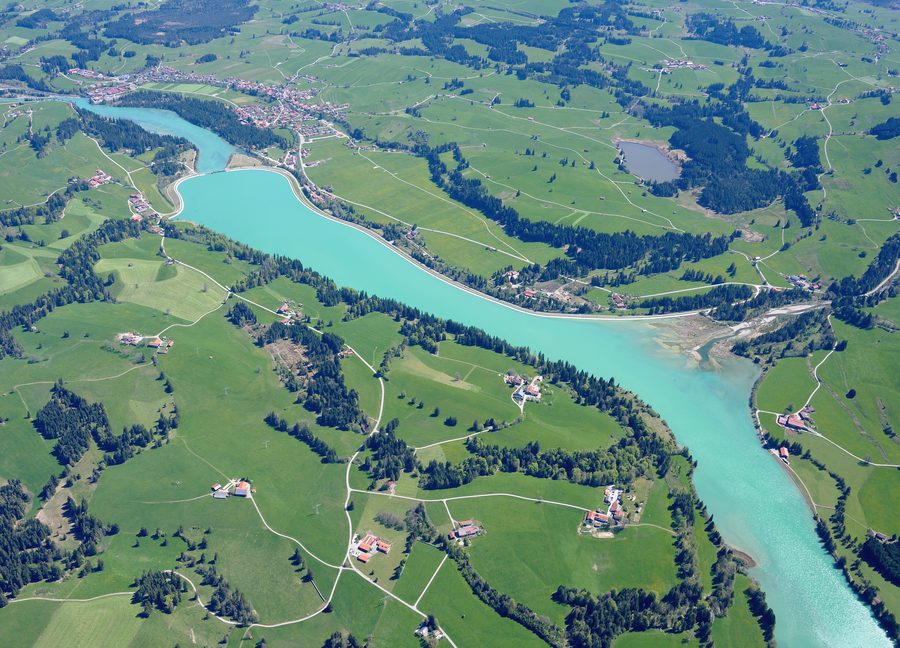 Luftaufnahme des Stausees Lechstaustufe 2 bei Prem
Photo: Carsten Steger via Wikimedia Commons, CC BY-SA 4.0
Exploring the landscape
Prem is connected to three long-distance hiking trails: the King Ludwig Way, the Lech Experience Trail and the Pfaffenwinkel Sacred Landscape Trail. Together, they link the town to an extensive regional trail network. The Premer Moor is a destination in its own right: you can explore the raised bog on foot. The Lechaue Nature Park also offers the opportunity to practise Kneipp water treading. There are several activities to choose from, from long-distance trails and the moor to water treading.
Cycling is another option. The “Cultural Tour to the Wieskirche” cycle route passes through Prem after crossing the Lech bridge, then continues past the hamlets of Schlöglmühle, Küchele and Häringen on its way to Ostern. This sequence gives you a clear indication of the route. Check the current route before setting off.
Church and peat-cutting history
St. Michael’s Parish Church brings together architectural influences from different periods: its tower dates from the Romanesque period, while the choir and nave are Gothic. In 1755, the church underwent extensive restoration under Abbot Marianus II. If you are interested in architecture, the contrast between the building’s parts offers a tangible point of reference: the tower is Romanesque, while the choir and nave are Gothic. The restoration adds another dated chapter to the building’s history.
The Königsfilzhütte, the peat hut belonging to the Heißerer family at house number 26 in Prem, illustrates another chapter of local history. Original tools from the peat-cutting era are on display inside. Peat cutting—the extraction of peat—comes to life here through the tools. The hut also serves as a picnic stop for hikers, bringing a glimpse of former working life together with a practical break on the trail.
The wider region: Weilheim-Schongau
The district of Weilheim-Schongau lies within the Pfaffenwinkel travel region. The Lech forms its western boundary, the Ammer flows through its central area, and the Loisach runs along its eastern border. This is the wider regional setting for the description of Prem.
The cultural attractions in Weilheim-Schongau also offer distinct highlights. The Wieskirche near Steingaden was built by Dominikus Zimmermann between 1745 and 1754 and has been a UNESCO World Heritage Site since 1983. It welcomes visitors to church services, summer concerts and quiet contemplation; check current dates for services and concerts. The Penzberg Mining Museum focuses on the history of the local pitch coal mine, which operated from 1796 to 1966. The museum offers guided tours in several languages for international visitors, families and school groups. The wider destination therefore encompasses industrial history as well as church architecture, with a variety of reasons to visit.
Choosing Prem as your base
If you are looking for accommodation in Prem, you can choose your destination based on your interests: the moorland and trails, cycling, or local architecture and peat-cutting history. These themes are rooted in Prem, while the attractions in Weilheim-Schongau provide an additional regional context.
Discover more destinations: Steingädele, Wildsteig, Urspring.
Return to the regional travel overview: Steingaden.

