
Ostheim v.d. Rhön: Fortified Church, Organ Building and Hiking Trails
Accommodation in Ostheim vor der Rhön
Ostheim v.d. Rhön offers several clearly distinct starting points for planning a trip: the fortified church with its historic clock mechanism, the organ museum, signposted hiking trails and the biennial Rhöner Wurstmarkt sausage market. When choosing accommodation, you can first consider whether culture, a hike or a specific event date will shape your stay. Each of these focuses offers a different way to experience Ostheim and the wider Rhön-Grabfeld travel destination.
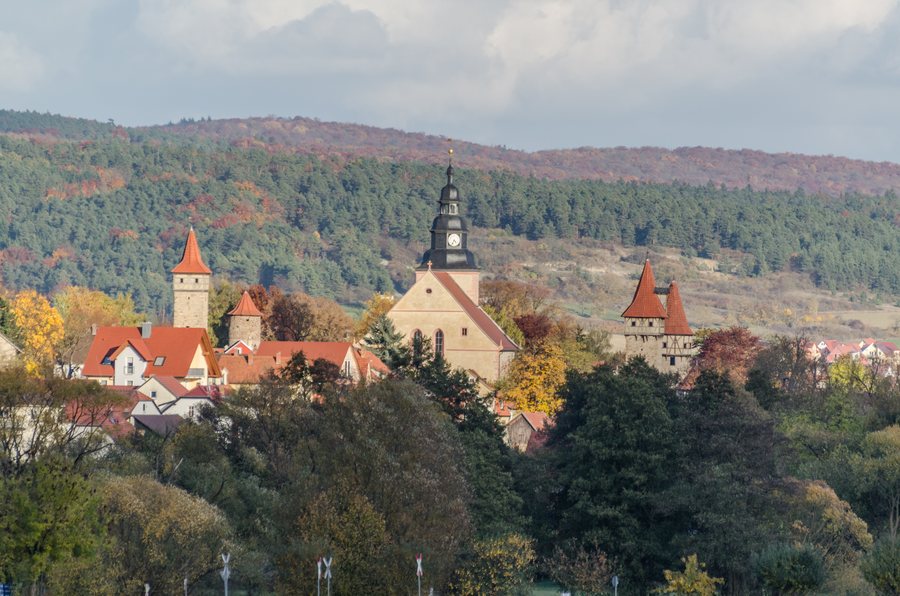 File:Ostheim v.d. Rhön, Kirchenburg von Westen-001.jpg
Photo: Tilman2007 via Wikimedia Commons, CC BY-SA 3.0
Fortified Church and Organ Building
The original clock mechanism, installed in the 15th century, is once again housed in the Waagglockenturm tower of Ostheim’s fortified church. Visitors can climb the tower, where information panels explain how the historic clock mechanism works. The mechanism is therefore not merely part of the architecture, but a distinct focus of a visit. Those interested in historic technology will find a clearly defined point of interest here.
The tradition of organ building in Ostheim comes to life at the Ostheimer Orgelbaumuseum Schloss Hanstein e. V. museum. Ostheim’s organ-building companies have been building organs for over 400 years. The clock mechanism and organ building offer different historical perspectives: one focuses on the mechanics of a single clock, the other on a long-standing craft tradition. Both subjects give Ostheim’s cultural scene a distinctive character.
Hiking Trails Around Ostheim
Signposted hiking trails around Ostheim range from seven to twelve kilometers. In the south of the Ostheim fields are the Blumenweg, Kirschweg, Hasenweg and Tannenweg trails; in the north are the Fuchsweg and Pilzweg trails. Their names and locations provide specific orientation within the local trail network, while the range of distances gives an idea of the routes’ length. When planning a hike, you can use the stated distance and the northern or southern location as your first points of comparison.
Rhöner Wurstmarkt and Star Park
The Rhöner Wurstmarkt sausage market takes place every two years in Ostheim on the second weekend in October. This open-air food fair offers traditionally made sausage and ham specialties, farm breads, beer, wine and fine spirits. If the market is a deciding factor in your stay, check the local dates for the next edition.
Ostheim is a member of the Star Park community and is one of the few areas with genuinely starry nights. This adds another travel highlight to the local cultural and hiking attractions. For specific stargazing plans, the conditions on the evening itself remain decisive.
Ostheim within the Wider Rhön-Grabfeld Travel Destination
Rhön-Grabfeld lies within the UNESCO Rhön Biosphere Reserve. Ostheim vor der Rhön’s fortified church is also part of this regional context: it was designated a monument of national importance in 2003 and is Germany’s largest and particularly well-preserved fortified church. The fortified church museum in Ostheim showcases a dozen more fortified churches from the region, including those in Nordheim, Oberstreu and Kaltensundheim. The subject thus extends beyond a single building to encompass the region.
The Franconian Open-Air Museum in Fladungen illustrates 350 years of everyday rural life in Lower Franconia and the Rhön through faithfully reconstructed houses and farmsteads. Around 30 historic buildings stand on the 12-hectare museum grounds, including farmhouses, workshops and a village school. Hands-on activities focused on crafts and traditions include demonstrations, practical courses and events. The Rhön-Zügle museum railway runs through the Streu Valley with steam and diesel locomotives.
The wider Rhön-Grabfeld travel destination also offers landscapes beyond Ostheim. The Lange Rhön is Bavaria’s largest nature reserve outside the Alps. The Black Moor is strictly protected as a core zone within the UNESCO Rhön Biosphere Reserve; a boardwalk leads through parts of it, with information panels explaining the route. The approximately 2.5-kilometer nature trail passes by the Gangolfsberg; sturdy footwear is required. The basalt column wall there formed between 30 and 10 million years ago during volcanic activity in the Rhön and can be explored along the nature trail. Guided group tours of the trail are available on request.
Discover more destinations: Sondheim vor der Rhön, Oberelsbach, Bischofsheim an der Rhön, Fladungen, Sandberg, Bad Neustadt an der Saale.
Return to the wider travel overview: Rhön-Grabfeld.

