
Rudolphstein: Castle History and Trails Along the Saale
Accommodation in Rudolphstein
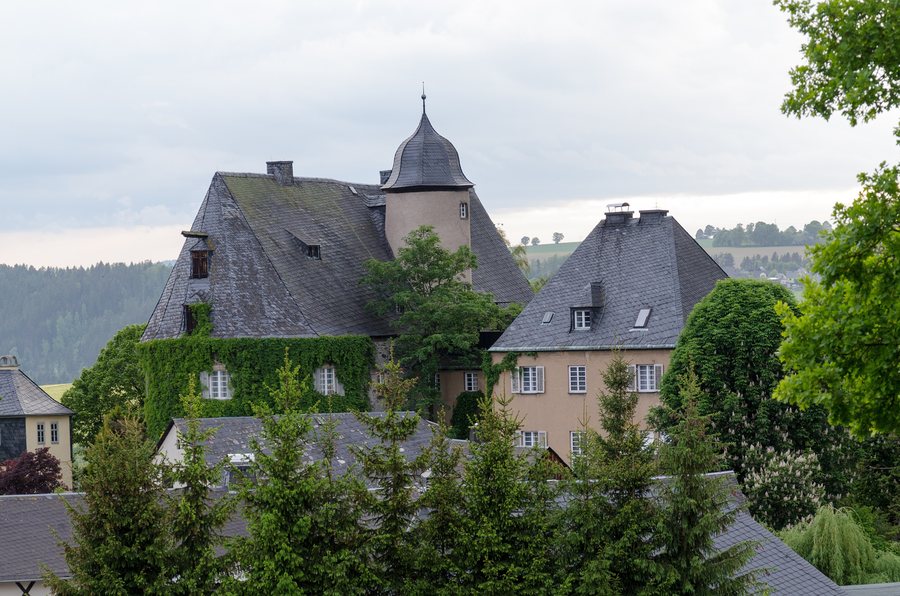
The former castle at Am Schloß 1 in Rudolphstein is now used as a hotel.
Castle Complex and Building History
The complex includes an eastern section dating from the 15th century, a western section, and a tower from the 16th or 17th century. In 1934, Prof. Eugen Hönig built a three-storey extension. The castle complex also includes a forester’s house, a dance hall, a dovecote, a service courtyard, an arched gateway, and a castle wall. Visitors interested in culture focus on the buildings from different periods and the additional structures that form part of the complex.
Border History Along the Saale
Rudolphstein Castle originated as one of the many border fortresses along the Saale. The Rudolphstein–Hirschberg motorway border crossing was established on 9 November 1989. The 1989 border crossing adds a 20th-century event to the history of the castle. For visitors interested in culture, both the castle’s origins as a border fortress and the date of the border crossing are therefore part of Rudolphstein’s history. The Saale is connected both with the origins of the border fortress and with the trails that run along its slopes.
The US 74 Slate Trail
The US 74 Slate Trail is an easy 4.8-kilometre circular hiking trail. Its route passes through former slate quarries and along the slopes of the Saale. Its closed-loop layout makes 4.8 kilometres the length of the circuit and distinguishes it from a single one-way route. This route format is important when planning your day: the circuit can be treated as a self-contained section without adding an extra final stretch within the circular trail. The route therefore incorporates both the former slate quarries and the slopes of the Saale into the circuit.
Connection to Rudolphstein
A spur trail connects the US 74 Slate Trail with Rudolphstein. This connection is 2.0 kilometres long and is designed as an out-and-back route. The 2.0 kilometres refer to the connection to Rudolphstein, not to the circular trail itself. If you plan both sections, keep the circular trail and the spur trail separate: the first figure applies to the circuit, while the second applies to the complete out-and-back connection. The starting point of the Slate Trail can be reached via the Rudolphstein motorway exit in the direction of Eisenbühl. The motorway exit and the direction of Eisenbühl are therefore part of the approach, while the spur trail provides the connection to Rudolphstein.
The US 76 Saalbach Trail
The US 76 Saalbach Trail passes the site of the former Saalbach estate. Via the Saalbach Bridge, it offers an additional access point from Rudolphstein’s large car park. On this trail, the access point and the former estate site are different points along the route. This means that both the specific orientation provided by the bridge and large car park and the historical reference to the former Saalbach estate are central for you.
To the higher-level travel overview: Berg.

