
Discover Pellheim: Village Character, History and Routes into the Countryside
Accommodation in Pellheim
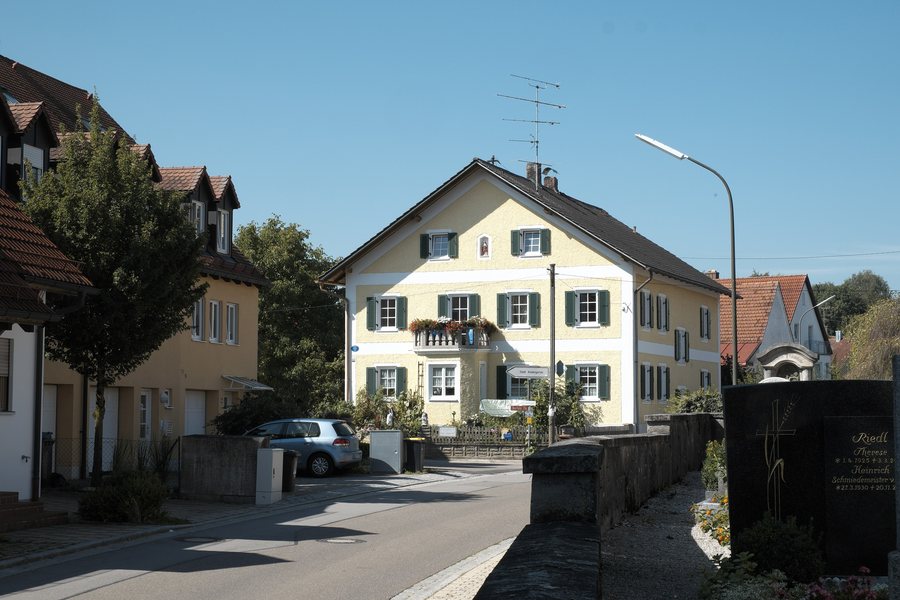
Pellheim has preserved its village character. Meadows, fields and orchards surround the village.
Village Character and Routes through the Countryside
A walking and cycling path connects Pellheim with Walpertshofen. The route is just under two kilometres long. The path from Pellheim to Walpertshofen also connects to an existing walking and cycling path that continues on to Hebertshausen S-Bahn station. When planning a route on foot or by bicycle, the section to Walpertshofen and the continuation can be considered as separate stretches. The first section can stand as a short route in its own right; the continuation towards Hebertshausen can be added as well. You can plan the just under two kilometres to Walpertshofen as a short walk or cycle ride; the connection towards Hebertshausen extends the route by another section. This allows you to choose between the short stretch and the continuation when planning your day. Anyone who deliberately limits the route to Walpertshofen remains on the short section; those who continue on foot or by bicycle also take the connection to Hebertshausen S-Bahn station.
Historic Traces in Pellheim
The historic heritage includes the medieval and early modern castle site of “Schloss Pellheim”, which is listed as a monument. The former castle once towered over the entire village with three towers.
Two historic buildings stand at neighbouring addresses on Dorfstraße. The historic inn at Dorfstraße 4–6 is a stately hipped-roof building dating from 1750. The vicarage at Dorfstraße 7 also has a hipped roof; its core probably dates from the 18th century.
A wayside cross from the mid-19th century stands in front of a building at Goppertshofer Straße 10. A house at the same address bears a Dachau house plaque with the year 1843 in its gable. The wayside cross and the house plaque are two separate historical features at the same address: spatially, the cross stands in front of the building, while the plaque is visible in the gable of the house.
St. Ursula and the History of the Village
The present parish church of St. Ursula was built in 1689 while retaining medieval masonry. Its church tower is 48 metres high. Its lower section preserves old Gothic and possibly even Romanesque masonry.
Three of St. Ursula’s four bells date from around 1490 and from the years 1599 and 1629. The four bells therefore do not all date from the same period. St. Ursula stands in the village of Pellheim, in the middle of a walled cemetery.
Guided tours of St. Ursula can be requested or arranged through the St. Jakob parish office.
Gasthaus Liegsalz and Bavarian Cuisine
The local offering includes Gasthaus Liegsalz in Pellheim. It serves Bavarian cuisine and welcomes guests for meals and celebrations in its large function room.
To the overarching travel overview: Dachau.

