
Wanne: Winter Sports and Cultural History
Accommodation in Wanne
In the Val de Wanne, alpine skiing, tobogganing and cross-country skiing are among the activities on offer. There are two cross-country trails: one is 3 kilometres long and the other is 8 kilometres. Operations depend on snow conditions. Wanne also offers specific cultural and historical attractions: the Sainte-Marie-Madeleine Church, Château de Wanne and Musée de Wanne, which features local geology, archaeology, nature and traditional rural occupations.
Winter Sports in the Val de Wanne
The three activities offer different experiences: alpine skiing, tobogganing and cross-country skiing. For cross-country skiing, trail length is a useful point of comparison. The 3-kilometre trail is the shorter option, while the 8-kilometre trail is longer; you can factor your preferred distance into your plans for the day. The trail information applies to cross-country skiing, while alpine skiing and tobogganing are separate activities on offer. You can therefore plan your day of winter sports around your preferred activity and, for cross-country skiing, the distance you want to cover. Since operations depend on snow conditions, take these into account when planning your trip.
During peak season, paid shuttle services are planned between Trois-Ponts station and the Val de Wanne ski slope. If you would like to use this connection, check before travelling whether it will be running on your dates.
The Construction History of Sainte-Marie-Madeleine Church
The origins of Sainte-Marie-Madeleine Church date back to the years following the founding of Stavelot Abbey; it is first mentioned in a list from 1130. The year marks its first recorded mention, while its origins go back further. The church was rebuilt from 1544, with a fortress-like tower, and the work was completed in 1549. The present-day church was rebuilt in 1844 and retains the old tower from its predecessor. Several building phases can therefore be distinguished: its early origins, the rebuilding that began in 1544, and the construction of the present-day church in 1844. This distinction helps you read the dates as milestones in a longer history rather than as a single construction date.
The Château and Museum: Two More Perspectives
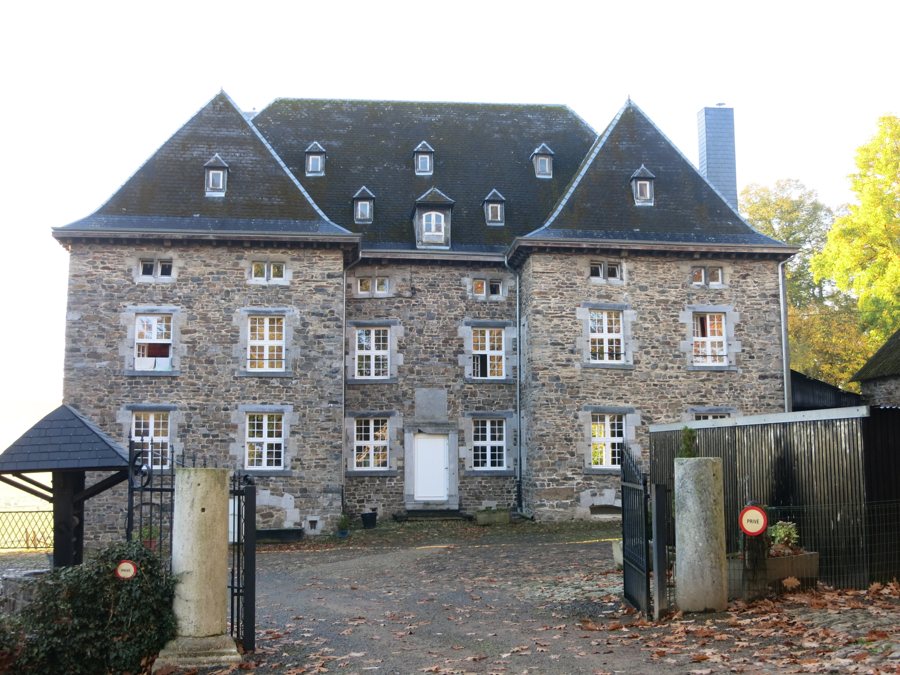
At Château de Wanne, the focus is on its long-standing function as a residence and a specific rebuilding. For centuries, it was the residence of the Mayeurs of Wanne; in 1712, Baron Waha de Bayonville rebuilt it. These two details answer different historical questions: the first places the Château’s role in context over a long period, while the second identifies a dated building project and the person associated with it. Together with the church’s construction history, they allow you to compare several building phases with the Château’s centuries-long function as a residence.
The Musée de Wanne presents local geology and archaeology, nature, and traditional rural occupations. Visitors can handle objects and use old-fashioned games. The museum offers a different perspective from the church and the Château: it focuses on a range of subjects and hands-on activities, while the known histories of the two buildings concern their construction phases and the Château’s historical function as a residence. To get a sense of what your stay can include, you can consider these topics separately: winter sports in the Val de Wanne, the history of the church, the role of the Château and the museum’s exhibits. This gives you a picture of what Wanne has to offer beyond its snow-dependent winter activities.
Discover more destinations: Basse-Bodeux.
Go to the main travel overview: Trois-Ponts.

