
Discover Eisenerz: Erzberg, history and nature
Accommodation in Eisenerz
Eisenerz can be explored through three distinct themes: the history shaped by Erzberg, historic buildings and nature at Lake Leopoldstein. When planning your visit, you can decide whether to focus on mining history, architectural heritage or time by the water. The sights and activities offer different perspectives on the town and its surroundings.
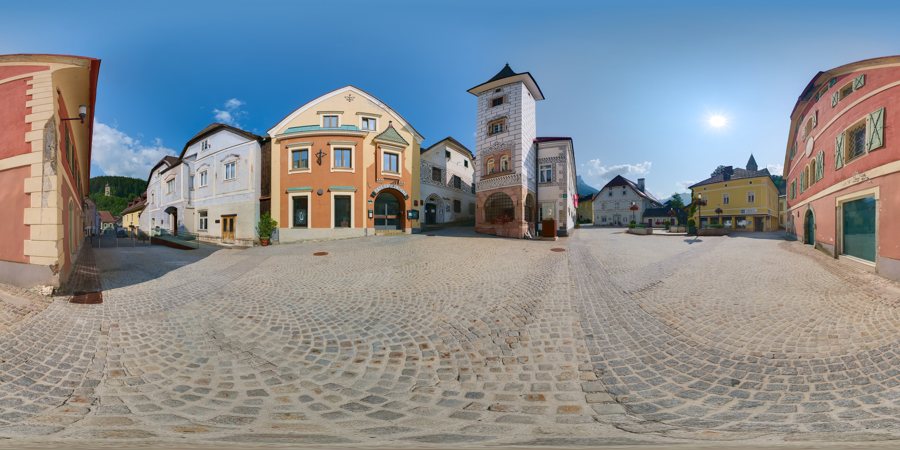 File:Eisenerz Bergmannsplatz panosphere 20210723.jpg
Photo: Daniel Kraft via Wikimedia Commons, CC-BY-SA-3.0
Erzberg and mining history
Erzberg is the largest open-pit mine in Central Europe and the most significant ore deposit in the Alps. As a symbol of industrialisation and a central part of the Iron Road, it also represents the region’s mining history. Guests can explore Erzberg on Hauly rides, travelling right through the open pit in a converted heavy-duty truck with 1,217 hp. A tour of the show mine takes visitors underground. There, guests discover Erzberg’s underground labyrinth and learn about miners’ working lives, both past and present.
The two experiences offer different perspectives: the Hauly ride goes through the open pit, while the show-mine tour focuses on the underground working world. When planning, you can choose whether you would prefer to discover Erzberg on a ride through the open pit or learn about its history and work below ground.
Old town and fortified church
The old town’s character is shaped by the houses of former Radmeister, or ironmasters, notable for their arcaded courtyards and sgraffito decoration. The Schichtturm adds another perspective on the town’s architectural history. In 1581, the ironmasters decided to build a watchtower; the Schichtturm was subsequently constructed as an elaborate Renaissance-style tower. The decision and the completed tower tell of two successive stages: the plan for a watchtower and its realisation as a Renaissance building.
Another landmark is the fortified church of St. Oswald, surrounded by its Tabor fortifications. Its history dates back to 1190. The complex is considered the largest and most significant fortified church complex in Styria and is one of the few fully preserved fortified church complexes in Austria. The exhibition there presents the lives, work and traditions of miners. St. Oswald thus combines architectural history with insights into mining traditions.
Museums and crafts
The Eisenerz Town Museum is located in the historic centre of the mining town, bears the Austrian Museum Quality Seal and documents the changing relationship between Erzberg and Eisenerz. The Museum in the Old Town Hall focuses on precious iron blooms and minerals, the Eisenerz “wonder specimen” and other rarities from mining and local cultural history. These include the Tendler puppet theatre.
The Austrian Postal and Telegraph Museum is housed in the historic rooms of the Kammerhof, a former hunting lodge of Emperor Franz Joseph I. Its exhibition traces the development of postal and telegraph services from the imperial era to the present day. The Gerberei Salzer Museum offers a different perspective on local working history: original, working tannery machines from the 1930s illustrate how leather was made. The museum also has a restored waterwheel that has been put back into operation. It was once used in leather production and today generates electricity.
The Nativity Scene Museum also brings different themes together. Alongside the story of the birth of Jesus, its nativity scenes honour the region’s mining traditions. The 1987 panoramic nativity scene also depicts scenes from public life and local history. Together with collections on mining, crafts and communications, the museums offer a variety of ways to explore Eisenerz’s history.
Lake Leopoldstein and walks
Lake Leopoldstein is a pristine Styrian mountain lake, untouched by development. The Hochschwab massif’s rock face is reflected in its emerald-green waters, and the lake is fed by spring water from the surrounding mountains. A four-kilometre hiking trail circles the lake and offers panoramic views of the surroundings. There is a public bathing area on the western shore. Seasonal conditions and operating details may change, so check the latest information before your visit.
The grounds of the Oswaldirücken open-air exhibition offer another option for a walk. The site is located right by Erzberg at an altitude of 878 metres. The lakeside circuit, bathing area and open-air exhibition are quite different from the historic buildings and museums: they take you out into the landscape or right up to Erzberg. You can choose the themes best suited to your stay based on your interests.
Discover more destinations: Präbichl, Hieflau, Vordernberg, Trofaiach.
Back to the main travel overview: Leoben.

