
Water and Storage Ponds for Snowmaking
Storage ponds and other water reservoirs can make the technical snowmaking of a ski area more predictable. However, they are not a sign that water is available without limit. To assess them, it is important to consider the water source, permits, filling, pipe network, weather and how the water is used in the area. Guests should distinguish general statements from the operator’s latest information.
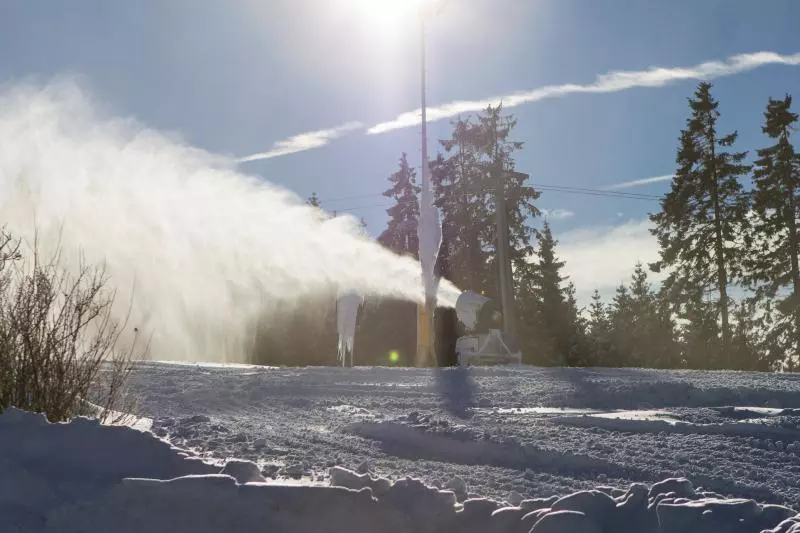 Schneekanone erzeugt technischen Schnee auf einer verschneiten Skipiste.
Photo: Dago Wiedamann
Schneekanone erzeugt technischen Schnee auf einer verschneiten Skipiste.
Photo: Dago Wiedamann
Why reservoirs are used for snowmaking
Snowmaking systems need water over a short period when temperatures and humidity allow snow production. A reservoir can store water in advance and deliver it to the slopes through pumps, pipes and snow cannons. Without this buffer, withdrawals would depend more heavily on the current flow or availability of a body of water. A pond’s location, size and technology are therefore part of the local infrastructure.
The German Cable Car Association explains in its information on technical snowmaking that water can come from storage ponds or permitted withdrawals from natural sources, and that it returns to the natural water cycle as the snow melts. This association information describes the principle. It does not verify the equipment, capacity or permits of any particular ski area.
Water management and permits
A reservoir is not usually considered solely in terms of winter use. The timing of filling, precipitation, water flow, groundwater, conservation requirements and the interests of other users all matter. Authorities may limit withdrawals or set requirements for construction, operation and returning the water. Even when water returns through snowmelt, the location and timing must be taken into account. Information about a specific pond should therefore come from the operator or the responsible authority.
For guests, the main concern is how water planning affects the services on offer. In favourable conditions, an operator may be able to prepare key slopes earlier. However, warm weather, low reservoir levels or a lack of sufficiently cold conditions for snowmaking still impose limits. A reservoir guarantees neither that all slopes will open nor any particular snow depth. On the day of travel, current webcams, snow reports and lift status are more informative than general promotional claims.
Technology and efficient use
Water is carried to the nozzles by pumps and pressurised pipes. Sensors can measure temperature, humidity and snow depth. This makes it possible to focus production on suitable time windows and particularly important slopes. Snow groomers then spread and compact the snow. Precise measurements can help prevent too much snow being made in one area and too little in another.
The terrain also affects how much snow is needed. A well-shaped slope, a sufficient natural snow base and careful grooming can reduce the amount required. This is not a blanket justification for every location: construction, soil, vegetation and waterways must be assessed separately. The information on snowmaking and snow cannons helps explain the technology; the relevant operator must provide details about current conditions.
What travellers can check before booking
Anyone planning to ski early or late in the season should check whether key beginner areas and connecting runs are covered. The size of a reservoir matters less than which slopes it supplies and whether the system can operate during the period in question. Families can also check whether, when only some slopes are open, there are short routes, lessons and safe ways to get back. For realistic trip planning, information about travel dates and the season and snow reliability can be useful.
Sustainability cannot be judged by looking at the reservoir alone. Water, energy, construction footprint, travel and the occupancy of the ski area as a whole all need to be considered together. When reading an operator’s information, look for specific details: Which facility is being discussed, what is its purpose, and what period does the statement cover? If these details are missing, the information remains general and should not be taken as a guarantee for your own ski day.
FAQ
Does technical snowmaking permanently consume water?
As the snow melts, the water generally returns to the natural water cycle. However, withdrawals, storage, evaporation, timing and local water conditions can still affect the environment and permitting.
Does a storage pond guarantee that slopes will be open?
No. Temperatures, humidity, energy supply, ground conditions, grooming and the ski area’s operating decisions must also be suitable.
What information is useful for travellers?
Useful information includes details about which slopes are supplied, current openings, the snow report, webcams and possible restrictions. A general statement about reservoirs is not enough for planning your day.
