
How to assess snow reliability: location, season and current conditions
Snow reliability for a ski holiday cannot be determined from a single figure. Elevation, slope aspect, natural snow cover, artificial snowmaking and current weather patterns all play a part. When choosing a date, it is therefore important to distinguish between the long-term likelihood of good snow conditions and the facilities actually open on the day of your visit.
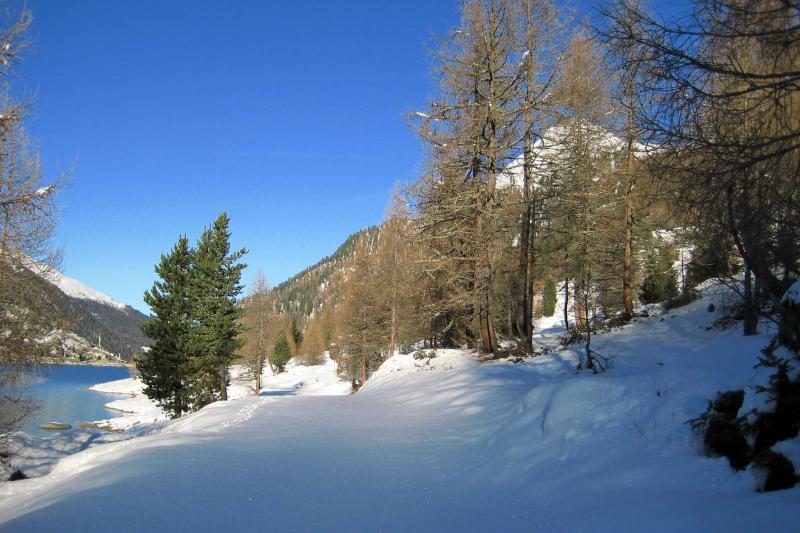 Ein verschneiter Weg führt durch kahle Bäume an einem blauen Bergsee entlang.
Photo: VinschgerEngl
Ein verschneiter Weg führt durch kahle Bäume an einem blauen Bergsee entlang.
Photo: VinschgerEngl
Factors that matter
Pistes at higher elevations often stay wintry for longer in cold temperatures. However, this does not automatically mean that valley runs, beginner slopes or connecting routes are open. North-facing and shaded slopes retain snow for longer when conditions are right, while sunny south-facing slopes can soften more quickly. Wind can blow snow around, and rain can change the surface in a short time. These factors vary from one location to another.
Artificial snowmaking can support base preparation and key connections. In its information on snowmaking, the German Association of Cable Cars and Surface Lifts explains that temperature, humidity, water, permits and snow management suited to the location all play a role. These statements describe the process in general. They do not show how many pistes a particular resort currently has open.
Choosing well in advance and checking conditions closer to your trip
When choosing a resort well in advance, travellers can compare elevation, time of season and the aspect of the ski area. Early in the season, beginner slopes and central lifts are often especially important. In spring, a resort with higher-altitude options may be a better fit. Families do not necessarily need the largest ski area, but they do need reliable beginner areas, short distances and a suitable ski school. A high number of piste kilometres alone says little about the quality of the ski day you have planned.
A week before departure, it is worth checking the official resort website, piste map and webcams. The evening before and the morning of your ski day, check the snow report, lift status, weather warnings and any possible closures again. Only this combination of information shows which facilities are actually available. If conditions are uncertain, flexible booking terms and an alternative activity can help you decide.
Putting snowmaking into perspective
Snow from a snowmaking system can help maintain a groomed piste, but it cannot overcome natural limitations. Suitable temperatures and humidity must coincide for snow to be produced. Water and energy are also required. The snow is spread, compacted and blended with the natural snow cover. Even so, high temperatures, rain or heavy use can still weaken the surface.
When deciding on a trip, it is therefore useful to ask a specific question: which of the areas that matter to me have snowmaking, and what alternatives will remain open? A beginner may only need one open practice slope. A group of experienced skiers may be more interested in long runs, options at different elevations and reliable routes back. If you are travelling without a car, also check whether a shuttle or another way back is available if valley runs are closed.
Plan around your own skiing goals
For a first ski holiday, short distances, a lesson and a manageable piste are often more important than record-breaking elevation. More advanced skiers can use the piste map to check whether several slopes at different elevations are accessible. For children, breaks, sunny places to relax and an easy route back to the accommodation are helpful. The advice on planning a ski holiday can help you get ready, while the information on travel dates and the season can help you choose when to go.
If you book a weather-dependent trip, do not rely on promotional claims alone. Current information from the resort operator is the authoritative source for openings, prices, lessons and piste conditions. General information about snow reliability on a ski holiday can help you make a decision, but it is no guarantee of specific conditions. The more clearly you define your personal priorities, the easier it is to check which information is relevant.
FAQ
Is a ski resort at a high elevation always snow-reliable?
No. Elevation is an important factor, but wind, slope aspect, temperature, precipitation, snowmaking and the condition of individual routes back also affect your ski day.
How up to date does the information need to be?
For booking, long-term information is enough as an initial guide. Before departure and on the ski day, check the operator’s updates, webcams, snow report and lift status again.
What does the number of piste kilometres tell me?
It describes the size of the ski area, but does not tell you which runs are currently open or whether they suit your ability and the trip you have planned.
