
Skiing in Bavaria
Key facts
Find more winter destinations in Skiing in Germany and Ski regions. Plan a ski holiday to explore destinations and preparation tips together.
Bavaria offers a wide range of options for a winter holiday: Alpine ski areas along the northern edge of the Alps, smaller slopes in the foothills and winter sports resorts in the low mountain ranges. Choosing a destination is about more than just piste kilometres. Altitude, travel arrangements, snow conditions, ski buses, beginner slopes and the location of your accommodation all help determine whether an area suits your group.
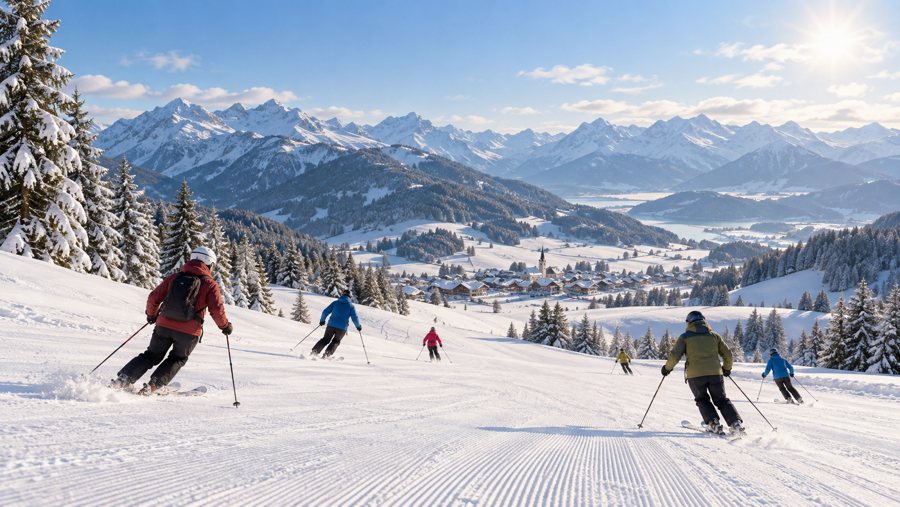 Illustrative winter scene with skiers in the Bavarian Alps; KI-generiert, illustrativ und nicht-dokumentarisch, kein Foto eines bestimmten Ortes.
Photo: Max-TD / OpenAI in-house AI generation
- Bavaria brings together Alpine ski areas, foothills and winter sports resorts in its low mountain ranges.
- The pistes on the Zugspitzplatt are at around 2,600 metres; the cog railway runs up from Garmisch-Partenkirchen and Grainau.
- Alpine ski areas include Zugspitze, Garmisch-Classic and Sudelfeld.
- Altitude and weather distinguish the long Alpine seasons from those on lower slopes.
- Cross-country skiing, tobogganing and winter hiking complement Alpine skiing in many regions.
- Traffic and demand can increase significantly on holiday weekends.
Compare the Alps, foothills and low mountain ranges
The Bavarian Alps are home to well-known winter resorts stretching from the Allgäu through Werdenfelser Land to Berchtesgadener Land. Higher-altitude areas generally offer better chances of a longer season, but can be harder to reach in strong winds or heavy snowfall. The foothills and low mountain ranges are closer to many parts of Germany.
For stays of several days, the resort’s facilities also matter. Restaurants, shops, ski hire and activities for bad weather can be more important than staying right beside a lift.
For families, beginners and experienced skiers
Families benefit from easy-to-navigate beginner slopes, ski schools and short distances. Experienced skiers tend to focus more on vertical drop, challenging runs and connections between different sectors. Resorts with winter hiking trails, toboggan runs or thermal baths are especially convenient for mixed groups.
Plan your journey and accommodation
On busy travel days, roads into the Alps, car parks and routes through towns can be congested. Trains and ski buses are an alternative, provided that timetables, luggage transport and the last connection to your accommodation work for you. When choosing accommodation, consider not only the price and amenities but also the gradient, winter road maintenance, distance to the lift and the actual travel time to the ski area.
Weather and other winter activities
Snow conditions vary with altitude, aspect and weather patterns. It is useful to have a backup plan in case of a thaw or storm. Cross-country skiing, winter hiking, tobogganing, museums and thermal baths can add to your stay without making every day dependent on open ski runs.
The Bavarian Alps and eastern low mountain ranges
Some of Bavaria’s best-known winter landscapes include the Allgäu, Werdenfelser Land, Chiemgau, Berchtesgadener Land, the Bavarian Forest and the Fichtelgebirge. Oberstdorf, Garmisch-Partenkirchen, Reit im Winkl, Ruhpolding and Bodenmais offer different combinations of Alpine skiing, cross-country skiing, biathlon, ski jumping and winter hiking. Individual Alpine ski areas include Zugspitze, Garmisch-Classic, Sudelfeld, Brauneck-Lenggries, Spitzingsee-Tegernsee and Winklmoosalm-Steinplatte; Jenner is another winter excursion destination, with freeride terrain. The Zugspitzplatt sits at around 2,600 metres; the cog railway runs there from Garmisch-Partenkirchen and Grainau.
