
Solna between parkland and palace history
Accommodation in Solna
Solna brings together several distinct cultural themes: landscaped parkland, palace history, art and environmental history. When looking for accommodation in Solna, these themes can help you decide what kind of trip you want. Haga is known for its landscaped parkland and the Gustav III Pavilion, while Ulriksdal is associated with palace history and art. Fjärilshuset Haga Ocean offers a different focus: as a living museum, it gives visitors the chance to learn about the life cycle of butterflies.
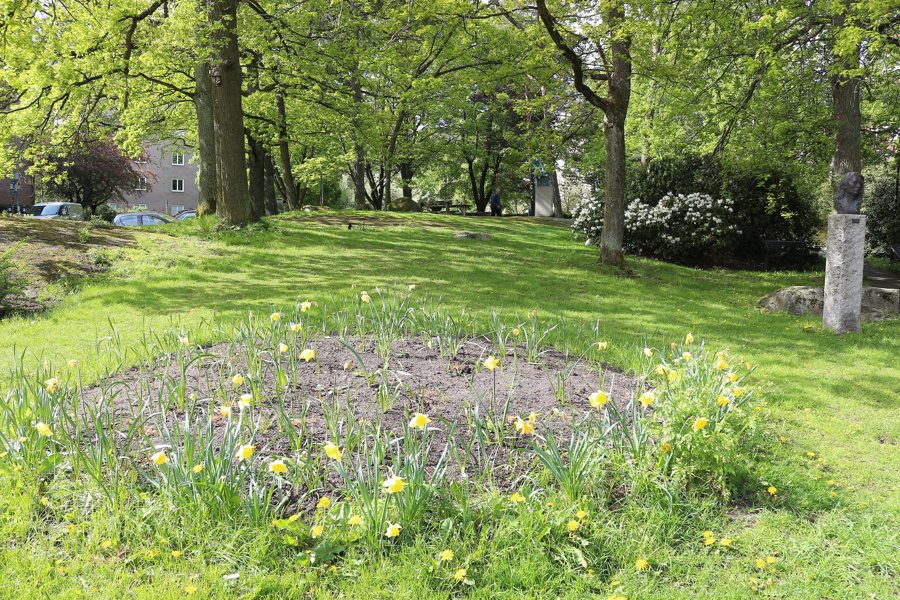 File:Påskliljor i Maria Wines park, Råsunda, Solna kommun.jpg
Photo: Sniper Zeta via Wikimedia Commons, CC-BY-SA-4.0
Parkland and local landmarks
The parts of the Kungliga nationalstadsparken located in Solna include Haga, Brunnsviken, Ulriksdal and Bergshamra with the Tivolihalvön. These names help orient you to the different areas of the protected landscape, rather than grouping them all into a single place. This makes it possible to describe Solna’s parkland through several specific locations.
Hagaparken is characterised by English-style landscaping. Its features include gently contoured lawns, wooded areas, semi-open pastures and winding paths. These features show that the park’s character is not defined by a single type of terrain: open and wooded areas sit alongside landscaped paths. For visitors interested in park design, Haga offers a different way to experience Solna from the palace history and art found elsewhere.
Palace history and art
Ulriksdals slott in Solna was built around 1640 for Lord High Constable Jacob De la Gardie. The Gustav III:s paviljong is located in Hagaparken, is furnished in the Pompeian style and is considered one of the most significant works of Swedish art from the late 18th century. These are two distinct historical reference points: the construction of the palace around 1640 and the pavilion’s art-historical significance in the late 18th century.
There is also a specific connection to art in Ulriksdals slottspark: the sculpture group “De nätdragande morianerna” is located by Igelbäcken. It adds a work of art tied to a particular spot in the park to the area’s architectural history. Visitors exploring Solna through its cultural themes can therefore consider palace history, pavilion art and sculpture as distinct highlights, rather than treating them as a single attraction.
Museum and environmental history
Fjärilshuset Haga Ocean is a living museum in Hagaparken in Solna. Visitors can learn about the life cycle of butterflies there. This learning experience differs from the historical themes connected with the palace and pavilion: the focus here is on how butterflies develop and on a nature-oriented museum visit.
Överjärva gård is an urban ecology centre in a cultural-historical setting that has been inhabited since the 5th century—that is, since the 400s. This combination of environmental work and settlement history complements the themes found in the parks. Its location on the cycle route also provides a specific geographical reference: the route runs from Sollentuna through Solna to Stockholm, and Överjärva gård lies along it.
Choosing Solna as a place to stay
First decide whether you are most interested in English-style landscaped parkland, palace history and art, the life cycle of butterflies, or environmental and settlement history. This helps you choose what to explore in Solna based on your specific cultural interests, without treating every site as the same experience. If the Gustav III:s paviljong is part of your plans, bear in mind the access requirement: individual visitors can visit as part of a guided tour; tours are included in the admission price.
For the broader travel overview: Municipality of Solna.

