
Tumba: Paper History, Art and Walking Trails
Accommodation in Tumba
If you are considering Tumba as a place to stay, you can explore it through a range of interests: the history of paper and banknotes, public art, or time spent in the park and on walking trails.
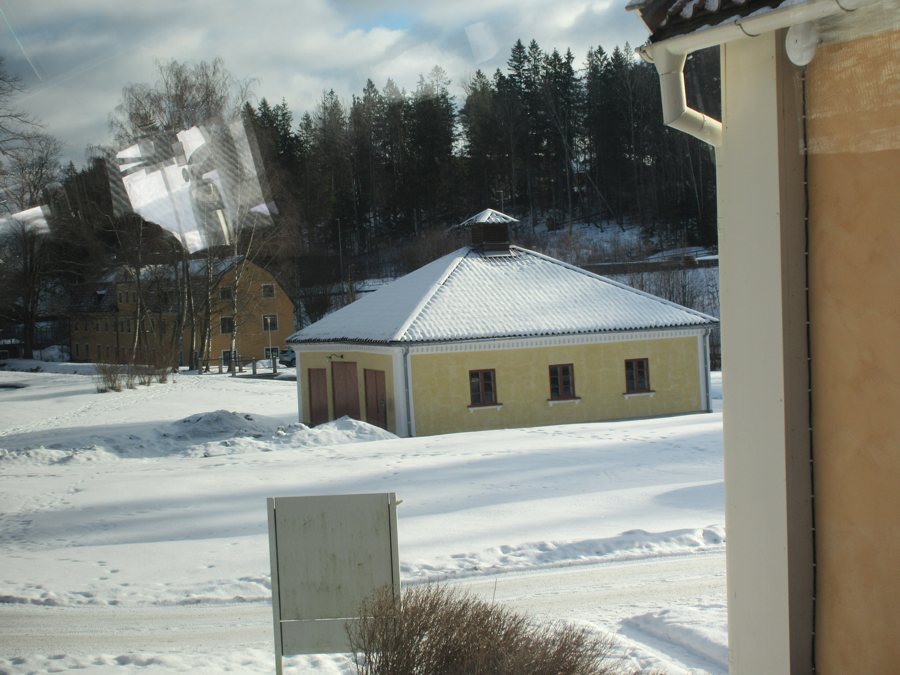 File:Spruthuset, Tumba bruksmuseum vid Tumba pappersbruk, i bakgrunden Klockhuset, febr. 2026a.jpg
Photo: Bysmon via Wikimedia Commons, CC-BY-4.0
Paper history by the Tumbaån
In 1755, the Swedish Riksbank established Tumba bruk by a waterfall on the Tumbaån. The Riksbank produced banknote paper there under its own management. This links the history of the facility to a specific production purpose. The exhibitions at Tumba bruksmuseum cover the history of paper and banknotes, their production, and the distinctive character of the facility. The subject therefore ranges from the establishment of the site to the materials and operations associated with paper production.
These different aspects offer a range of ways to explore industrial history: paper and banknotes sit alongside the facility’s production and character. If you are considering Tumba primarily for its history, this connection is a distinctive local highlight.
Mellanrum: Public Art
At Mellanrum in Tumba, four tall stones stand in a gentle curve at the edge of a green space. One of the openings is large enough for a person to stand in. You can experience the artwork both through its form and arrangement and through this physical detail. The curve gives the stones a shared context; the opening introduces a different scale, as a person can fit inside it. This offers a concrete contrast to viewing paper history in a museum: here, the design of the work itself shapes how you engage with the subject.
Hågelbyparken and its activities
At Hågelbyparken, visitors can stroll through the large park and visit a 4H farm. These two options offer different experiences: a walk takes you through the parkland, while the farm provides a separate destination. Tumba can therefore also appeal to those interested in green spaces and a visit to a farm, rather than focusing their stay exclusively on history and art.
Tumba racket och motion is another local facility. It has a shop, a café, showers and a sauna. This offers a different point of interest from the historical and nature-oriented themes; whether it matters to your plans depends on whether you want to include this particular facility.
Walking trails in the Tumba area
Aspen runt is a popular walking trail in Tumba, with archaeological remains along the route. The trail thus combines physical activity with visible traces of the past. If you are interested in archaeological history, it offers a different perspective from the industrial history of Tumba bruk. Trail conditions may vary by season, so take this into account when planning your walk.
Sjöslingan in Vinterskogen is a walking trail in the Vinterskogen nature reserve, in the Tumba and Vårsta area. The two trails have different features: archaeological remains are noted along Aspen runt, while Sjöslingan is noted for its location in the nature reserve. This information helps distinguish the trails by their described character, without treating them as one combined route. Trail conditions on Sjöslingan can also vary by season.
The themes described above can therefore help guide your choice of accommodation in Tumba: paper and banknote history, art, a park, a farm or walking trails. What matters is which of these you would most like to include in your stay.
Discover more destinations: Botkyrka, Grödinge.
For the main travel overview: Botkyrka Municipality.

