
Piątnica Poduchowna: Forts and Local History
Accommodation in Piątnica Poduchowna
Piątnica Poduchowna can be understood through two historical periods: the military history of the forts and the earlier parish history. A nearby excursion option is the 3.3-kilometre Nadnarwiańskie Górki nature trail. When planning your trip, it is worth distinguishing the group of forts in the village from this trail, which has its own start and end points.
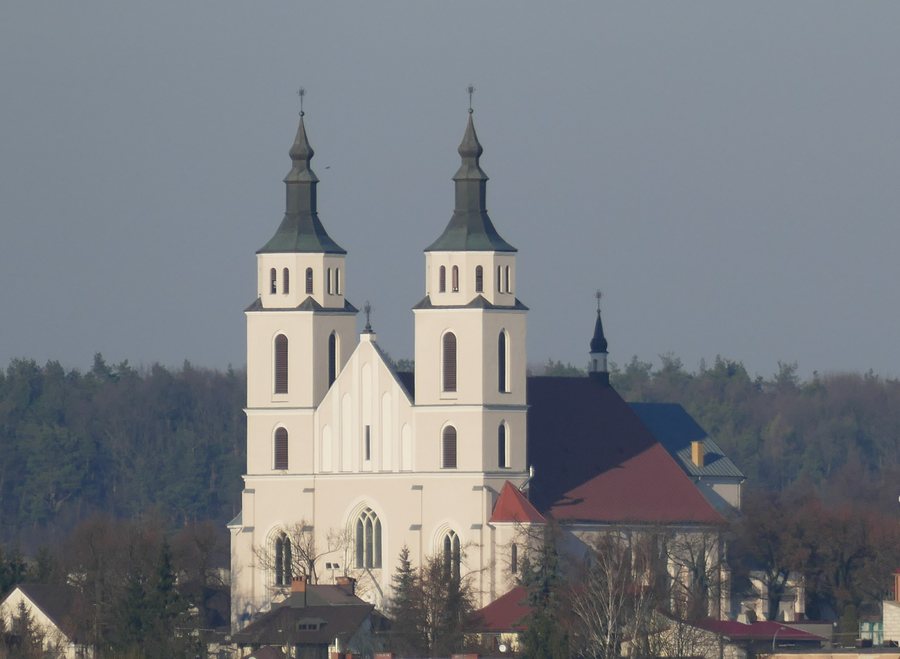 Church of the Transfiguration in Piątnica
Photo: Patryk Korzeniecki via Wikimedia Commons, CC BY 4.0
Forts and Fortifications
Construction of the five forts of the Łomża Fortress began in 1887 as a ring fortress. Forts I, II, and III stood on the right bank of the Narew around Piątnica. These details place the fortifications on two different scales: the number five refers to the Łomża Fortress, while Forts I to III are located around Piątnica.
The three forts in Piątnica Poduchowna are connected by ramparts and ditches to form a complex called “Główna Osłona.” This complex is part of the 19th-century fortifications of the Łomża Fortress. This helps distinguish the larger fortification from the local group: construction of the five forts began in 1887, while the three forts in Piątnica are characterized by the connecting ramparts and ditches and the name of the complex. Those interested in military history can therefore find both the group’s place within the Łomża Fortress and the name and connecting features of the local group.
Church and Parish History
The parish history began earlier than the 19th-century fortifications. A church already existed in Piątnica before 1396; the parish was founded in 1407. These dates refer to different historical details: one to the existence of a church, the other to the founding of the parish. They should therefore not be combined into a single year of foundation when establishing the chronology. Together, they provide an early point of reference for the area’s ecclesiastical history, clearly distinct from its later military history.
Nature Trail Nearby
The 3.3-kilometre Nadnarwiańskie Górki nature trail adds a route in the vicinity of the destination to its historical attractions. It starts at the bus stop in Kalinowo and ends beyond Fortification Wall No. 1 in Piątnica Włościańska. Its length and endpoints describe the trail precisely: the starting point is in Kalinowo, and the endpoint is by the aforementioned wall in Piątnica Włościańska. This distinguishes the route geographically from the three forts in Piątnica Poduchowna.
The attractions in the two places also remain distinct: the trail is a nature trail, while the forts form a complex within the fortifications of the Łomża Fortress. The endpoint beyond Wall No. 1 is a specific point of reference in the fortification landscape; the route itself is described by its own name, length, and two endpoints. This lets you consider the nature trail as a nearby addition without equating it with the local group of forts.
Local History for Trip Planning
Three distinct points of reference can help you choose a focus for your visit: the forts and their place in the Łomża Fortress, the chronology of the church and parish foundation, and the nature trail with its length and endpoints. This can help you decide whether you are most interested in military history, the earlier parish history, or a route in the nearby area.
Discover more destinations: Łomża.
For the broader travel overview: Łomżyński.

